


Victorian mourning jewellery and the art of remembrance
The smallest mourning jewel can hold the most intimate history. Victorian mourning jewellery and the art of remembrance bring together symbolic flowers, hairwork and materials chosen to preserve a loved one’s memory; the Victorian era ran from 1837 to 1901. Willow trees, urns and gravestones made grief visible in miniature, while Queen Victoria’s prolonged mourning for Prince Albert helped shape the period’s customs and fashions.
For collectors, the appeal of Victorian mourning jewellery and the art of remembrance lies not only in a jewel’s dark surface or delicate workmanship, but in the personal story its details may suggest. An inscription, a lock of hair or the condition of an enamelled setting can change how a piece is understood. This guide explores floral motifs, hairwork and Queen Victoria’s influence, then turns to practical considerations for collecting antique mourning jewellery. Close attention to materials, symbolism and evidence of age helps you appreciate these objects as both works of art and records of remembrance.
Key Takeaways
- Read floral motifs as deliberate memorial symbols: urns, gravestones and willow trees could make remembrance visible in a jewel’s design.
- Look beyond the setting to understand hairwork, an intimate art form that transformed a personal keepsake into a lasting memorial.
- Place mourning jewellery in its wider cultural context, where Queen Victoria’s example helped shape public expressions of grief and fashion.
- When collecting, consider materials, condition, inscriptions and provenance together; these details help reveal a piece’s history and character.
Floral and botanical symbolism in jewellery
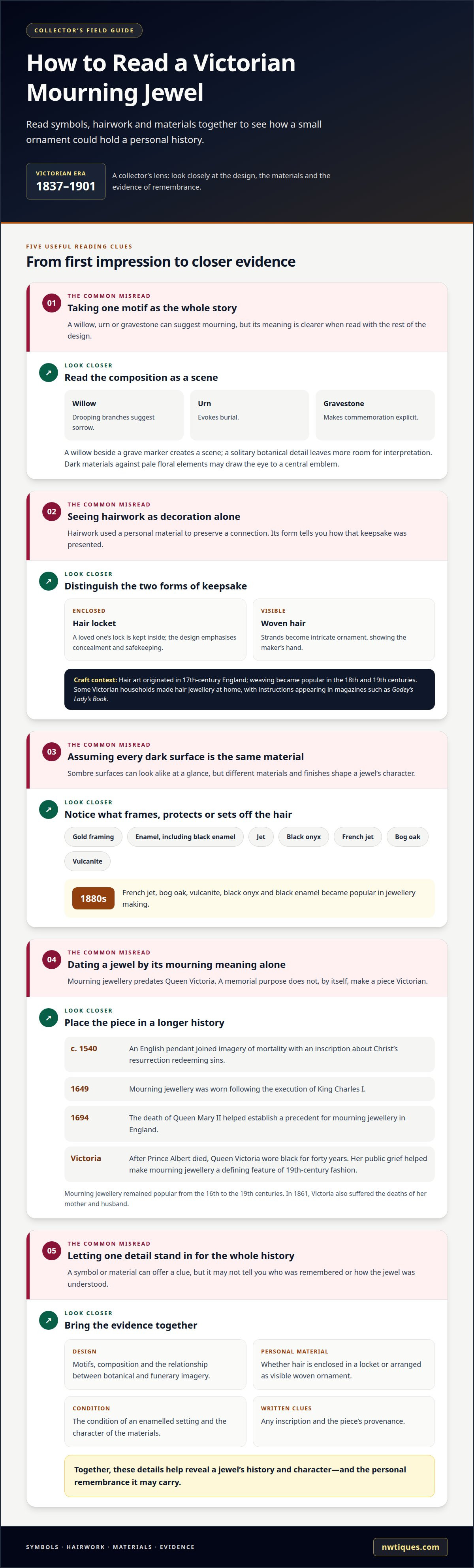
Victorian mourning jewellery drew on botanical forms and grave imagery to make remembrance visible. The Victorian era, from 1837 to 1901, saw motifs including willow trees, urns and gravestones appear in commemorative pieces. These symbols turn a small ornament into a considered expression of loss: the urn evokes burial, while the gravestone identifies mourning as the subject. Their compact scale made private sentiment wearable.
Willow branches bring a distinctive visual language to mourning jewellery. Their drooping form suggests sorrow, while their presence connects natural imagery with remembrance. An urn or gravestone can make the commemorative meaning more explicit. When studying a piece, consider how the botanical motif relates to the other imagery rather than interpreting it in isolation.
The older memento mori tradition offers useful context for Victorian designs. An English pendant dating to around 1540 depicts mortality and carries an inscription about Christ’s resurrection redeeming sins. It demonstrates how a jewel could unite an image of death with religious reflection. Victorian mourning motifs continued this practice of compressing layered ideas into a personal object, though their language often centred on grief and commemoration.
Look closely at the composition. A willow tree carved or painted beside a grave marker creates a scene; a solitary botanical detail leaves more room for interpretation. Contrast between dark materials and pale floral elements can also draw the eye towards a central emblem. These details may help distinguish a deliberate memorial design from decoration without an evident mourning theme.
Symbols rarely tell the whole story of the person remembered. Instead, they provide a visual framework for interpreting the jewel: a gravestone signals commemoration, an urn invokes burial, and a willow suggests sorrow. Together, these Victorian motifs show how floral and funerary imagery could make jewellery a portable memorial. Look closely at the composition, materials and any accompanying inscription.
Hair art and other forms of mourning art
Hairwork made remembrance tangible by incorporating a personal material into carefully composed jewellery and keepsakes. Its development connects domestic craft with the wider memorial arts of the Victorian period.
Locks and Woven Hair
A hair locket encloses a loved one’s lock, while woven hair turns strands into visible, intricate ornament. Hair art originated in 17th-century England as a practice for mourning and commemoration; weaving became popular during the 18th and 19th centuries. Some Victorian households made hair jewellery at home. Magazines such as Godey’s Lady’s Book provided instructions for preparing and weaving hair, bringing this intimate craft within domestic reach. For collectors, construction matters: an enclosed lock and a woven design represent distinct ways of preserving personal connection.
Materials in Hair Jewellery
Hairwork could be combined with settings and materials that gave a jewel its form, contrast and durability. Gold might frame a lock or woven element; enamel, including black enamel, could provide a dark ground for a memorial design. Jet and black onyx offered other sombre surfaces. In the 1880s, French jet, bog oak, vulcanite, black onyx and black enamel became popular in jewellery making. These materials can appear similar at a glance, yet their different textures and finishes shape the object’s character. Note how the material surrounds, protects or sets off the hair. For collectors interested in the contrasting world of modern fine jewellery and bespoke coloured gemstone creations, jurassic.asia showcases custom designs and rare stones.
Hair as Memorial Art
Hair jewellery is memorial art because it transforms a physical remnant into a crafted object of remembrance. During the Victorian era, hair’s resistance to decay made it suitable for preserving a personal connection beyond the funeral. A jeweller might arrange strands in a woven pattern or set a lock inside a locket, turning private sentiment into something wearable. Such work also offered a discreet expression of grief that accorded with mourning fashion of the period. Its artistry lies not only in the finished ornament, but in the careful handling of material with intimate significance.
When examining hairwork, consider how the strands relate to the setting and surface. A woven motif reveals the maker’s hand; a locket places emphasis on concealment and safekeeping. Together, these choices show how Victorian memorial art could preserve memory through material and design.
Queen Victoria and the popularity of mourning jewelry
Queen Victoria’s public grief helped make mourning jewellery a defining feature of 19th-century fashion. Its history, however, began well before her reign and developed through changing customs of remembrance.
Queen Victoria's Influence
Queen Victoria’s long mourning for Prince Albert brought personal bereavement into public view. After Albert died, she wore black for forty years, making mourning an enduring part of her image. In 1861, she also suffered the deaths of her mother and husband, deepening the period’s association between royal example and public mourning. For collectors, this context helps explain why Victorian pieces can reflect both private grief and widely recognised conventions of dress.
Origins of Mourning Jewellery
Mourning jewellery predates Victoria, with examples and customs reaching across several centuries. Such jewellery was worn following the execution of King Charles I in 1649; the death of Queen Mary II in 1694 helped establish a precedent for its use in England. Mourning jewellery remained popular from the 16th to the 19th centuries. These earlier histories matter because a memorial piece’s date and style need not be Victorian simply because it expresses grief.
The Rise in Popularity
In the 19th century, mourning jewellery became an essential part of fashion, expressing love, sentimentality and remembrance. Queen Victoria’s example after Albert’s death helped increase its popularity during the 1800s. By the 1870s, mourning jewellery’s fashionability had helped propel Whitby’s jet industry to prominence. These developments linked personal commemoration with skilled production, allowing pieces in dark materials to participate in an established visual language of mourning. While historic memorial pieces remain prized by antique collectors, readers exploring contemporary clothing and fashion accessories can find everyday styles at nancyr787.myshopify.com.
The chronology offers useful context when interpreting a jewel. A piece associated with the 19th century belongs to a longer tradition, while its materials and design may reflect specific fashions. The rise of Whitby jet in the 1870s, for instance, situates a jewel within a period when mourning taste and material culture reinforced one another.
Queen Victoria’s influence was considerable, but she did not originate mourning jewellery. Earlier English precedents and evolving customs had already established the practice. Her decades of mourning for Prince Albert gave those conventions renewed visibility, helping memorial pieces move between private keepsake and public fashion.
Collecting antique mourning jewellery
Collecting begins with the object’s evidence, not its dark appearance alone. Consider materials, construction, wear, inscriptions and provenance together. A miniature locket bearing a name offers different clues from an uninscribed brooch or necklace. Victorian mourning jewellery and the art of remembrance invites close examination: each feature contributes to an object’s history, but no single detail establishes its age or authenticity.
To distinguish an authentic Victorian piece from a later reproduction, compare its construction, materials, workmanship and wear with its claimed period. Consider inscriptions and documented provenance alongside the overall condition; a Victorian-style motif alone cannot establish age. This approach gives Victorian mourning jewellery and the art of remembrance a sound collecting context without relying on appearance alone.
Protect fragile hair, enamel and settings by avoiding abrasive cleaners, soaking and unnecessary handling. Store each jewel separately in a dry, padded place, away from direct sunlight and friction. If surface dust needs attention, gently use a soft, dry cloth, taking care not to disturb delicate components or original patina.
Online listings can help collectors examine pieces remotely. Prioritize detailed photographs, condition descriptions, inscriptions and provenance information. These details allow you to study construction and evidence before making a collecting decision, even when you cannot view the object in person.
Specific records can make a memorial jewel more legible. A Georgian memorial ring records the death of a person aged 51 on 19 January 1784, and the ring is described as 18-karat gold. Its date, material and inscription together offer several points for assessing the object’s history, rather than leaving interpretation to its appearance.
A useful collection record separates observation from interpretation. Note the jewel’s visible materials, construction, inscription and condition, then record what its provenance establishes. This helps distinguish documented details from assumptions and preserves information for future study. Sound collecting decisions depend on considering the object alongside its evidence.
Nwtiques
Nwtiques offers a considered perspective on historic objects and interiors. While this guide focuses on mourning jewellery, antique furniture can place personal pieces within a period-inspired room. Explore the collection of Centre Tables, Side & Console Tables, End Tables and Occasional Tables when considering how antique furnishings might complement your collection.
When furnishing a home around objects with distinctive histories, the character, form and patina of each antique can contribute to a thoughtful setting. Nwtiques presents its collection online for private collectors and interior designers. Explore the antique furniture collection to find a considered addition to your interior.
Let remembrance shape your collecting practice
A memorial object invites more than admiration; it calls for thoughtful attention to the history it carries and the care that history deserves. Victorian mourning jewellery and the art of remembrance can inform a broader collecting practice guided by curiosity, close observation and respect for an antique’s original character. Patina and signs of use are part of that character, not imperfections to erase.
Make your next step deliberate. Record what draws you to a piece, preserve any accompanying history, and let its materials and craftsmanship guide how you live with it. A collection gains meaning through the thought connecting its objects, rather than through quantity alone.
For another perspective on the histories objects can hold, explore the sold archive. May each discovery deepen your appreciation of the hands, memories and traditions preserved in antique work.
Frequently Asked Questions
What is Victorian mourning jewelry and when was it popular?
Victorian mourning jewelry is jewellery associated with remembrance during the Victorian period. In a collection record, distinguish the object’s commemorative purpose from its date attribution: an inscription may establish whom it names, but does not by itself establish when every part was made. Record visible construction, alterations and provenance separately. This prevents a meaningful memorial association from being mistaken for proof of original manufacture.
How did Queen Victoria influence Victorian mourning customs and jewelry?
Queen Victoria influenced mourning customs and jewellery by making her grief highly visible, lending public prominence to established expressions of remembrance. For collectors, this association provides historical context, not a shortcut to dating. Do not assign a piece to a specific year simply because it resembles familiar Victorian mourning fashion. Construction, inscriptions and provenance should support any precise attribution.
What materials were used in Victorian mourning jewelry, including jet, hair, and ivory?
Materials varied by piece, so distinguish a material’s appearance from its identification. You can describe a dark surface, pale inset or strand-like element visually without assigning a composition. In particular, pale colour alone does not establish ivory. Keep material notes separate from date, condition and provenance so each description rests on its own evidence rather than assumptions based on appearance.
What symbols and motifs appear in Victorian mourning jewelry, and what do they mean?
Design symbols communicated remembrance, but their interpretation depends on arrangement and accompanying details. When documenting a jewel, record each image and inscription separately before considering how they relate. Avoid inferring a precise family connection or personal story from a motif alone. This preserves what the object visibly shows while keeping unsupported biography out of its account.
How was human hair incorporated into Victorian mourning jewelry?
Human hair could be incorporated as a personal element in a memorial jewel. In a collection record, note where the hair appears and how it relates to the surrounding design. An accompanying label or history may provide context, but the presence of hair alone cannot establish whose it is. Keep this distinction clear when describing a piece or recording its provenance.
What types of Victorian mourning jewelry were made, such as rings, brooches, and lockets?
Mourning jewellery was made in wearable forms suited to different ways of displaying or keeping a remembrance. To understand an individual object, note whether its construction suggests it was pinned, worn on a finger, suspended or opened to hold something. Record its fastenings and interior surfaces, which may clarify its function more reliably than a later catalogue label alone.


Leave a comment