


Uranium glass, cranberry glass and Osler crystal antique lighting
A cranberry chandelier’s value is shaped by more than its colour: age, form, scale, glasswork and condition all influence how a particular piece is regarded. In uranium glass, cranberry glass and Osler crystal antique lighting, the distinction between a chandelier and a single-bulb pendant also helps define the object and its place in a room.
The appeal is clear. Cranberry glass brings rich, warm colour to historic lighting, while uranium and Vaseline glass have a distinct character of their own. Each can reflect the craftsmanship and taste of its period. But appearance alone tells only part of the story: two similarly coloured pieces may differ in design, materials and historical interest.
This guide explains the factors that shape cranberry chandelier prices and how to assess the qualities that give these lights their character. It also explores historical styles of cranberry lighting, the distinctive qualities of uranium and Vaseline glass, and the enduring elegance of Osler crystal.
Key Takeaways
- Assess a cranberry chandelier by considering its age, design, glasswork, scale and condition rather than colour alone.
- Recognise how cranberry lighting spans distinct historical styles, from Victorian lanterns to later decorative forms.
- Explore the contrasting character of uranium and Vaseline glass, including examples that combine these materials with cranberry glass.
- Learn which historical and physical clues can help distinguish Osler crystal and appreciate its place in antique lighting.
How Much is a Cranberry Chandelier?
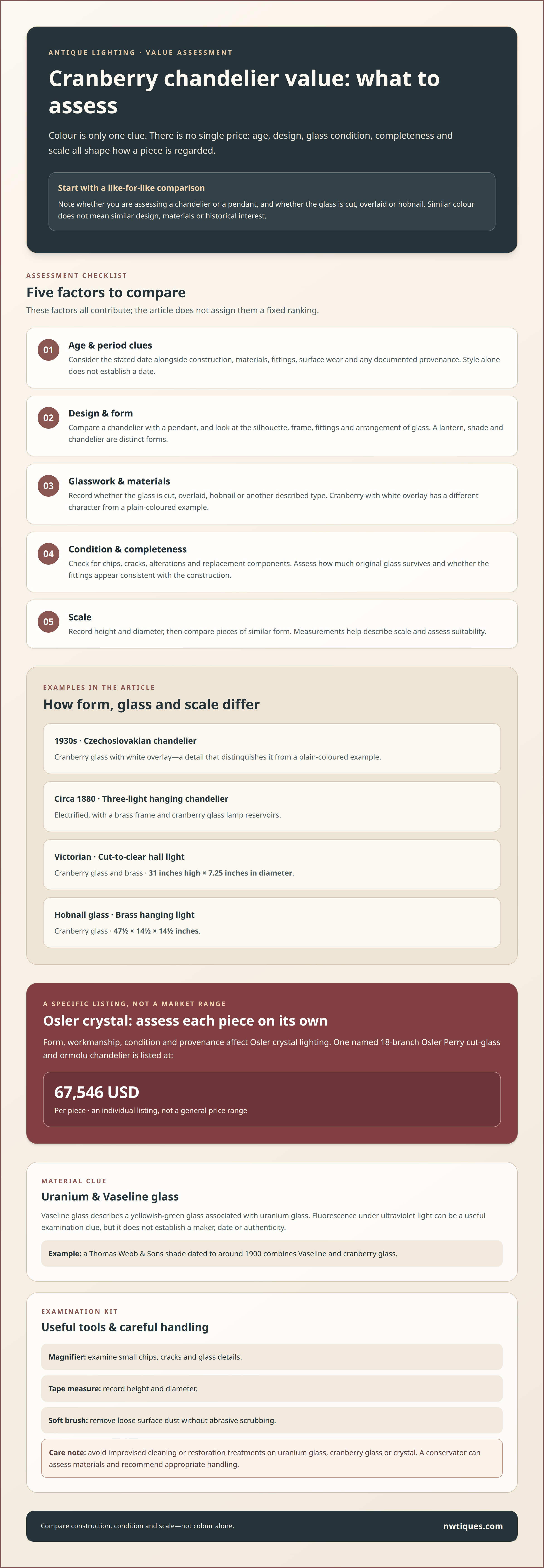
There is no single price for an antique cranberry chandelier: age, design, glass condition, completeness and scale all shape its value. Compare like with like, noting whether the piece is a chandelier or a pendant, and whether its glass is cut, overlaid or hobnail. A 1930s Czechoslovakian chandelier, for example, combines cranberry and white overlay glass, a detail that distinguishes it from a plain-coloured example.
Other historical examples show how varied these lights can be. An electrified three-light hanging chandelier with a brass frame and cranberry glass lamp reservoirs dates to circa 1880. A Victorian cut-to-clear cranberry glass and brass hall light measures 31 inches high by 7.25 inches in diameter. A cranberry hobnail glass and brass hanging light measures 47 1/2 inches by 14 1/2 inches by 14 1/2 inches. Such measurements help assess scale and suitability, while condition and the quality of the glasswork remain important considerations.
Osler crystal lighting has no single typical price: form, workmanship, condition and provenance affect each example. One named 18-branch Osler Perry cut-glass and ormolu chandelier is listed at 67,546 USD per piece as of 2026-10-26; that is an individual listing, not a general market range.
Pendant lights and chandeliers are distinct forms of lighting. For safe cleaning or restoration, avoid improvised treatments on uranium glass, cranberry glass or crystal. A conservator can assess the materials and recommend appropriate handling.
- Magnifier: helps examine small chips, cracks and glass details.
- Tape measure: records height and diameter for comparing scale.
- Soft brush: removes loose surface dust without abrasive scrubbing.

These distinctions are useful when comparing antique lighting styles, from a compact pendant to a larger chandelier. The gallery’s antique lighting collection provides context for the forms and materials discussed here.
Cranberry lighting styles across historical periods
Cranberry glass lighting comes in a range of silhouettes and decorative styles. Mid-Century Modern, Neoclassical and Arts and Crafts designs are often sought after. Their contrasts matter: a restrained outline, a formal composition and handcrafted ornament each create a distinct relationship between coloured glass and its setting.
A Victorian cranberry glass lantern dated to 1870 offers a period example. Lantern form gives the coloured glass a defined architectural frame, while the glass itself becomes a focal point when illuminated. Compare its proportions, metalwork and arrangement of glass panels with a chandelier; those details help describe the object more precisely than colour alone.
Style alone does not establish a date. A light may borrow historic motifs, and later alterations can change its appearance. Examine how the glass fits the frame, whether the fittings seem consistent with the construction, and whether wear is coherent across adjoining surfaces. Cranberry glass with white overlay, for instance, has a different visual character from a single-colour shade.
To assess the date and authenticity of antique glass lighting, consider its construction, materials, fittings, surface wear and documented provenance together. No single visual clue establishes a date. Compare the details with reliable records and established examples.
- Loupe: reveals small details in glass edges, joins and surface wear.
- Flashlight: helps inspect the frame and fittings in shaded areas.
- Camera: records close views of marks, joins and construction for comparison.
Photographing the 1870 lantern’s frame and glass together preserves useful evidence for later study; its form can also be compared with other examples in the antique lighting collection.
Cranberry chandeliers are sought in styles including Mid-Century Modern, Neoclassical and Arts and Crafts. When assessing one alongside a lantern, consider its proportions, metalwork and arrangement of glass panels. Compare these details with the overall construction and fittings. Style can guide a description, but dating and authentication require a broader assessment of physical details and reliable records.
Uranium and Vaseline glass lighting
Uranium glass has a distinctive material character, while “Vaseline glass” describes a yellowish-green glass associated with this category. Under ultraviolet light, uranium glass can fluoresce, providing a useful clue during examination. Fluorescence alone cannot establish a maker, date or authenticity. With uranium glass, cranberry glass and Osler crystal antique lighting, it is essential to distinguish material clues from stylistic attribution.
A Thomas Webb & Sons shade dated to around 1900 combines Vaseline and cranberry glass. The contrast between its coloured elements gives the shade a layered appearance, with each material contributing a different tone. Another Thomas Webb & Sons example is described as uranium glass and opaline glass, illustrating how varied the firm’s lighting-related glasswork could be.
The price of antique uranium glass lighting depends on its form, maker, condition, rarity and how much original glass survives. Without a specific comparable example, quoting a general price would be misleading: a complete, well-documented fitting differs substantially from a shade alone.
When examining uranium glass, cranberry glass and Osler crystal antique lighting, record the construction before interpreting the colour. Note whether the glass is a shade, reservoir or decorative element, and photograph its attachment points and surface. Compare these details with the fixture’s overall design and any available provenance. A replacement component can change both a light’s appearance and its historical interpretation.
- Ultraviolet lamp: helps reveal fluorescence in glass, but does not prove age or origin.
- Hand lens: assists close inspection of edges, surface wear and joins.
- Camera: preserves details of colour, fittings and construction for comparison.
Use examination tools for observation, not treatment. Avoid polishing away surface character or applying cleaners before understanding the glass and its condition. Examples by Thomas Webb & Sons show why identifying materials matters: uranium, opaline and cranberry glass can appear together, and each calls for careful description rather than a guess based on colour.
What is Osler Crystal and How to Identify It?
“Osler crystal” is a name associated with historic cut-glass lighting attributed to Osler or Osler Perry. The term alone does not authenticate a fixture: an attribution depends on the whole object, including its cutting, metalwork, construction and history. An 18-branch Osler Perry chandelier combining cut glass and ormolu offers a useful example of how crystal and gilt metalwork can form one elaborate design.
Begin by examining the glass: note the arrangement and consistency of the cuts, the clarity of the surfaces and how the pieces fit together. Then inspect the frame and mounts. Their construction should be consistent with the glasswork, rather than appearing unrelated or recently assembled. No single feature proves an Osler attribution, so assess several clues together.
Next, look for evidence of provenance. A documented ownership history, an old photograph or a catalogue reference can support an attribution when its details match the surviving fixture. Record the overall form, distinctive cutting patterns, mounts and any marks. Compare the evidence as a group rather than treating a maker’s name or one detail as decisive.
- Hand lens: brings small cuts, joins and surface wear into view.
- Raking light: reveals facets and variations across cut-glass surfaces.
- Camera: records the arrangement of glass and ormolu for close comparison.
Handle a crystal fitting gently during examination. Avoid abrasive polishing, which can disturb the surface and obscure signs of age; preserve the patina of the metalwork instead of making it appear newly finished. For an Osler Perry chandelier, careful observation of cut glass and mounts places it within the wider history of antique lighting, while provenance helps support a more considered attribution.
Nwtiques
Nwtiques is a natural next step for collectors placing historic lighting within a considered interior. The glass, frame and provenance of a fixture each shape its character; surrounding furnishings can help establish a coherent period setting without competing with its detail.

For those furnishing a room around a distinctive chandelier or lantern, Nwtiques offers antique tables, including centre, side and console tables. These pieces can provide a measured counterpoint to elaborate glasswork while preserving the lighting’s place as a focal point.
Contact Nwtiques to discuss antique furnishings for your interior.
Let Historic Lighting Shape the Room
A historic light can do more than illuminate a room: its colour, silhouette and preserved surface can inform the wider interior. Consider how the glow and detailing of uranium glass, cranberry glass and Osler crystal antique lighting might complement existing furnishings while preserving each piece’s individuality. Fine art shippers make delivery straightforward for clients in New York, Texas, San Francisco, California, the Hamptons and Greenwich, Connecticut.
That balance is often the most rewarding part of collecting: allowing an exceptional object to remain true to its history while finding a thoughtful place in a contemporary interior. If you’re considering antique lighting for your home, share your interest and discuss the possibilities with Nwtiques.
Contact Nwtiques about antique lighting, and take the next step towards a room shaped by enduring character.
Frequently Asked Questions
What is uranium glass and how can it be identified in antique lighting?
Uranium glass is coloured with uranium compounds and often appears yellow or green in antique lighting. To identify a particular component, note its colour, shape, location in the fixture and any maker’s marks. Appearance alone cannot confirm its composition. A shade, reservoir or decorative fitting may use different glass, so record exactly which component you are examining.
What is cranberry glass and how was it used in antique lamps and chandeliers?
Cranberry glass is a rich red-pink glass used in antique lighting for shades, decorative elements and reservoirs. In a lamp, a coloured glass shade can soften the appearance of the light source; repeated components can give a chandelier a more unified decorative effect. Compare the glass’s shape and placement with the frame to understand its role.
What are typical prices for antique cranberry glass lighting?
There is no single typical price for antique cranberry glass lighting. Value depends on the form, maker, condition, completeness and quality of the glasswork. A complete chandelier with original components differs from an individual shade or a fitting with replacements. Provenance and design coherence also matter, so assess each piece on its own characteristics.
Is uranium glass lighting safe to own and use, and what radiation precautions apply?
Uranium glass contains uranium, but colour or fluorescence does not reveal the radiation level of an individual object. Keep the glass intact and avoid grinding, drilling or sanding it, as these actions could create dust. A UV lamp shows fluorescence, not radiation; measuring emissions requires a suitable radiation meter. Store a fragile fitting securely to reduce the risk of breakage.
How should uranium glass, cranberry glass, and crystal lighting be cleaned and restored safely?
Avoid improvised treatments, abrasive polishing and cleaners until the materials and condition have been assessed. A conservator can recommend appropriate handling and restoration. A soft brush can remove loose surface dust without abrasive scrubbing.


Leave a comment