


The great Victorian builders and engineers
Victorian engineering was built as much on audacity as on iron and stone. The great Victorian builders and engineers transformed Britain’s landscape, but Isambard Kingdom Brunel stands apart for the breadth of his ambition: bridges, ships, railway works and tunnels all belonged to his world of design. His formation began close to the work itself, as the son of an engineer apprenticed to his father on the Thames Tunnel.
It’s easy to remember Brunel for monumental achievements and overlook the education, practical experience and setbacks behind them. At twenty, he became engineer in charge of the Thames Tunnel; a breach in 1827 left him seriously injured during rescue operations. His later career carried that hard-won experience into projects on a grander scale, including the Clifton Suspension Bridge, completed in 1864, after his death.
This article explores how Brunel’s early training shaped his engineering, then follows the bridges, ships, railway works and tunnels that defined his career. It places his achievements within the wider story of Victorian construction, where technical ingenuity met a changing society.
Key Takeaways
- Trace how Brunel’s early education and practical training on the Thames Tunnel prepared him for ambitious engineering work.
- See how railway projects and major bridges reveal the challenges behind turning bold designs into lasting structures.
- Compare the SS Great Western, SS Great Britain and SS Great Eastern to understand Brunel’s evolving approach to ship design.
- Discover how the Thames Tunnel’s engineering difficulties shaped Brunel’s experience and influenced his later achievements.
Royal Albert Bridge and other railway works
Brunel’s railway projects paired ambitious design with challenging construction, from the Royal Albert Bridge to the Clifton Suspension Bridge. Their histories show how Victorian engineering advanced through competition, adaptation and persistence.
Railway Engineering Projects
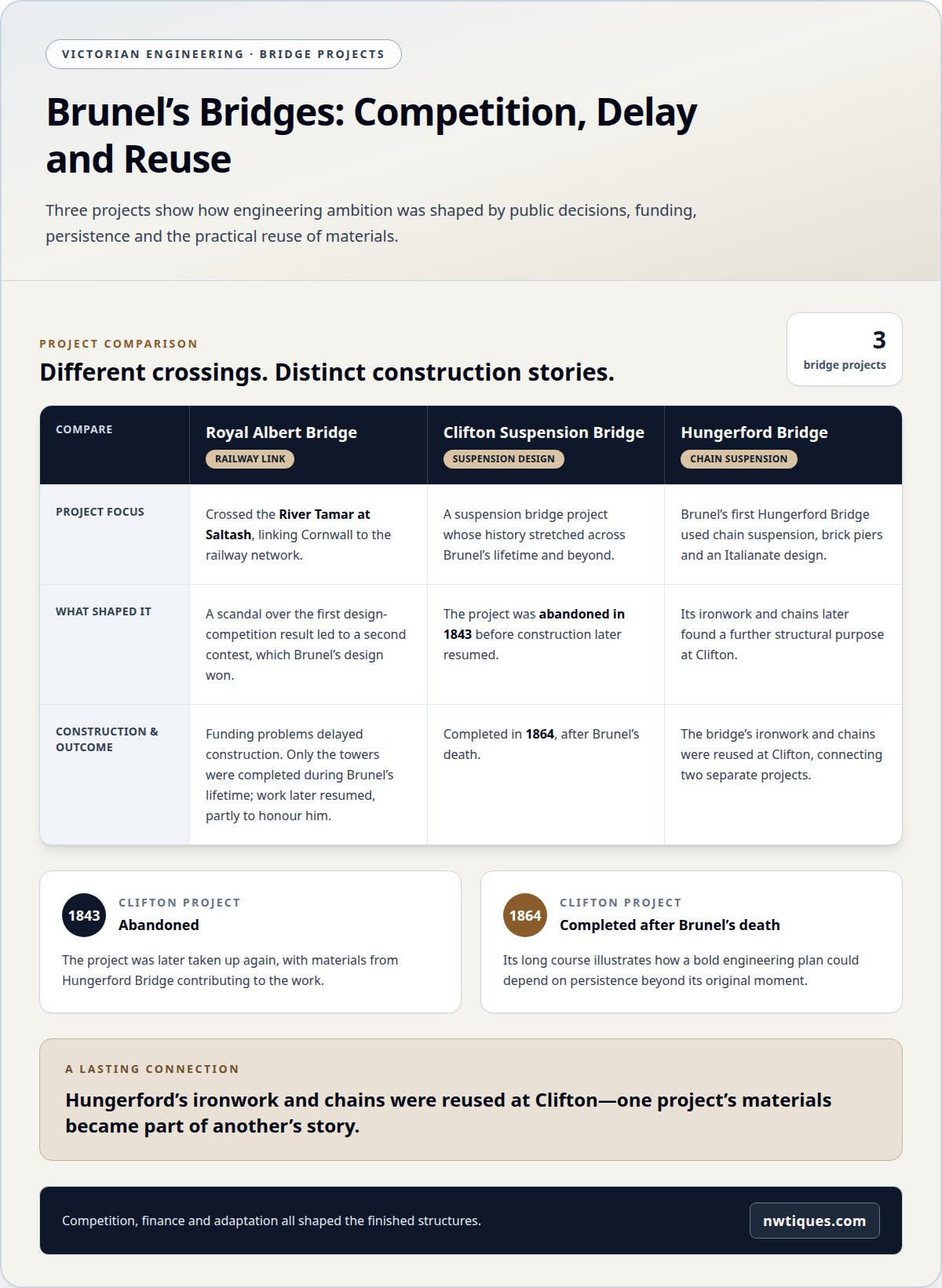
Railway engineering projects carry trains across difficult terrain and connect distant places. Brunel’s Royal Albert Bridge crossed the River Tamar at Saltash, linking Cornwall to the railway network. Thomas Telford judged the design competition, but a scandal over its first result led to a second contest, which Brunel’s design won.
Funding problems delayed construction, and only the bridge’s towers were completed during Brunel’s lifetime. Work later resumed, partly to honour the engineer. The Royal Albert Bridge shows how financial constraints and public decisions could shape engineering as powerfully as the original design.
Compared with engineering in other countries, British Victorian work stood out for integrating railways, bridges and tunnels into expanding transport networks. Its influence came not from a single invention, but from applying engineering ideas across connected, large-scale projects.
Engineering Innovations
Victorian engineering innovations were practical solutions that extended transport and construction beyond familiar limits. Brunel’s bridge designs addressed demanding crossings, while the railway itself linked routes into systems for moving people and goods. The Clifton Suspension Bridge illustrates the long course such work could take: its project was abandoned in 1843, then completed in 1864, after Brunel’s death.
Builders and engineers transformed cities with transport links and infrastructure. Water supply and waste management could also support public health by providing cleaner water and carrying waste away. These systems show that engineering mattered beyond transport, even though railway structures and urban utilities addressed different needs.
Materials and Construction Techniques
Victorian construction combined structural materials with careful adaptation to each site. Brunel’s first Hungerford Bridge used chain suspension, brick piers and an Italianate design. Its ironwork and chains were later reused at Clifton, linking separate projects and giving existing materials a further structural purpose.
Construction brought financial and physical risks. Funding delayed the Royal Albert Bridge, while the Thames Tunnel suffered two major river breaches. A later section explores Brunel’s injury during rescue operations.
Brunel’s early life and education
Brunel’s engineering education combined technical study with practical experience on working projects. Born Isambard Kingdom Brunel on 9 April 1806 in Portsea, Portsmouth, Hampshire, he entered a family already closely connected to engineering. His father was an engineer, giving the young Brunel an early view of the profession’s demands and possibilities.
His apprenticeship on the Thames Tunnel introduced him to engineering as a discipline shaped by materials, water and risk. Brunel learned not from theory alone, but on an active construction project. The tunnel’s difficult conditions made observation and practical judgement essential, qualities central to his later work.
An apprenticeship is practical training in which a learner develops skills alongside experienced practitioners. Brunel’s early work with his father gave this approach particular significance: he learned engineering through direct involvement in a major undertaking. The Thames Tunnel was more than a family connection; it was an early setting where engineering problems had immediate physical consequences.
Professional institutions also helped define engineering as a recognised vocation. The Society of Civil Engineers began in 1771 and is now known as the Smeatonian Society of Civil Engineers. Thomas Telford became the first president of the Institution of Civil Engineers in 1820. Brunel joined that institution in 1829, placing his career within a developing professional community.
Brunel later served as the Institution of Civil Engineers’ vice president from 1850 to 1859. That progression, from apprenticeship to professional leadership, shows how practical experience and institutional standing could complement each other. His formation helps explain the range of his later projects: the young engineer encountered construction first-hand, then developed within a profession increasingly organised around shared expertise.
SS Great Western, SS Great Britain and SS Great Eastern
Brunel’s three named ships reveal the maritime dimension of his engineering career. The SS Great Western, SS Great Britain and SS Great Eastern show how ship design addressed changing demands.
SS Great Western
The SS Great Western was one of Brunel’s major ship projects, extending his engineering ambitions beyond bridges, railways and tunnels into maritime design. A ship faces different demands from a fixed structure: it moves through water, carries people or goods, and must work as an integrated whole.
The vessel offers an entry point into Brunel’s approach to large-scale engineering. Its name is often discussed alongside the SS Great Britain and SS Great Eastern, but each was a distinct project. Considering the SS Great Western on its own foregrounds a central question of ship engineering: how form and construction serve a vessel’s intended use.
SS Great Britain
The SS Great Britain was another of Brunel’s major ships, connecting his name with Victorian maritime engineering. Its design can be considered in relation to its function: a ship’s structure must support movement, capacity and dependable operation, not merely make an impression in port.
Set beside the SS Great Western, the SS Great Britain invites comparison between distinct projects in Brunel’s career. The useful distinction is not an unsupported ranking, but the breadth of work these vessels represent. Together, they show that Brunel’s engineering extended beyond fixed infrastructure: ships required their own solutions to scale, movement and practical service.
SS Great Eastern
The SS Great Eastern completes this trio of Brunel’s named ship projects. It represents the maritime engineering within a body of work that also encompassed railways, bridges and tunnels.
Comparing the SS Great Eastern with the SS Great Western and SS Great Britain reveals Brunel’s ships as related yet individual projects. Each name refers to a distinct vessel, not a generic example of Victorian shipbuilding. This distinction matters: engineering history is clearer when designs are considered in context, with attention to each project’s purpose and the problems its builders had to solve. Together, the three ships make Brunel’s maritime work an essential part of his wider engineering legacy.
Thames Tunnel
The Thames Tunnel was an ambitious passage beneath the River Thames, built through ground exposed to river water. Its construction tested how engineers could manage a subterranean worksite with the river above as a constant hazard.
Isambard Kingdom Brunel became the project’s engineer in charge at twenty. His earlier apprenticeship with his father on the tunnel had brought him close to the work before he took responsibility. The move from apprentice to engineer in charge placed him at the centre of a demanding undertaking, where design decisions met immediate construction risks.
The tunnel suffered two major disasters when the river broke through into it. Each breach brought water into the worksite, threatening workers and interrupting construction. These episodes reveal a fundamental challenge of building below a river: the ground must contain the water while crews excavate and extend the passage.
The second breach occurred in 1827, during rescue operations, and seriously injured Brunel. The incident gives the project a personal dimension, but also demonstrates the risks engineers faced beyond the calculations and plans. Rescue work in a flooded tunnel put Brunel directly in danger, linking his own experience to the hazards confronting the workforce.
For Victorian engineering, the Thames Tunnel was a severe test of judgement under pressure. Repeated river breaches showed that bold design could not eliminate the hazards of an unstable construction environment. The project belongs alongside Brunel’s later achievements, not as a simple triumph, but as evidence of the dangers and difficulties behind major infrastructure.
The tunnel also shows what engineering leadership demanded of Brunel. At twenty, he carried responsibility for a project shaped by water intrusion, dangerous conditions and the need to respond when disaster struck. Its construction made the risks tangible: technical ambition depended on managing the site as well as designing the structure.
Nwtiques
Nwtiques offers a considered next step for readers whose interest in Victorian engineering extends to the craftsmanship and material history of interiors. Its antique furniture includes centre, side and occasional tables, with each piece offering its own evidence of period design and skilled making.
For collectors and design professionals, an antique’s character lies not only in its form but also in its surface patina, which bears traces of age and use. Conserving that surface preserves part of the object’s history rather than erasing it. This perspective offers a tangible connection to the care and judgement evident in historic construction.
If you’d like to discuss antique furniture, please contact Nwtiques.
Let engineering history inform your eye
The great Victorian builders and engineers offer more than a roster of celebrated names; they invite us to look more closely. Trace the decisions behind a structure, from the challenge it addressed to the form chosen to meet it. This approach makes engineering history a continuing study in judgement, not merely a record of finished monuments.
Carry that curiosity into your next encounter with architecture or design. Notice how proportion guides movement, how materials shape an impression and how practical purpose can produce enduring beauty. Each observation opens another route into the history of the built world, whether your interest lies in historic infrastructure or the objects that furnish a room.
Keep exploring at your own pace, and discuss your interest with Nwtiques. A thoughtful discovery can lead to fresh perspectives on the history around you.
Frequently Asked Questions
What does the phrase “great Victorian builders and engineers” refer to?
The phrase describes prominent engineers and builders whose projects reshaped Britain’s infrastructure and built environment during the Victorian period. It is an informal category, not a formal list or professional title. The field also drew on engineering ideas and institutions that predated Victoria’s reign, so its history encompasses both earlier foundations and later Victorian achievements.
Who were the most influential Victorian builders and engineers?
Isambard Kingdom Brunel, Thomas Telford, George Stephenson and Joseph Bazalgette are among the best-known figures. Their influence extended across different parts of engineering, from transport and construction to the profession’s institutions. Stephenson became a member of the Institution of Civil Engineers in 1853, while Bazalgette served as its 24th president in 1884, reflecting the breadth of expertise associated with the period.
What major buildings did Victorian builders construct in Britain?
Major Victorian engineering works in Britain included Brunel’s Royal Albert Bridge, Clifton Suspension Bridge, first Hungerford Bridge and Thames Tunnel.


Leave a comment