


Royal Navy West Africa Squadron and the end of the slave trade
Britain banned its transatlantic slave trade in 1807, and the Royal Navy formed the West Africa Squadron in 1808 to intercept ships carrying enslaved people. The Royal Navy West Africa Squadron and the end of the slave trade are closely connected, but suppressing the trade did not itself abolish slavery. The patrols pursued suspected slave ships along West Africa’s coast, where distance and evasive tactics made enforcement difficult.
Naval patrols were not a simple contest between warships and merchant vessels. Their reach depended on the ships available, legal limits and the evidence officers could establish during an interception. Understanding the Royal Navy West Africa Squadron and the end of the slave trade means tracing both the campaign’s purpose and its constraints. This account explains why the Squadron was formed, how it operated, how captains tried to evade capture, and why ending Britain’s participation in the trade remained distinct from abolishing slavery itself.
Key Takeaways
- See how treaties shaped enforcement, including the 1810 convention that let Portugal continue trading enslaved people from its own colonies.
- Understand how captains could exploit legal limits and the expanse of the patrol ground to evade seizure.
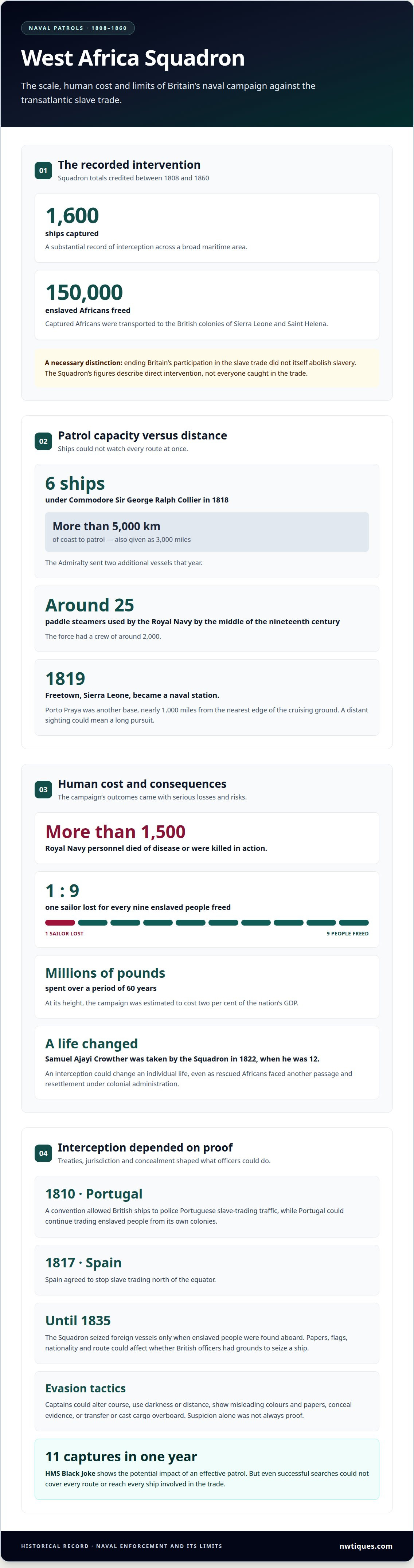
- Put the campaign’s record in perspective: the squadron is credited with capturing 1,600 ships and freeing 150,000 enslaved Africans between 1808 and 1860.
- Trace how a prolonged naval effort remained constrained, and why interception could not reach every ship involved in the trade.
Fines and practices used by slave-ship captains to evade capture
A financial penalty gave patrols a legal instrument, but it also shaped captains’ calculations. Financial penalties could make the discovery of enslaved people aboard a foreign ship costly for its operators. The risk therefore rose with the number of people discovered, while a vessel’s papers and flag could affect whether British officers had grounds to seize it. Enforcement depended not simply on spotting a ship, but on establishing what it carried and which authority applied.
Treaties created uneven boundaries. In February 1810, Portugal signed a convention allowing British ships to police Portuguese slave-trading traffic, while permitting Portugal to continue trading enslaved people from its own colonies. Spain agreed in 1817 to stop slave trading north of the equator. These distinctions mattered at sea: a captain could exploit disputed identity, nationality or route to complicate an interception. British patrols had to assess a vessel’s conduct against the agreements then in force, rather than treat every ship as subject to identical rules.
Captains also sought to make detection harder. A slaver might alter course to avoid a known patrol ground, use darkness or distance to escape pursuit, or present misleading colours and papers. Concealing evidence of the trade could delay an inspection or weaken a case, while transferring or casting cargo overboard carried grave human consequences. Such evasions exploited the difference between suspicion and proof. Until 1835, the West Africa Squadron seized foreign vessels only when enslaved people were found aboard, making concealment especially consequential.
Captain Joseph Denman’s anti-slavery work was part of this contest between enforcement and evasion. His operations against slave-trading activity show why patrols could not focus solely on vessels already at sea: the trade also relied on coastal sites where people were held and transported. Pursuing these networks required naval officers to connect ships with their shore-based support. The penalty per person, treaty limits and captains’ concealment tactics therefore formed one connected challenge. A successful interception depended on locating a vessel, establishing the relevant jurisdiction and finding evidence of the trade before its crew could escape or conceal it.
Ships seized and Africans freed by the Squadron
The Squadron used coastal patrols, visual searches and pursuit to locate suspected slave ships, then boarded vessels to establish what they carried. Its work depended on finding ships across a broad maritime area, not on any single piece of technology. HMS Black Joke illustrates the potential impact of an effective patrol: it captured eleven slave traders in one year.
Between 1808 and 1860, the West Africa Squadron is credited with capturing 1,600 ships and freeing 150,000 enslaved Africans. These figures describe a substantial intervention, but not the full scale of the Atlantic trade. Captured Africans were transported to the British colonies of Sierra Leone and Saint Helena. Their liberation from a slave ship was therefore followed by another passage and resettlement under colonial administration.
One rescued child was Samuel Ajayi Crowther, taken by the Squadron in 1822, when he was 12 years old. His story makes the human consequence of an interception legible beyond totals: a ship’s seizure could alter the course of a life. It also demonstrates that the Squadron’s record includes people whose later histories became part of the wider account of abolition and mission work.
The campaign carried severe health risks. More than 1,500 Royal Navy personnel died of disease or were killed in action, and the Squadron lost one sailor for every nine enslaved people freed. Rescued Africans faced the effects of confinement, exhaustion and disease aboard slave ships; the available figures do not establish their mortality rate.
The Royal Navy spent millions of pounds on the Squadron over a period of 60 years, and at its height the campaign was estimated to cost two per cent of the nation’s GDP. Such expenditure supported long-distance patrols, while jurisdictional limits complicated searches of foreign vessels, particularly where treaties set different terms.
These outcomes must be considered together: seizures freed people, but neither the ships captured nor the lives rescued represent everyone caught in the trade. The Squadron’s record is therefore both an account of direct intervention and a measure of the formidable limits of naval enforcement.
The Royal Navy’s West Africa Squadron and anti-slavery patrols
The Squadron patrolled a vast coastline, but ships and distance constrained enforcement. Its record is best understood in light of those limits, the ports supporting patrols and its place among wider efforts.
Patrol Capacity and Limits
Patrol capacity means the ships and crews available to search a large sea area. In 1818, Commodore Sir George Ralph Collier had six ships for more than 5,000 kilometres (3,000 miles) of coast; the Admiralty sent two additional vessels that year. The imbalance mattered: ships could not watch every route at once. The Royal Navy used around twenty five paddle steamers by the middle of the nineteenth century, with a crew of around 2,000.
Coastal Routes and Key Ports
The Squadron operated along the West African coast, concentrating on maritime routes used by slave traders. Its scale is illustrated by Collier’s patrol ground, while the 1819 naval station at Freetown, Sierra Leone, provided a coastal base. Porto Praya served as another base, but lay nearly 1,000 miles from the nearest edge of the cruising ground. These distances shaped response time and coverage: a sighting far from port could demand a long pursuit.
Effectiveness Compared with Other Efforts
The Squadron added armed interception to abolition measures, but its reach was limited. It captured roughly 6-10% of slave ships during its operation, while treaties and other national actions addressed the trade through different means. The United States agreed in 1842 to maintain a naval squadron with Great Britain off Africa. Comparing these efforts shows why patrols alone could not end trafficking: enforcement relied on cooperation, jurisdiction and sustained presence at sea.
The Trade’s Decline and the Squadron’s Role
The decline unfolded across decades, rather than at one decisive moment. Spain agreed in 1817 to stop slave trading north of the equator; from 1840, captured crews were taken to St Helena for trial. The Squadron remained active until the 1860s, applying pressure through interception, while other agreements narrowed routes available to traders. By about 1870, slave ships were no longer being found in Cuba. The Squadron helped suppress the trade, but its limited capture rate shows that naval patrols were only one part of its decline.
Formation and purpose of the Royal Navy squadron
Britain banned its transatlantic slave trade in 1807, but a prohibition required enforcement at sea. The British Parliament passed the Slave Trade Act 1807 on 25 March, prohibiting British subjects from engaging in the Atlantic trade. The Royal Navy formed the West Africa Squadron in 1808 to pursue that task. Its purpose was to intercept slave-trading vessels and enforce the new ban beyond British ports, where ships could continue their voyages unless patrols found them.
The Squadron’s formation marked a shift from legislation to maritime enforcement. Its vessels searched shipping routes off West Africa, where slave ships embarked captives and began Atlantic crossings. The command was based out of Portsmouth, England, while its operational challenge lay far from home, along a long and difficult coast. The patrols gave the British ban a naval presence, but could not make the prohibition universal or end slavery itself.
How many ships and sailors served over time? There was no single fixed complement: the force changed as the campaign and its demands evolved. In 1818, Commodore Sir George Ralph Collier had six ships, and the Admiralty dispatched two additional vessels. By the middle of the nineteenth century, around twenty five paddle steamers were in use, with a crew of around 2,000. During the nineteenth century, one-sixth of the Royal Navy’s ships and marines were employed in the struggle against the trade.
That scale helps explain both the Squadron’s significance and its limits. Naval patrols could seize vessels and disrupt voyages, yet the trade persisted through changing routes and jurisdictions. Britain’s 1807 ban concerned the slave trade, not slavery across its empire. Britain abolished slavery across the empire in 1833, a quarter-century after banning the trade, while British slavery continued in the colonies until 1838. The distinction is essential: the Squadron enforced a prohibition on trafficking, not a complete abolition of enslavement. Its formation made enforcement a sustained naval undertaking, rather than a declaration alone.
Nwtiques: Centre Tables
Nwtiques offers Centre Tables for collectors seeking a considered focal point for a room. After exploring the Squadron’s history, readers interested in the material culture of historic interiors can turn to furniture whose character is shaped by age, workmanship and surface patina. A centre table can anchor a formal arrangement, while Side & Console Tables, End Tables and Occasional Tables offer other ways to bring antique furniture into a living space.
Choose a table by considering the room’s proportions, its intended use and how its finish will sit alongside existing furnishings. Preserving an antique’s distinctive surface helps retain traces of its history rather than obscuring them through unnecessary intervention. Explore Nwtiques’ Centre Tables and related antique table offerings.
Carry the history into your next discovery
The story of the Royal Navy West Africa Squadron and the end of the slave trade invites a wider reflection: historical change is recorded not only in laws and naval dispatches, but also in the objects people made, used and preserved. Considering the Royal Navy West Africa Squadron and the end of the slave trade alongside material culture offers another way to explore how history is remembered, without diminishing its human cost.
For collectors considering how historic character might find a place in a contemporary interior, Nicholas Wells Antiques offers Centre Tables, Side & Console Tables and End Tables. Each category offers a different scale and function, allowing an antique to complement a room while retaining its distinctive surface and signs of age. Objects around us can keep historical curiosity present in everyday life.
Explore the collection or contact Nwtiques to learn more. A thoughtful next discovery can begin with a closer look.
Frequently Asked Questions
When was the Royal Navy's West Africa Squadron established, and what were its goals?
The Royal Navy established the West Africa Squadron in 1808 to enforce Britain’s 1807 ban on its transatlantic slave trade. Its goal was to intercept ships transporting enslaved people and suppress British participation in that traffic. The distinction matters: the Squadron enforced a trade prohibition at sea; it did not itself abolish slavery. Britain abolished slavery across its empire later, in 1833, with colonial slavery continuing until 1838.
What treaties and laws authorized the West Africa Squadron to intercept slave ships?
The Slave Trade Act 1807 prohibited British subjects from engaging in the Atlantic slave trade, providing the domestic basis for the Squadron’s mission. International agreements shaped searches of foreign vessels: Portugal’s February 1810 convention allowed British ships to police Portuguese slave-trading traffic, with limits concerning Portuguese colonies. France agreed to cease slave trading in 1814, and Spain agreed in 1817 to stop trading north of the equator. These agreements did not create one uniform rule for every flag.
How many slave ships and enslaved people did the squadron intercept or liberate?
Between 1808 and 1860, the West Africa Squadron is credited with capturing 1,600 ships and freeing 150,000 enslaved Africans. These totals describe recorded outcomes of the campaign, not every voyage or person affected by Atlantic trafficking. The Squadron’s tally also cannot indicate the scale of suffering aboard each vessel. Read together, the figures show both the reach of naval intervention and the limits of counting a human tragedy through seizures and releases.
What happened to Africans rescued by the West Africa Squadron after interception?
After interception, Africans rescued from slave ships were transported to the British colonies of Sierra Leone and Saint Helena. Their rescue ended captivity aboard the intercepted vessel, but it involved another sea passage and a transition into colonial settings. The Squadron’s action therefore did not mean an immediate return to a home community. Samuel Ajayi Crowther, rescued in 1822 when he was 12, offers one documented example of a life changed by interception.
What were the financial costs and political controversies of the squadron?
The Royal Navy spent millions of pounds on the Squadron over 60 years, and at its height the campaign was estimated to cost two per cent of the nation’s GDP. Its enforcement also faced politically negotiated limits: the 1810 convention let Portugal continue trading enslaved people from its own colonies, and Britain’s trade ban did not abolish slavery.


Leave a comment