


Napoleon, Waterloo and the furniture of the Regency
Regency furniture can reveal more than design history. Its form, finish and use show how ideas travelled between rooms and cultures. Thomas Hope’s interiors, the classical language of Empire Style and objects commemorating Waterloo offer distinct ways to explore the period’s decorative arts. Together, they show how makers and patrons gave furniture meaning beyond function, using proportion, ornament and materials to shape an interior.
This guide explores these connections through Thomas Hope’s influence, objects associated with a defining historical episode and furnishings linked to two French residences. It also considers how upheaval affected workshop practice and why surviving pieces should be understood through their construction and surfaces, not appearance alone. The aim is to help you distinguish period objects from later interpretations and see how historically informed furniture can enrich a thoughtfully composed home.
Key Takeaways
- Recognise how Thomas Hope’s approach to classical forms shaped British interiors and furniture design.
- Read George IV’s Waterloo collection as a way to understand how a military event entered royal rooms and decorative arts.
- Consider how wartime conditions influenced the materials, design choices and production of Regency furniture.
- Use Napoleon’s writing table and the Table of the Great Commanders as clues to the furnishings associated with his residences.
Thomas Hope’s furniture and interior design
Thomas Hope treated furniture as part of a complete interior, not as an isolated collection of pieces. His designs drew on ancient Greek and Roman forms, using architectural lines, sculptural supports and classical ornament. A table or chair could contribute to the room’s overall visual order, while its proportions and finish remained legible up close. This measured approach helped spread a taste for antiquity through British Regency interiors.
The Regency Style is often dated 1783-1830, though another commonly used range is 1800-1830. Within that broad period, Hope’s work offered a particularly intellectual interpretation of historic design. He brought together motifs from different ancient cultures, rather than relying on a single source, and treated furniture as a means of arranging space as well as a practical object. In a formal room, a carefully placed table could support display, balance a sculptural element or establish a focal point.
Battle imagery and symbols of defeat also entered the period’s decorative language, while imperial references evoked authority and classical precedent. Such motifs could accompany restrained forms, setting ornament against structure. A prince’s formal interior might use furniture to express cultivated taste; an emperor’s image or emblem could reinforce the same classical vocabulary. Thomas Hope’s significance lies in this synthesis, not in any single decorative formula.
What are typical prices for Regency furniture at auction in the United States? There is no single typical price: results depend on the object, its condition, provenance, rarity and workmanship. Compare similar pieces, since a table and a chair can differ greatly in desirability and value.
To distinguish authentic Regency furniture from later reproductions, examine construction, joinery, materials and wear together. Consistent age-related patina and evidence of period craftsmanship can support an attribution, while mismatched components or modern alterations warrant closer scrutiny. No single detail proves age; compare the whole piece with documented examples. The same attention to proportion and surface helps when assessing cabinet furniture for a historically coherent interior.
George IV’s Waterloo collection
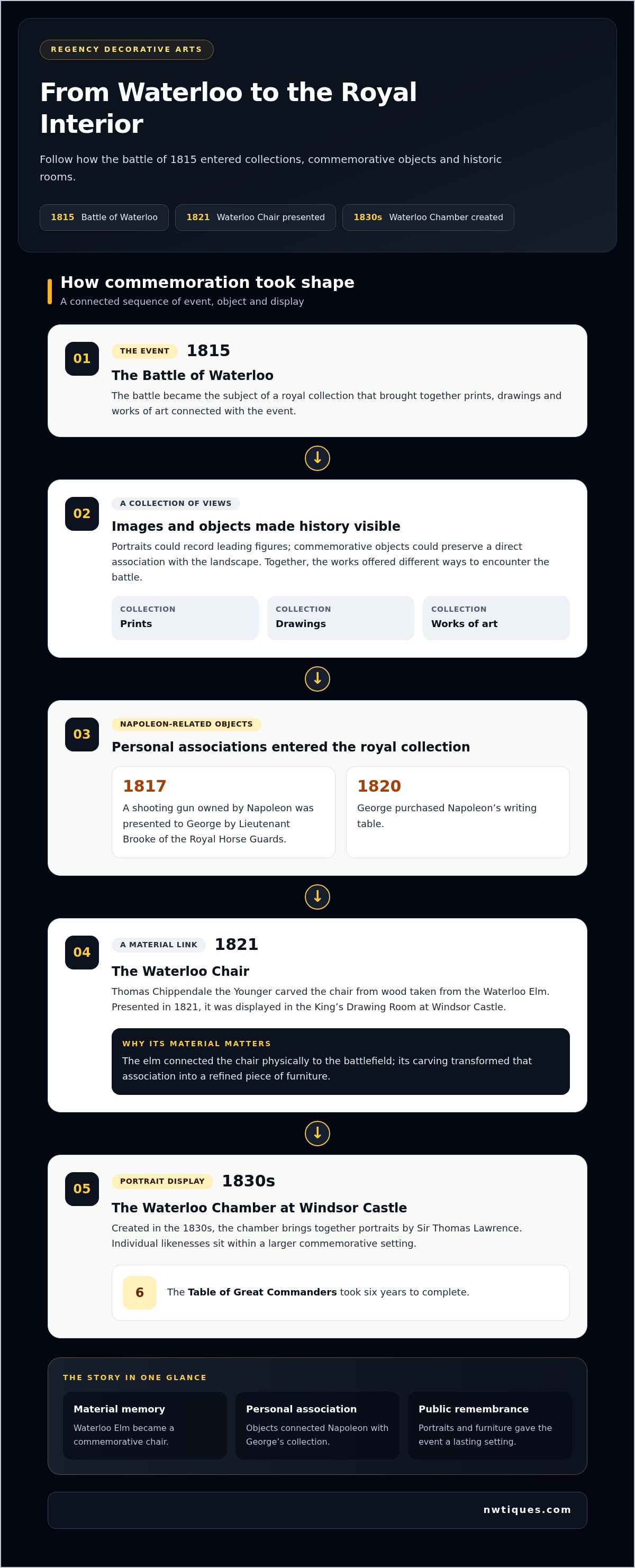
The Waterloo collection brought together prints, drawings and works of art connected with the battle of 1815. Its arrangement made the event visible through images and objects, rather than through written accounts alone. For viewers, the collection offered different ways to encounter the episode: a portrait could record its leading figures, while a commemorative object could preserve a direct association with the landscape. This range gave the collection its character as both a historical record and a carefully assembled display.
A particularly evocative object is the Waterloo Chair, carved by Thomas Chippendale the Younger from wood taken from the Waterloo Elm. Presented in 1821, it was displayed in the King’s Drawing Room at Windsor Castle. The choice of elm connected the chair materially to the battlefield, while its carving turned that association into a refined piece of furniture. Its position in a state interior also shaped how visitors encountered the commemorative object.
Windsor Castle’s Waterloo Chamber extends this narrative through portraits painted by Sir Thomas Lawrence. The chamber was created in the 1830s, and its portraits place individual likenesses within a larger commemorative setting. Another ambitious work, the Table of Great Commanders, took six years to complete. Together, portraiture and furniture show how a collection could use different art forms to build a sustained account of military memory.
For American visitors interested in Regency objects associated with the battle, Windsor Castle is the principal setting discussed here. The Waterloo Chair was displayed in the King’s Drawing Room, and the Waterloo Chamber preserves the portrait display. A temporary exhibition, Waterloo at Windsor, marked the battle’s 200th anniversary and closed on 6 January 2016. These locations and objects offer distinct ways to explore how commemoration entered historic interiors.
George purchased Napoleon’s writing table in 1820. A shooting gun owned by Napoleon was presented to George by Lieutenant Brooke of the Royal Horse Guards in 1817.
How did the Napoleonic Wars affect Regency furniture design and production?
The Napoleonic Wars overlapped with the British Regency, which lasted from 1811-20. The Peninsular War lasted from 1808-14, while the Battle of Waterloo came in 1815. Regency furniture therefore developed amid continuing conflict and its immediate aftermath. This context helps explain why interiors could combine classical references, military associations and refined domestic forms. The period’s design was not a single response to war, but a changing conversation between taste, commemoration and the practical demands of furnishing.
Designers drew on ancient Greek and Roman forms, a vocabulary also found in Empire Style furniture. Columns, laurel motifs, sculptural supports and strong geometric outlines gave tables and chairs an architectural presence. Military emblems and classical ornament could accompany these forms, lending a room a ceremonial character. The effect depended on the object: a dining table served everyday use, while a richly ornamented piece might carry a more formal message. Regency interiors accommodated both.
Production relied on skilled workshops, materials and the intended finish. Veneered surfaces, carved details and metal mounts required different kinds of labour, so a maker’s choices shaped both appearance and construction. During periods of conflict, trade and transport could affect access to materials and components; workshop capacity and patronage mattered too. These factors help explain why surviving pieces vary in scale and elaboration instead of following one uniform wartime design. Close examination of joinery, finish and patina can reveal how an object was made and preserved.
After 1815, Waterloo offered a fresh subject for commemorative design and royal display, while older classical forms remained in use. The Regency Style is often dated 1800-1830, a broader span than the political Regency itself. That distinction matters when dating furniture: style developed across changing historical circumstances and did not begin or end neatly with a war. For collectors, the useful approach is to consider form, materials, workmanship and condition together, rather than treating military imagery alone as proof of a piece’s date.
What furniture did Napoleon use at the Tuileries and Malmaison?
Furniture associated with the Tuileries and Malmaison includes objects that reveal contrasting roles within formal interiors. A Jacob Frères writing table, estimated to date from 1796-1815, represents the practical furnishings required for correspondence and administrative work. The Table of the Great Commanders, made between 1806 and 1812, is more ambitious in conception. Together, these pieces suggest how a residence could accommodate both private activity and ceremonial display.
The writing table’s date spans a period of changing use and ownership, so it is best understood as an object with a long history, not a fixed snapshot of one room. Jacob Frères is associated with refined French furniture making, and the table’s function places it within the daily rhythms of a residence. Writing furniture often belonged in a more intimate setting than pieces intended to impress visitors, giving this example a distinct place in the history of domestic interiors.
The Table of the Great Commanders differs in purpose and subject. Its title signals an elaborate commemorative conception, while its production between 1806 and 1812 situates it within the era’s taste for furniture carrying historical associations. The table was not merely a useful surface; its theme made it a statement piece, designed to draw attention and shape the meaning of the surrounding room.
These examples offer a focused answer, not a complete inventory of the Tuileries or Malmaison. The writing table represents work and correspondence, while the commanders’ table speaks through its subject and presentation. Their contrasting roles show why furnishings in formal residences ranged from practical desks to highly symbolic showpieces. When exploring a historic interior, consider the room’s function and documented object histories rather than assuming every celebrated piece stood in the same residence.
Nwtiques: Centre Tables
Nwtiques offers centre tables for readers seeking an antique focal point with a distinct historical character. After exploring the furniture associated with the Regency and Napoleonic era, consider how a table’s proportions, materials and surface patina might complement a room today. The centre table selection provides a focused starting point for comparing forms and choosing a piece suited to your interior.
Side and console tables, end tables and occasional tables offer other ways to bring antique furniture into a room, whether beside seating or within a hall. Look closely at each piece’s details and condition, and consider how its scale relates to the surrounding furnishings. For enquiries about a particular table, contact Nwtiques or visit nwtiques.com.
Bring historical character into your own rooms
The story of Napoleon, Waterloo and the furniture of the Regency offers more than a historical reference. It invites a closer look at how proportion, surface and material shape a room’s atmosphere. When considering an antique, let its patina remain part of its character. Traces of age distinguish an object with a lived history from one chosen only for its outline; thoughtful placement can give that history a meaningful place in a contemporary interior.
Nwtiques offers Centre Tables, Side & Console Tables and End Tables for collectors considering how an antique table might serve their space. Explore the pieces with attention to their individual presence, rather than treating period style as a fixed formula. Explore antique tables at Nwtiques and consider which form could bring depth and historical texture to your rooms. A considered choice can make heritage feel at home in the present.
Frequently Asked Questions
What furniture styles were popular in Britain during the Regency era?
Regency interiors favoured classical forms influenced by ancient Greek and Roman design, alongside the French Empire idiom. Look for architectural silhouettes, sculptural supports and classical ornament, whether restrained or elaborate. These styles could appear together rather than as rigidly separate fashions. A room, for example, might pair a structurally simple table with more emphatic decorative objects, using contrasts in scale and ornament to shape its character.
How did the Battle of Waterloo influence British furniture and commemorative designs?
Waterloo’s influence was especially visible in commemorative objects and royal display, rather than as a wholesale change in furniture design. Battle-related imagery, portraits and objects gave interiors a way to preserve public memory. For collectors, this distinction matters: military symbolism may indicate a commemorative purpose, but the motif alone does not establish a piece’s date or origin. Consider its construction, materials and provenance alongside its decoration.
Who were the leading Regency furniture makers and designers?
Thomas Hope was a significant designer, while Thomas Chippendale the Younger was an important cabinetmaker associated with a Waterloo commemorative chair. In France, Jacob Frères made a writing table owned by Napoleon. These names represent different contributions: Hope shaped ideas about interiors, Chippendale the Younger demonstrated skilled carving, and Jacob Frères is linked to refined furniture making. An attribution should rest on evidence from the individual object, not on a famous name alone.
See our antique Regency furniture and writing and library tables in stock, including Pair of Regency Pier / Console Tables and Rich Plum Pudding Mahogany and Brass Bound Pedestal Desk.


Leave a comment