


Mudlarking: treasures from the Thames foreshore
A find on the Thames foreshore isn’t automatically yours to take home. Mudlarking can reveal treasures from the Thames foreshore, but searching is restricted to permitted areas, objects can’t be removed without a permit, and new permits stopped being issued in 2022.
The appeal of mudlarking is easy to understand: a pottery shard or small object shaped by centuries in river mud can offer a tangible trace of London’s past. The rules matter just as much as the discovery. This guide explains how permits and access work, what to do when you find an object of interest, and which finds must be reported. It also shows how careful recording turns individual discoveries into evidence of the city’s history, from objects people lost or discarded to the lives and trades they reveal. The foreshore rewards curiosity, but responsible mudlarking starts with knowing what may be collected and what needs to be recorded.
Key Takeaways
- Don’t assume a Thames foreshore find can be taken home: a permit is required to search and remove objects, and searching is limited to designated areas.
- Learn which discoveries should be reported, including objects more than 300 years old and potential treasure.
- See how recording finds helps build a richer picture of London’s history, connecting everyday objects with the lives of the people who left them behind.
- Understand how the changing tide reveals the foreshore, and why access rules shape what a mudlarking visit can involve.
Foreshore permits and reporting finds
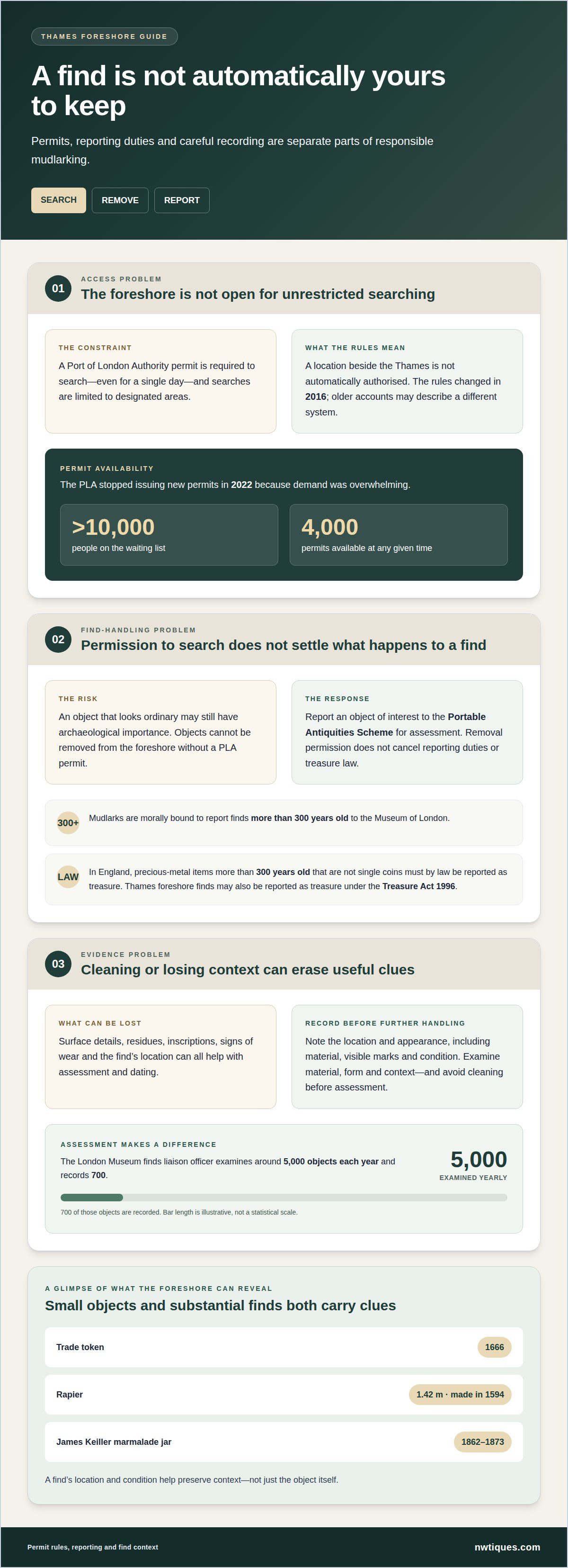
Yes. A permit is required to search the Thames foreshore, even for a single day, and searches are restricted to designated areas. To help identify and date a find, examine its material, form and context. Avoid cleaning it before assessment, as surface details may hold evidence.
Reporting and Retaining Finds
Reporting means recording an object with the appropriate archaeological scheme or museum, so its context can inform London’s history. People who find an object of interest are asked to report it to the Portable Antiquities Scheme for assessment. Mudlarks are morally bound to report finds more than 300 years old to the Museum of London. In England, items made of precious metal that are more than 300 years old and are not single coins must by law be reported as treasure. Archaeological finds from the Thames foreshore may be reported as treasure under the Treasure Act 1996. For readers exploring Mudlarking: treasures from the Thames foreshore, assessment helps establish whether a find may be retained or needs further action.
Rules for Removing Finds
Removal rules determine whether a foreshore discovery may leave the riverbank with its finder. Objects cannot be removed from the foreshore without a Port of London Authority permit. This matters even when an object appears ordinary: permission to search does not cancel reporting duties or treasure law. The London Museum finds liaison officer examines around 5,000 objects each year and records 700 of them, showing how assessment can preserve knowledge beyond a private collection.
Finds range from familiar fragments to objects that prompt closer historical study. Examples include 18th-century glass cufflinks, a trade token dated 1666, and a James Keiller marmalade jar dated 1862-1873. A 1.42-metre rapier made in 1594 illustrates how substantial discoveries can surface alongside small personal objects. Pottery, glass and metal fragments can also help reveal patterns of domestic life and trade.
Record a find’s location and appearance before handling it further, including visible marks, material and condition. Avoid vigorous cleaning, which can obscure residues, inscriptions or signs of wear. Dating may depend on features such as manufacturing technique and decoration, as well as comparison with documented examples. In Mudlarking: treasures from the Thames foreshore, careful observation helps distinguish a modest fragment from a discovery with wider archaeological significance.
Mudlarking’s contribution to London’s history
Objects from the Thames preserve evidence of London life across more than 2,000 years. In the 19th century, Victorian mudlarks searched the exposed riverbed for saleable scraps. Henry Mayhew described 20 or 30 boys looking for coal at daybreak in London Labour and the London Poor, published in 1851, with an additional volume in 1861 examining mudlarks. Their work was often driven by poverty; today, searching is valued for the archaeological knowledge discoveries can contribute.
Over the past 30 years, mudlarks have contributed to the study of London’s history. The Portable Antiquities Scheme database includes 14,000 finds made by mudlarks, allowing individual objects to inform a wider record. More than 500 pieces of the Doves Press typeface, discarded into the Thames in 1916 and 1917, have been recovered. A set of 24 tiny bone dice found in a lead pot offers another view of past leisure and gaming. Recording an object’s location and condition helps preserve context, not just the object itself.
Export rules matter when a find leaves the country. The Thames Explorer Trust page states that an export licence is required for any object over 50 years old. Mudlarking differs from beachcombing because it takes place on a tidal river foreshore, where finds may carry archaeological context; metal detecting relies on a detector, while foreshore discoveries can be made by close visual searching. Guided mudlarking tours have been offered in London, including tours associated with the Thames Discovery Programme. Tour costs depend on the organiser and format.
For a visit, wear sturdy, closed-toe footwear, clothes suited to wet mud and gloves. Avoid sandals on uneven, slippery ground. The foreshore is exposed for only a few hours at low tide, and the water returns, so check tide times. Mud can conceal sharp fragments and unstable footing. Thames Explorer Trust advises washing your hands thoroughly after visiting and before eating or drinking. If symptoms of Weil’s disease develop within three weeks, tell a doctor about contact with river water.
Port of London Authority permits and access rules
The Port of London Authority (PLA) controls mudlarking access on the Thames foreshore. A permit is required even for a single day, and searching is restricted to designated areas. The rules for searching the London Thames foreshore changed in 2016, so older accounts of access may not describe the current system.
For a new mudlark, the application question has a practical answer: the PLA stopped issuing new permits in 2022 because demand was overwhelming. More than 10,000 people are on the waiting list, competing for 4,000 permits available at any given time. The current pause means prospective searchers cannot apply for a new permit now. No fee figure is needed to understand the immediate barrier: access depends first on the PLA issuing permits again.
A permit is not an informal courtesy. It allows searching in designated places, not unrestricted access to every stretch of riverbank. Foreshore boundaries and access points matter: a location beside the Thames is not automatically authorised for searching. The PLA’s rules apply even to a visit lasting only a day.
Permission and archaeological responsibility are separate. A permit governs access, but a discovery may still need to be reported for assessment. Objects of interest can add to London’s archaeological record, and a documented find may reveal more than its material or appearance alone. An artefact’s location and context are part of that record, which is why searching within an authorised area matters beyond compliance.
Before planning a visit, establish whether the intended stretch is designated and whether a permit is available under the PLA system. The 2022 suspension makes spontaneous, unpermitted searching an unsuitable alternative. Tide conditions also shape the brief period when the foreshore is exposed, but a low tide does not override the Port of London Authority’s access rules. Respecting both conditions helps preserve the river’s archaeological evidence and keeps discoveries within the proper framework.
The PLA stopped issuing new permits in 2022, so prospective mudlarks cannot apply at present.
Thames foreshore mudlarking
There isn’t one universally best London foreshore location. The title Mudlarking: treasures from the Thames foreshore evokes a landscape where history varies from stretch to stretch. The most rewarding ground is not defined by a guaranteed object, but by the layers of human activity that make each riverside area distinctive. Roman Britain offers an early frame: after invading in 43 C.E., the Romans established Londinium just north of the Thames’s marshy valley.
The river’s shores form an archaeological landscape, not a uniform field of finds. Deposits shift, and the visible surface reveals only part of a much longer sequence. A fragment’s position and condition can help explain how it entered the river environment. That context is why careful searching values observation as much as discovery. Mudlarking: treasures from the Thames foreshore is ultimately about reading these traces, rather than expecting every visit to produce a remarkable object.
The practice itself has changed profoundly. Searching the foreshore was once a profession, but 1904 was the last year mudlarking was used in that way. The modern hobby began in the late 1970s, when the emphasis shifted from subsistence scavenging towards curiosity about London’s material past. That change also makes a finder’s care for an object and its context central to the experience.
On a first visit, pay attention to how the exposed surface changes between patches. Mud, gravel and visible fragments offer different clues; wear, material and shape can suggest what deserves closer study. Don’t judge significance by size alone: an unassuming piece may carry evidence that becomes meaningful through its context and careful recording.
The key is to approach London’s foreshore as a place to observe and interpret, not simply a source of souvenirs. Its character lies in the relationship between an object, the riverbank and the human activity that shaped both. Patient attention is what makes a Thames discovery more than a curiosity.
There is no universally best location: each stretch has its own archaeological character. Choose a place where you can carefully observe and interpret the exposed surface and its context.
Nwtiques
Nicholas Wells Antiques offers a considered next step for readers whose interest in the Thames has deepened their appreciation of objects shaped by history. Its collection includes antique centre tables, side and console tables, end tables and occasional tables, each suited to a different role in a room. An antique’s appeal lies not only in its form, but also in the marks, patina and evidence of earlier use that give it character. For those considering how historic objects might inform a contemporary interior, the collection brings together furniture with its own material and decorative history. Contact Nicholas Wells Antiques to discuss the collection and the pieces that suit your interests.
Let history inform what comes next
The fascination of mudlarking’s treasures from the Thames foreshore extends beyond the moment of discovery. It encourages closer attention to material, workmanship and the quiet traces left by time, qualities that also shape how historic objects are appreciated in a present-day interior. Patina is more than age on a surface: it carries evidence of use and forms part of an object’s character.
For collectors and design-minded readers, this perspective offers a thoughtful way to approach antiques: not as decoration alone, but as objects with a past worth preserving. Let curiosity about London’s river lead to a broader appreciation of the histories held in objects and the considered choices that bring them into a home.
Contact Nwtiques to continue the conversation and explore the collection. May the next discovery, whether on the foreshore or at home, deepen your sense of history.
Frequently Asked Questions
Can I take the things I find away with me?
Only if you have the required permit to remove objects from the foreshore. The Port of London Authority restricts searching to designated areas, and it stopped issuing new mudlarking permits in 2022. So a striking object is not automatically a keepsake: leave it in place if you lack permission, and report a find of archaeological interest through the appropriate process.
What if I find something that might be valuable?
Record where it lies and what you can see, then report an object of interest to the Portable Antiquities Scheme for assessment. Mudlarks are morally bound to report finds more than 300 years old to the Museum of London. In England, precious-metal objects over 300 years old, except single coins, must be reported as treasure under the Treasure Act 1996.
What is Mudlarking?
Mudlarking is searching exposed river or shoreline mud for objects lost or discarded by people. The term has an older, harsher history: the Oxford English Dictionary records its first published use in 1785 as slang meaning “a hog.” By 1796, it described men and boys searching beneath ships when the tide allowed, often seeking useful or saleable scraps.
What is mudlarking on the Thames foreshore?
Mudlarking means searching the Thames’s exposed foreshore at low tide for traces of London’s past. Unlike a general riverside walk, it takes place on a shifting archaeological landscape where location can help explain an object’s significance. Pottery, glass and small personal belongings can each offer evidence of everyday life, trade or riverfront activity across centuries.
What kinds of treasures and historical artefacts are commonly found mudlarking?
Finds range from small personal objects to much older tools and vessel fragments. Examples include Frozen Charlotte china dolls, made from about 1850 to about 1920, and Bartmann bottle necks manufactured in Europe during the 16th and 17th centuries. One remarkable example is a Palaeolithic flint hand-axe dated to 400,000-150,000 BCE, showing the breadth of the Thames’s archaeological record.
What are the current Thames foreshore access rules and tide restrictions?
The Port of London Authority requires a permit, including for a single day, and allows searching only in designated areas. The foreshore is exposed at low tide twice a day, but is accessible for only a few hours before the water rises. The PLA stopped issuing new permits in 2022, so a low tide alone does not grant access.


Leave a comment