


Louis XVI or Louis XV Furniture: Compare Their Defining Features
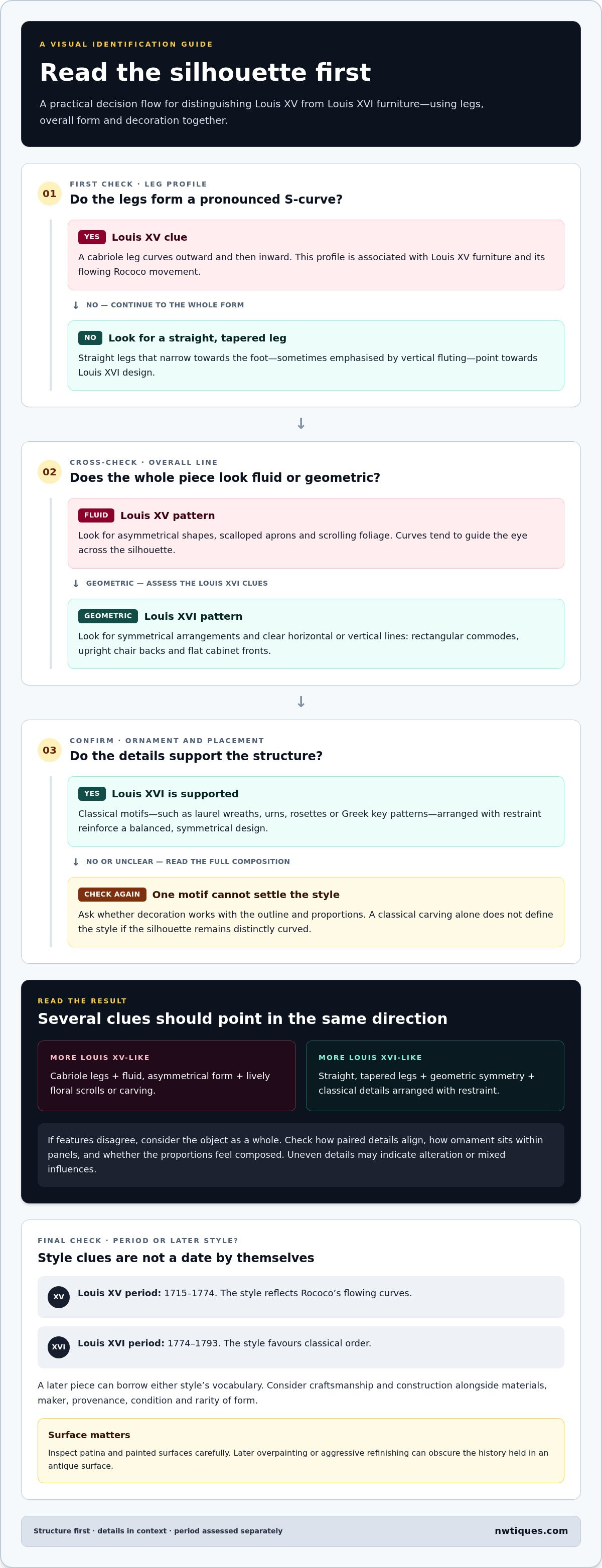
The clearest difference is the line: Louis XVI furniture favours straight, often tapered legs and symmetrical forms, while Louis XV pieces are known for curved cabriole legs and more fluid, asymmetrical shapes. Identifying the characteristics of Louis XVI furniture means looking beyond ornament to the structure beneath it. The contrast reflects a wider shift from Rococo movement and naturalistic decoration towards Neoclassical order and classical references.
The distinction can feel subtle because both styles may be richly ornamented, finely made and graceful in scale. Their silhouettes, however, tell different stories. Louis XV furniture draws the eye along curves, scalloped aprons and scrolling foliage; Louis XVI pieces arrange details around balanced proportions, fluting and classical motifs such as laurel wreaths, urns and rosettes.
This guide compares the most useful clues, from legs and chair backs to case shapes, decoration and historical context. Learn how to read these features together, recognise where the styles overlap, and distinguish a Louis XV piece from one shaped by emerging Neoclassical taste.
Key Takeaways
- Read a chair’s back, seat frame, and leg construction together to build a more reliable picture of its design.
- Look for classical decoration and balanced geometry, then consider how each detail relates to the piece’s overall proportions.
- Separate period furniture from later Louis XVI-style work by weighing craftsmanship and construction alongside the style’s visual language.
- Explore Nwtiques’ Centre Tables to see how historic furniture can bring character and purpose to an interior.
What is Louis XVI Style and why do I love it?
Louis XVI furniture is characterised by measured proportions, symmetrical arrangements and straight, often tapered legs. Its classical vocabulary replaces the animated curves of Louis XV Rococo with an architectural sense of order.
Cabriole Legs and Straight Tapered Legs
A cabriole leg curves outward and then inward, forming the S-shaped profile associated with Louis XV furniture. A Louis XVI leg, by contrast, descends in a straight line and narrows towards the foot; vertical fluting may emphasise its column-like form. Compare the legs in profile, then check whether their shape repeats around the frame. Matching, tapered supports point towards Neoclassical restraint rather than Rococo movement.
Straight Lines and Restrained Ornament
Louis XVI design gives the eye clear horizontal and vertical lines. Rectangular commodes, upright chair backs and flat cabinet fronts establish the structure before decoration appears. On cabinets, straight or parallel borders frame the surface rather than overwhelm it; this treatment can be seen across examples of antique cabinet furniture. The result is not plainness, but ornament kept in balance with the underlying geometry.
| Feature | Louis XV | Louis XVI |
|---|---|---|
| Leg profile | Curved cabriole | Straight, tapered, often fluted |
| Overall line | Fluid and asymmetrical | Geometric and symmetrical |
| Decorative effect | Floral scrolls and lively carving | Classical motifs arranged with restraint |
Louis XVI ornament draws on classical forms, including laurel wreaths, urns, rosettes and Greek key patterns. These motifs are often placed with care, such as a rosette at a leg block or a laurel detail centred on a panel. Identifying the characteristics of Louis XVI furniture means reading decoration alongside structure: a classical motif alone does not define the style if the silhouette remains distinctly curved.
Start with the frame: repeated straight lines and tapered supports suggest Louis XVI design, while a pronounced S-curve points to Louis XV influence.
Louis XVI symmetry, fluted legs and classical motifs
The defining characteristics are architectural proportions, coordinated ornament and balanced forms. Read them as a system rather than treating one carved detail as conclusive.
Symmetry and Fluted Legs
Check how details align across the whole object. On a commode, compare the divisions and fittings on the left and right; on a chair, see whether paired elements have matching proportions. Fluting matters in relation to the frame, not in isolation. A consistent arrangement suggests a coherent design, while mismatched or uneven details may indicate alteration or mixed influences.
This architectural approach shapes the whole object, not just its individual components. Classical buildings valued proportion as well as symmetry, and Louis XVI furniture brought that ordered sensibility into domestic interiors. Consider the relationship between a piece’s height, width and decorative panels. Balanced proportions can make an object feel composed even when its ornament is elaborate.
Geometric Shapes and Classical Motifs
Consider how decoration uses the available surface. A motif centred on a panel creates a different effect from the same carving repeated along an edge. Notice whether the ornament leads the eye through the composition or competes with the outline. This helps distinguish a considered decorative scheme from a collection of details that simply share a classical vocabulary.
Balance also affects how furniture reads in a room. Louis XVI interiors could place seating against a wall or in the centre, with side tables arranged for conversation. In either setting, proportion and placement contributed to the room’s visual order. Examine an object both on its own and in context: a well-resolved piece keeps its composure without relying on a crowded setting.
For a practical assessment, begin with the overall proportions, trace the placement of the ornament, then consider whether the details work together. This sequence reveals the design logic beneath the surface and offers a fuller reading than identifying one feature in isolation.
Louis XV vs Louis XVI Furniture: What's the Difference?
Louis XV furniture belongs to the period from 1715 to 1774; Louis XVI furniture followed from 1774 to 1793. The former reflects Rococo’s flowing curves, while the latter favours classical order. These dates describe French furniture periods, but a later piece can borrow either style’s vocabulary.
How much is Louis XVI furniture worth, and what affects its price? Value depends on whether a piece is period or later, its maker and provenance, the quality of its materials, its condition and the rarity of its form. Original details and well-preserved surfaces can further distinguish one commode or table from another.
What are the most common types of Louis XVI furniture? Chairs, commodes, chests, tables, bureau plats and secrétaires are characteristic forms. Details differ by type: a table may have a wood or marble top, while a secrétaire à abattant combines a fall-front writing surface with storage.
What condition issues should buyers look for in Louis XVI furniture? Examine joints for looseness, wood for splits, veneer for lifting, and mounts for signs of replacement or loss. Check painted surfaces and patina carefully: later overpainting or aggressive refinishing can obscure the history held in an antique surface.
Materials provide further clues, but no single wood proves a date. Louis XVI makers used mahogany, walnut and oak, sometimes with veneer, marquetry or ormolu mounts. Louis XV pieces may feature warm walnut, giltwood or painted finishes, with damask or velvet upholstery. Compare construction and decoration together rather than treating any material as definitive.
Distinguish period furniture from later Louis XVI-style work through construction, wear and the coherence of its details. Much Louis XV and Louis XVI furniture available today dates from the 19th century; faithful copies and revival pieces were also commissioned then. A convincing classical silhouette can therefore reflect later taste, not necessarily the original period.
In an interior, Louis XV curves add movement and soften rectilinear rooms; Louis XVI geometry creates a more composed rhythm. A Louis XVI table can anchor a formal arrangement, while Louis XV seating can provide contrast. Choose the silhouette that suits the room’s architecture, then assess authenticity and surface condition separately.
Historical context and the shift from Rococo to Neoclassicism
Louis XVI’s furniture belongs to a courtly world undergoing political and social strain. He married Marie Antoinette in 1770, and their royal household remained closely associated with Versailles. Yet court life was not the only setting shaping interiors: salons and châteaux offered more intimate settings, where furniture served conversation and daily use as well as ceremony.
Events surrounding the monarchy help place surviving furnishings within their time. Louis XVI convoked the Estates General on 8 August 1788, setting its opening for 1 May 1789. The assembly opened on that date, amid mounting public pressure and financial difficulty. In 1788, the king’s household spending accounted for 13% of France’s total state expenses, excluding interest on debts.
These circumstances matter to furniture history because court commissions existed within a larger system of patronage, expenditure and changing domestic life. A richly appointed piece was not simply an isolated expression of taste; it belonged to a household, a room and a network of makers working for patrons. The Grand Salon from the Hôtel de Tessé in Paris, dating to circa 1768-72, offers a glimpse of interiors created before Louis XVI’s accession.
The political rupture became impossible to separate from the monarchy’s cultural legacy. Louis XVI was brought before the National Convention on 11 December 1792 to hear his indictment; Raymond Desèze delivered his response on 26 December. Louis XVI died on 21 January 1793. The French Revolution lasted from 1789 to 1799, disrupting the courtly world that had supported commissions and reshaping the circumstances in which royal furnishings survived.
For collectors, this history is a reminder to look beyond appearance. An object’s documented ownership, use and subsequent history can show how it moved from a private interior into the modern market, where period design and later historical taste may coexist.
Nwtiques: Centre Tables
Nicholas Wells Antiques offers centre tables for collectors seeking a distinctive focal point with historical character. Having compared Louis XV’s animated curves with Louis XVI’s disciplined geometry, consider how a table’s silhouette, materials and surface will work with the room around it. Centre, side and console, end, and occasional tables offer different ways to introduce an antique table into an interior, whether as a focal point or a quieter supporting piece.
Explore the Centre Tables collection to consider the forms and details that suit your space. For questions about a particular piece, contact Nwtiques, or visit nwtiques.com.
Let a Considered Choice Shape the Room
Choosing an antique also means deciding what atmosphere you want a room to convey. As you continue identifying the characteristics of Louis XVI furniture, consider how a piece will sit alongside the architecture, light and existing furnishings, rather than treating historical style as a label alone. Its surface and patina carry a history that can bring depth and individuality to a contemporary interior.
Before choosing a piece, picture its role in the room and how it will shape the space over time. Look from the object’s silhouette to its relationship with the surrounding furnishings, then choose what feels coherent with your taste. A considered choice can make a room feel personal and rich with history.
Frequently Asked Questions
Which design features distinguish Louis XVI furniture from Louis XV and Directoire styles?
Louis XV furniture favours animated, naturalistic forms, while Louis XVI design is more formally balanced. Directoire furniture continues the classical vocabulary but generally reduces courtly ornament for a simpler, more austere appearance. To assess a piece, examine how its decoration relates to the frame: Louis XVI designs integrate classical details into an ordered composition, while Directoire pieces tend towards greater restraint.
What woods, veneers, and finishes are typical of Louis XVI furniture?
Characteristic woods include mahogany, walnut and oak, as well as fruitwood and other materials. Veneer consists of thin sheets of decorative wood applied over a base such as oak or pine. Painted finishes were prominent, and lacquer and Martin varnish were also used. Upholstery could include brocade, silk, embroidered linen or stripes, often in quieter patterns than those of earlier styles.
What motifs and decorative elements are common in Louis XVI furniture?
Common decorative motifs include rosettes, acanthus leaves, swags, oak and laurel foliage, urns and Greek key borders. Their placement reveals the design logic: a rosette may mark a chair-frame joint, while a swag can frame a panel or centre a composition. Compare the motif’s scale with the surrounding surface. Well-proportioned ornament complements the furniture’s structure rather than obscuring it.
How can you identify authentic 18th-century Louis XVI furniture?
Assess the whole object, including its construction, materials, surface and documented history, rather than relying on one stylistic feature. Museum examples offer useful comparisons: the Metropolitan Museum of Art holds a commode made by Jean-Henri Riesener in 1783, and the Wallace Collection holds a Riesener secrétaire model made circa 1783. Compare proportions and workmanship against such documented pieces.
What construction details and hardware are found on Louis XVI furniture?
Chair frames may have die joints beneath the seat corners, sometimes carved with rosettes or flowers. Commodes and chests can feature bronze fittings, while ormolu, or gilt bronze, may appear on handles, feet and trim. Check how the mounts meet the wood and whether their finish is consistent with the rest of the piece. Veneered surfaces may also feature intricate marquetry.
How can you tell an antique Louis XVI piece from a reproduction?
Compare the construction beneath and behind the visible surfaces with the quality of the decoration. Look for consistent wear across exposed edges and protected areas, examine joints and mounts, and note whether later alterations interrupt the original design. A Louis XVI silhouette alone doesn’t establish age: 19th-century revival furniture can echo the style. Provenance and close examination of materials help distinguish period work from later interpretation.
See our antique chests of drawers and commodes and centre tables in stock, including George III Chippendale Mahogany Serpentine Commode and Specimen Marble and Rosewood Centre Table.


Leave a comment