


European clockmaking and automata: singing bird boxes and longcase clocks
A singing bird clock’s value is shaped by more than the brief music of its mechanism. The maker, the quality and originality of the movement, the condition of the case and the object’s provenance all matter; European clockmaking and automata, from singing bird boxes to longcase clocks, offers a rich context for understanding why these pieces differ.
The appeal is readily understood: a minute clockwork performance gathers sound, movement and ingenious craftsmanship within an intimate object. Yet the box is not merely a decorative shell. Its concealed mechanism drives the bird’s motion and music, connecting these miniature automata to a broader tradition of European horology. This article explains what influences a singing bird clock’s cost, how its box and mechanism work, and how such creations relate to other automata. It also considers notable examples in museum collections, placing each object within the history of clockmaking rather than treating it as a novelty alone.
Key Takeaways
- Assess a singing bird clock by its maker, mechanism, condition and provenance to understand what shapes its value.
- Recognise how a compact case conceals a coordinated system of clockwork, gears and sound-producing components.
- Explore museum examples to see how bird automata belong within a wider history of European horology and mechanical ingenuity.
- Consider longcase clocks as another expression of European clockmaking, with a distinct presence and function in an interior.
How Much is a Singing Bird Clock?
There is no single price for a singing bird clock: maker, condition, originality and provenance shape its market value. The study of European clockmaking and automata: singing bird boxes and longcase clocks reveals a contrast in purpose and form. A bird box concentrates intricate craft into a compact musical performance; a longcase clock gives timekeeping a larger architectural presence.
Production and Rarity of Bird Boxes
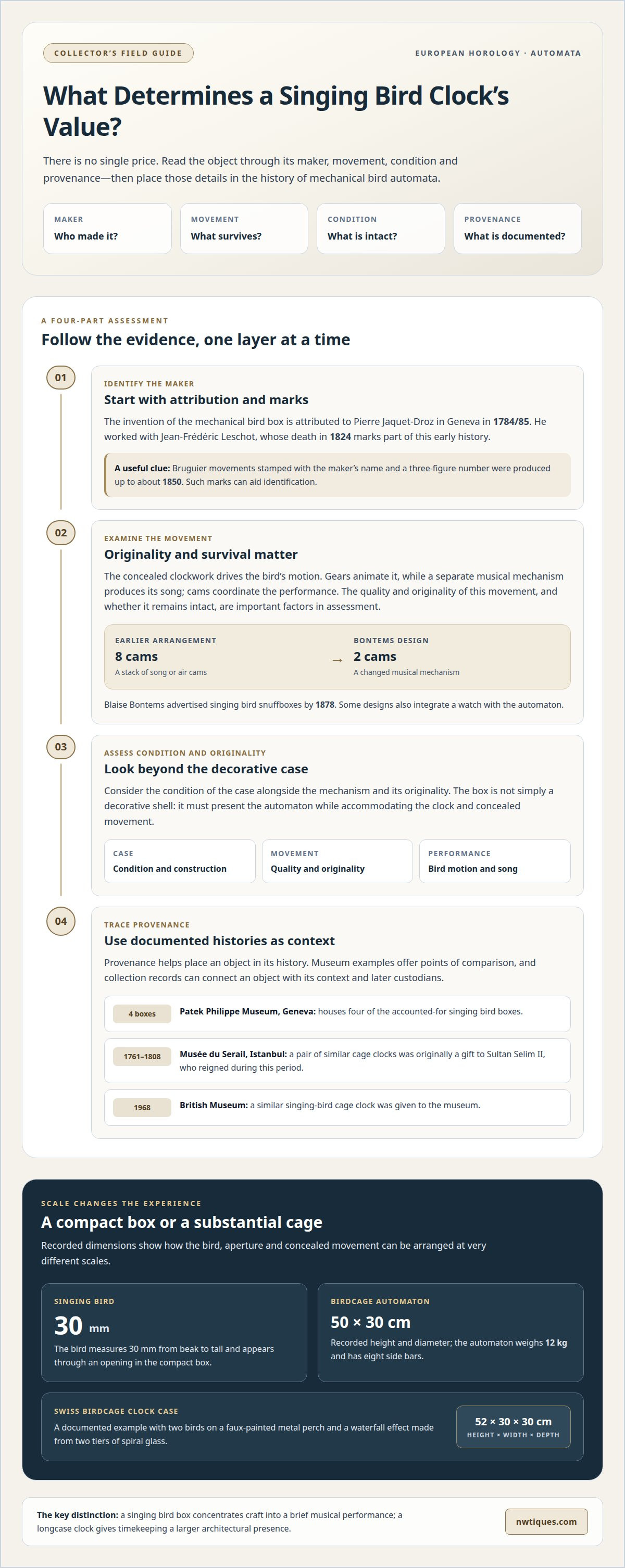
Mechanical bird boxes unite a miniature automaton with a concealed movement, making rarity inseparable from the survival of their mechanisms. The invention is attributed to Pierre Jaquet-Droz in Geneva in 1784/85, while musical automata had reached a high artistic and technical standard by the mid-18th century. Maker, intact mechanism and documented history all inform an object’s significance and market appeal.
Jaquet-Droz worked with Jean-Frédéric Leschot, whose death in 1824 marks part of this early history. These objects required specialised craftsmanship rather than ordinary clockmaking alone. Their value reflects the survival of intricate work as well as the bird’s performance.
Musical Mechanism Changes
Blaise Bontems changed the musical mechanism by replacing a stack of eight song or air cams with two cams. This design difference helps explain how makers controlled a bird’s song and distinguishes one generation of automata from another. Bontems was advertising singing bird snuffboxes by 1878, extending the tradition into later forms.
Bruguier movements stamped with the maker’s name and a three-figure number were produced up to about 1850. Such marks can aid identification, although condition and originality also affect assessment.
Bird Animation and Musical Mechanisms
Turning the winder powers the clockwork: gears animate the bird, while a separate musical mechanism produces its song. Cams coordinate the performance, translating stored mechanical energy into a measured sequence. Movement and sound work together as parts of the mechanism, not as independent embellishments.
Some designs integrate a watch with the automaton, combining timekeeping with performance. For enthusiasts interested in how this legacy of horological artistry endures in modern luxury watches, zhaveri.com showcases fine timepieces and jewellery. This distinction within European clockmaking and automata, from singing bird boxes to longcase clocks, helps explain why the objects are judged differently. A longcase clock prioritises sustained timekeeping and an imposing case; a singing bird box makes a brief mechanical performance its central event.
Construction and dimensions of singing bird boxes
The dimensions and proportions show how makers arranged the bird, aperture and concealed movement within a compact case. Larger birdcage clocks bring the same mechanical ingenuity into a more architectural form.
Automaton Dimensions and Weight
Measurements distinguish a portable singing bird box from a freestanding birdcage automaton. Singing bird boxes are compact objects, with an opening through which the bird appears during its performance. The bird itself measures 30 mm from beak to tail, a scale that allows its motion to emerge through the aperture.
By contrast, a birdcage automaton measures 50 x 30 cms in height and diameter and weighs 12 kilogram. Its cage has eight side bars. These proportions matter: they indicate a substantial object, not a scaled-up snuffbox, and help explain how the display accommodates a more visible mechanical performance.
Materials, Techniques, and Decorative Styles
Documented examples show a range of finishes and components, rather than one universal European style. One Swiss birdcage clock has two birds on a faux-painted metal perch, with a waterfall effect formed from two tiers of spiral glass. Such details show how painted surfaces and shaped glass could enrich the automaton without obscuring its movement.
Another birdcage design features four individually painted porcelain or enamel cartouches. Their placement adds colour and ornament across the cage, while the bird and mechanism remain the focal point. Recorded features like these provide a firmer basis for describing technique than applying a broad decorative label to every example.
Clock cases also vary in scale. The Swiss birdcage clock case measures 52 cm high, 30 cm wide and 30 cm deep. Those dimensions, considered alongside the cage’s bars, perch and glass tiers, help readers understand the relationship between the timepiece and its display. A beautiful case is not merely a surround: its construction must present the automaton while accommodating the clock and its mechanism.
These differences show how European makers balanced enclosure with spectacle. Compact boxes bring the bird close to the viewer; a larger cage gives its movement a more prominent setting. Compare openings, finishes and proportions to understand the design of each object.
Known examples in museums and collections
Museum collections preserve singing-bird clocks as historical objects and records of mechanical artistry. Their documented histories offer useful comparisons when placing an individual piece in its period.
Museum Collection Examples
The Patek Philippe Museum in Geneva houses four of the accounted-for singing bird boxes. These pieces provide a reference for studying the form alongside other examples in horological collections. A pair of similar singing-bird cage clocks in Istanbul’s Musée du Serail was originally a gift to Sultan Selim II, who reigned from 1761 to 1808. Their history also traces the movement of such objects between European workshops and royal collections.
A similar singing-bird cage clock was given to the British Museum in 1968. Together, these institutional examples show how collections preserve more than mechanisms: their records can connect an object with its original context and later custodians. For collectors, comparing documented histories can help distinguish a convincing resemblance from evidence of a particular object’s provenance.
Antique and Vintage Examples
Public collections are only part of the surviving record. A similar cage clock from the collection of Mrs. James A. de Rothschild was sold in London on 20 June 1972. Another, from a private collection, was sold in Monaco on 26-27 May 1985. These dated sales place comparable pieces within the history of collecting without making either result a universal measure of value.
Authentication, dating and condition assessment depend on considering several kinds of evidence together. Compare construction and maker’s marks with documented examples, then examine the movement, case and surfaces for consistency. Provenance can add context, while signs of alteration and wear help describe condition. A museum record may inform a comparison, but resemblance alone does not prove authorship or a direct connection.
Singing-bird clocks and automata
Singing-bird clocks unite horology with automata, transforming measured time into a brief mechanical performance. A diary entry records a singing-bird clock belonging to the Marquise in 1754, evidence that these objects were already valued as intimate marvels. Pierre Jaquet-Droz, who lived from 1721 to 1790, became central to this tradition, where timekeeping could share attention with movement, music and display.
The Jaquet-Droz firm reached the height of its career in 1788 and appears to have ceased trading by 1810. This short chronology places the maker’s legacy within a concentrated period of innovation. The surviving objects are therefore more than ingenious mechanisms: they preserve the ambitions of a workshop whose reputation rested on combining precision with spectacle.
A birdcage clock makes that union especially legible. In a Matthias Naeschke automaton, the clockwork has a power reserve of 3 days and uses a Swiss lever escapement with a double barrel. On the hour, it releases an organ with 10 tin pipes. Timekeeping and performance are coordinated within one mechanism, rather than added as unrelated decoration.
The cage also shapes the viewer’s experience. Two birds rest on a faux-painted metal perch, while four individually painted porcelain or enamel cartouches bring colour to the structure. Ornament frames the animated focal point without diminishing the mechanical ingenuity. Together, the materials create the impression of a miniature theatrical scene, with sound, movement and surface carefully composed.
Later makers continued this union of craft and spectacle. Gustave Sandoz exhibited at the Exposition Universelle de Paris in 1889. A French singing-bird automaton clock is described as crafted circa 1880, while a Karl Griesbaum singing-bird box with a clock is dated to the 1950s or 1960s. These examples reveal a tradition adapted across generations. Explore antique clocks to continue considering timepieces as both mechanical instruments and works of art.
Nwtiques: Longcase Clocks
Nicholas Wells Antiques offers longcase clocks for collectors drawn to the measured presence of traditional horology. After exploring compact automata, a longcase clock offers a different experience: its movement serves practical timekeeping, while its case creates a distinctive architectural focal point in a room.
Consider a longcase clock when you want an antique timepiece whose scale and character can anchor an interior, whether furnishing a Greenwich, Connecticut home or another setting. The collection also includes Boxes and Caddies and Centre Tables, allowing different forms of craftsmanship to sit in dialogue. Preserving an antique’s original surface and patina helps retain the history carried by its materials. Nwtiques can arrange straightforward international delivery to the United States using fine art shippers.
For help considering a longcase clock, contact Nwtiques.
Let Craftsmanship Shape the Next Choice
The choice is not simply between a singing bird automaton and a longcase clock. Consider how the object’s movement, scale and original surface will contribute to its setting. The study of European clockmaking and automata, from singing bird boxes to longcase clocks, rewards close attention: each piece carries both mechanical ingenuity and the marks of its history.
In an interior, a timepiece can establish a focal point, while surrounding furniture creates a considered visual rhythm. Centre Tables, Side & Console Tables and End Tables offer different ways to balance a clock’s presence without obscuring its individual character. Preserving the patina and distinctive surface of antique objects helps retain the evidence of their age and making.
If you are considering a singing bird clock or a longcase clock for your collection, contact Nwtiques about singing bird clocks. Let historical craftsmanship guide a choice that feels enduring and distinctly your own.
Frequently Asked Questions
How do mechanical singing bird boxes work, and what are their key components?
Winding the box sets its concealed mechanism in motion, coordinating the bird’s movement with its song. The principal components are the winding mechanism, gears, song-producing mechanism and mounted bird, which moves into view through an opening. Their arrangement varies by maker and period. For example, Bontems’ use of two cams instead of eight changed how the musical sequence was controlled.
Which European makers and regions were renowned for singing bird boxes?
Notable makers include Pierre Jaquet-Droz and Charles Abraham Bruguier of Geneva, Blaise Bontems in France, and the German firm of Karl Griesbaum. Swiss and French workshops became especially associated with these finely made objects, while German production continued the tradition in later forms. A maker’s mark can offer a useful clue, but attribution is strongest when considered alongside the movement and construction.
What are the auction prices and market values of antique European singing bird boxes and longcase clocks?
Auction prices and market values depend on the individual object, not a single figure for the category. For a singing bird box, buyers consider the maker, originality, condition, performance and provenance. Longcase clocks are assessed by their movement, case, completeness and decorative quality. Auction results are most useful when compared with pieces of similar type and condition, rather than treated as a universal valuation for either form.
How did European clockmaking develop from the 17th to 19th centuries?
Musical automata had reached a high artistic and technical standard by the mid-18th century, and the singing bird box’s invention is attributed to Pierre Jaquet-Droz in Geneva in 1784/85. Later developments included Blaise Bontems’s two-cam musical mechanism and his advertising of singing bird snuffboxes by 1878.
What are the risks and best practices for restoring and maintaining mechanical bird boxes and longcase clocks?
To assess condition, compare the construction and maker’s marks with documented examples, then examine the movement, case and surfaces for consistency, alteration or wear. Provenance records can add context.


Leave a comment