


British campaign furniture: built to travel the Empire
Its defining innovation was not simply that it could be carried, but that it could be dismantled, folded and made ready for the next stage of a journey. British campaign furniture was built to travel the Empire: portable tables, chairs and chests served officers and civilian gentlemen moving between distant postings, while the form developed through the eighteenth and nineteenth centuries. The name reflects its association with military campaigns, though its purpose extended beyond the battlefield.
Campaign furniture is often imagined as plain equipment valued only for its utility. In reality, its ingenuity lies in balancing portability with domestic comfort: hinges, detachable parts and compact proportions made pieces practical in transit, while careful joinery and considered design preserved their character. This article explains the term and its history, introduces makers associated with the tradition, and examines how chairs, tables, desks and larger furnishings could be dismantled, packed and reassembled. These details show why campaign furniture remains compelling as both an ingenious solution and a distinctive expression of furniture-making.
Key Takeaways
- Understand how the term “campaign furniture” reflects a tradition shaped by travel, military life and the demands of distant postings.
- Recognise the makers and designers associated with the craft, and how their work helped establish its distinctive character.
- Learn which materials and construction details made campaign chests easier to transport while protecting their contents.
- Spot the ingenious folding and knock-down features that turned chairs, tables and other furnishings into portable pieces.
What is campaign furniture and where did the term come from?
British campaign furniture was made to travel, with pieces that folded, separated or packed compactly. Its forms developed to meet the practical needs of officers and civilians moving across the British Empire.
Portable Construction for Travel
British campaign furniture was designed to fold, dismantle and pack for journeys over difficult routes. Its defining feature was mobility built into the construction, rather than portability achieved by sacrificing domestic use. Travelling armies had used portable furnishings since the time of Julius Caesar or earlier; Caesar carried elaborate furnishings on campaigns and journeys lasting about a month. British examples combined transportable construction with the elegance expected in a furnished home.
British Army Officers and Campaign Furniture
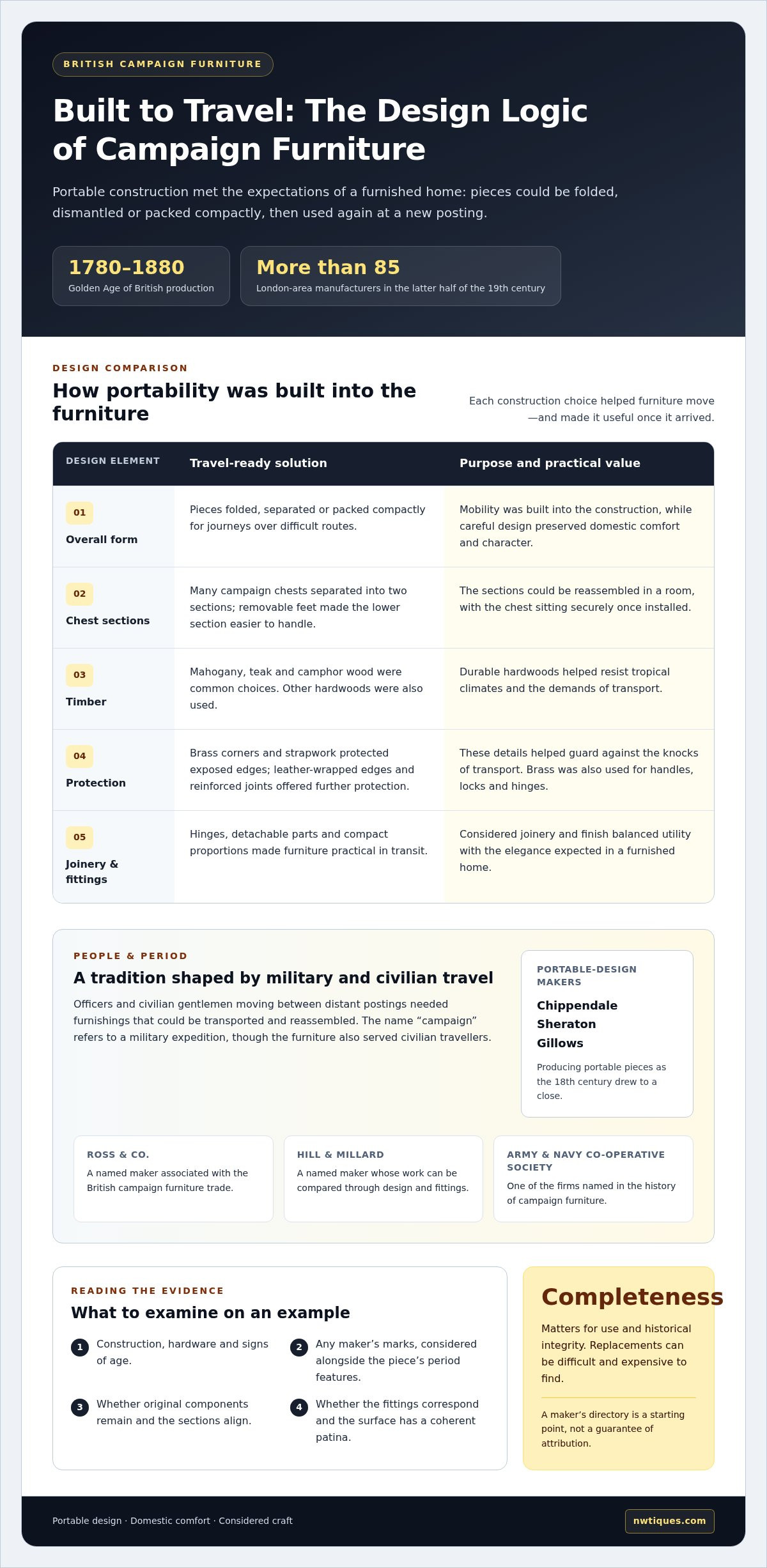
British officers stationed in distant colonies needed furniture that could be transported and reassembled at a new posting. Military campaigns in India, Africa and other colonies encouraged more sophisticated designs, while civilian gentlemen could also order complete suites for travel to India, Africa, North America and the South Seas. As the Empire expanded, portability became a practical requirement for pieces intended to preserve familiar comforts far from home. The military association explains the name: “campaign” refers to a military expedition.
Cabinet Makers and Portable Design
British cabinet makers adapted established furniture forms for travel, bringing technical ingenuity to tables, chairs and chests. Portable furniture had roots in the eighteenth century, and specialists became prominent towards its close. As the eighteenth century drew to a close, makers including Chippendale, Sheraton and Gillows began producing portable pieces. Their work joined functional construction with considered proportions and finish. Related distinctions between cabinet furniture and other furnishings are useful when exploring the cabinet furniture category.
Authentic antique British campaign furniture has no single cost. Value depends on the piece, maker, materials, condition and completeness. To assess and date an example, examine its construction, hardware, signs of age and any maker’s marks, then check whether its original components remain. Replacements can be difficult and expensive to find, so completeness matters for both use and historical integrity.
British campaign furniture makers
London’s trade brought specialist makers together with established cabinet-making firms to meet military and civilian demand. Their names and construction choices help place individual pieces within a tradition that changed over time.
Notable Makers and the Golden Age
The Golden Age of British campaign furniture production is identified as 1780-1880, when demand and specialist manufacture flourished. More than 85 manufacturers were active in the London area during the latter half of the nineteenth century. Ross & Co., Hill & Millard, and the Army & Navy Co-operative Society are among the named makers. Their work offers useful points of comparison when examining a piece’s design and fittings.
Eighteenth- and Nineteenth-Century Evolution
Across the eighteenth and nineteenth centuries, portable furniture evolved from a specialist response to travel into a broader market shaped by military campaigns and fashion. Demand increased considerably in the mid-nineteenth century, as British officers and civilian travellers sought familiar furnishings for distant postings. Makers refined practical forms without abandoning elegance. By the early twentieth century, changes in transport and military logistics had reduced the need for such furniture.
Museum and Collection Examples
In museum and private collections, campaign furniture can be studied through its forms, makers and transport-minded details. A campaign chest, a folding coaching table and a chair designed to break down each demonstrate a different solution to portability. Compare these forms with work associated with Ross & Co. or Hill & Millard, noting materials, joints and hardware. Such comparisons can help distinguish functional design from later alterations.
A directory of makers is most useful as a starting point, not a guarantee of attribution. The London names above provide documented leads, while the wider trade included more than 85 manufacturers in the latter half of the nineteenth century. Compare a suspected maker’s name or mark with the piece’s construction and period features; a mismatch may prompt closer examination rather than a firm conclusion.
Campaign chests and their construction
A campaign chest combined domestic storage with construction suited to travel. Its materials, fittings and separable sections show how makers balanced durability with mobility.
Materials Used in Campaign Chests
Mahogany, teak and camphor wood were common choices for campaign chests, while other hardwoods offered durability and resistance to tropical climates. Timber was only part of the design: brass corners and strapwork protected exposed edges, while solid brass could also be used for handles, locks and hinges. Leather-wrapped edges and reinforced joints provided further protection from the knocks of transport.
Many chests were built in two sections that could be separated for carrying, then reassembled in a room. Removable feet made the lower section easier to handle and helped the chest sit securely once installed. For collectors, these features are functional evidence, not mere ornament. Check whether the sections align, the fittings correspond and the surface has a coherent patina rather than an abruptly altered finish.
The Wellington Chest
The Wellington chest is a compact campaign form, distinguished by its vertical arrangement of drawers and emphasis on secure storage. It typically has six to twelve drawers, allowing clothing and personal effects to be organised while keeping the overall footprint practical for travel. Some examples have seven drawers, one for each day of the week, turning an everyday feature into a memorable design detail.
Drawer count helps describe a chest, but cannot establish its date or authenticity by itself. Consider the drawer construction alongside the materials, hardware, removable feet and evidence of two-section construction. Brass corners and strapwork should make sense as protection for vulnerable edges, rather than appear as unrelated decoration. Original components matter: replacements can be difficult and expensive to find, and mismatched fittings may alter both function and character. The British Army’s need for portable storage provides the wider context, while the chest’s considered proportions allowed it to remain useful furniture after a journey. In a contemporary room, its upright profile offers substantial storage without the spread of a low, wide case.
Knock-down chairs, tables, desks, bookcases, sofas, and beds
Campaign furniture’s portability extended beyond chests to seating, work surfaces and larger furnishings. Ingenious construction let useful pieces travel and then serve again in settings across the colonies.
Knock-Down Chairs and Tables
Knock-down chairs were made to separate into flat components, while folding tables reduced their bulk for transport. A campaign coaching table, for example, folds flat on an X-frame base. Removable tops and folding legs offered other practical solutions. These mechanisms matter because they show how a piece was intended to function, not merely how it looks in a present-day interior.
The Roorkhee chair became a notable portable form. In 1933, Kaare Klint made a version known as the Safari Chair. The Paragon Chair offers another example: Fenby patented it on 22 March 1877, and a Harrods catalogue described it in 1895 as “the most Portable Chair in the Market.” These named designs make portability tangible.
Portable Desks and Bookcases
Portable desks adapted the writing place for journeys and sometimes incorporated hidden compartments. Bookcases and other furnishings could be made in stackable sections, making them easier to carry and arrange after arrival. Multipurpose tables also served several domestic needs. These designs show how practical requirements shaped campaign furniture without removing the expectation of refinement.
Not every piece used the same method. A chair might fold into a carrying case; a table could separate at its top or legs. The construction is the key: inspect the joints, fittings and way the components meet, rather than assuming every Victorian-looking piece was designed for travel. Mahogany and other durable hardwoods appear in campaign furniture, but the wood alone does not establish portability or age.
For collectors, the clearest takeaway is to read each mechanism as evidence of intended use, while distinguishing original construction from later changes. Explore antique seating to consider how portable chair forms relate to the broader history of furniture.
Nwtiques: Centre Tables
Nwtiques offers Centre Tables as a natural next step for readers considering how historic furniture forms might inform an interior today. For collectors in New York, Texas, California, the Hamptons or Greenwich, Connecticut, fine-art shippers can help make the delivery of an antique purchase more straightforward through specialist handling.
Explore Centre Tables alongside Side & Console Tables, End Tables and Occasional Tables to consider their different roles in a room. This is a natural next step if your interest has shifted from portable construction to choosing a distinctive antique table for your home. Consider each piece’s form, craftsmanship and surface character, and how it might sit within your interior.
For a closer look, explore Nwtiques’ Centre Tables or visit nwtiques.com.
Let History Shape Your Next Choice
British campaign furniture, built to travel the Empire, speaks to a broader idea: an object can carry its past into a new setting without losing its individuality. Let that thought guide your next choice. Consider what draws your eye first, how the piece relates to the room and whether its presence feels considered rather than merely decorative.
Choosing an antique is also an opportunity to shape a room around an object with character, allowing its distinctive details to become part of your home’s story. If you’re ready to explore that possibility, contact Nwtiques about antique furniture. A thoughtful choice can bring history into daily life with quiet assurance.
Frequently Asked Questions
What is British campaign furniture and when did it originate?
British campaign furniture describes furnishings designed to travel with their owners, especially on military expeditions. British portable furniture had roots in the eighteenth century, while the broader tradition of campaign furnishings reaches back to Roman times. This distinction helps date objects carefully: an ancient precedent explains the concept, but a British piece belongs to a later national tradition shaped by travel and military life.
Which types of furniture were designed for British military campaigns and colonial travel?
Portable campaign furnishings included chairs, tables, writing desks and chests, as well as bookcases made in stackable sections. A traveller might use a folding chair for seating, a table for several purposes and a desk for correspondence. Forms differed in how they packed, so identifying a piece’s intended use can clarify whether its portability came from folding, detachable components or compact construction.
What materials and construction methods made campaign furniture portable and durable?
Mahogany, teak, camphor wood and other hardwoods were used for campaign furniture. Makers combined these timbers with brass corners, strapwork, handles, locks and hinges; some pieces also had leather-wrapped edges or reinforced joints. When assessing a piece, compare its materials with its fittings and construction. A coherent relationship between protective hardware and vulnerable edges can help explain how the design addressed travel.
How did campaign furniture fold, dismantle, and pack for transport?
Designs reduced bulk in different ways: chairs could break down into flat components, tables could have folding legs or removable tops, and chests could separate into sections. A coaching table’s X-frame, for example, folds flat. These mechanisms were not interchangeable; each suited a distinct form. Studying the joints and how parts meet can reveal how a piece was assembled and prepared for a journey.
Which British makers and designers were famous for campaign furniture?
London names associated with campaign furniture include Ross & Co., Hill & Millard, and the Army & Navy Co-operative Society. Hepplewhite and Sheraton are also associated with its design. These names represent different roles: a designer’s influence doesn’t by itself establish who manufactured a particular object. For attribution, consider a maker’s mark alongside the piece’s construction and period features, rather than relying on style alone.
How did British campaign furniture serve officers, administrators, and travelers across the Empire?
Portable furnishings allowed officers and civilian travellers to bring familiar domestic comforts to distant postings and on journeys. Complete suites could be ordered for travel to India, Africa, North America and the South Seas. A chest offered organised storage, a desk supported correspondence and a table served everyday needs. This furniture connected a mobile life with the routines of a settled interior.


Leave a comment