


What Is a Cheval Mirror? How to Use One in Your Home
What if a full-length mirror could serve as both a practical dressing aid and a sculptural piece of furniture? The answer to what is a cheval mirror and how to use one lies in its defining feature: a freestanding frame that lets the mirror tilt, so you can adjust the reflection to suit your height and position.
That adjustable movement is useful, but a cheval mirror also brings character to a room. Its best position depends on the available floor space, light and your daily routine. An antique example also calls for careful handling, especially when you move or adjust it.
This guide explains how to identify a cheval mirror, position and angle it for everyday use, and care for an antique. It also covers why an original surface patina is part of a mirror’s history, not simply a finish to polish away.
Key Takeaways
- Understand what is a cheval mirror and how to use one: look for a freestanding, adjustable design and handle the pivot gently.
- Choose a position that suits your routine and leaves clear space around the base.
- Check sightlines, nearby furnishings and natural light before settling on a position.
- When assessing an antique, consider its scale, stability, frame and mirror surface, and value age and patina as part of its character.
What Is a Cheval Mirror? The Defining Features of This Freestanding Form
A cheval mirror is a full-length mirror held upright by a freestanding frame with side supports and pivot points. Unlike a wall mirror, it isn’t fixed directly to the wall; the glass tilts within its frame. A floor mirror may also stand independently, but the pivoting panel is what distinguishes a cheval mirror. Frames can rest on feet or a broader base, and their proportions, materials and details vary.
The French word cheval means horse; the name is traditionally linked to the four-legged appearance of the supporting structure. Also known as a cheval glass, this form combines a useful dressing mirror with a piece of furniture that has its own visual presence. With an antique, look at the timber, finish and aged surface as well as the overall shape. For further context, explore the antique mirror collection.
How the cheval mirror’s frame and pivot work
Side supports hold the mirror upright, while pivots at its sides allow the glass to move between angles. This lets you adjust the reflection to suit your position and the mirror’s placement. Designs differ in the outline of the supports, the feet or base, and the pivot hardware. On an antique, handle the frame carefully and don’t force a stiff or unfamiliar mechanism.
How it differs from a wall or floor mirror
A wall mirror is secured to a wall; a cheval mirror stands independently and turns on its pivots. A floor mirror can also stand freely, but that alone doesn’t make it a cheval mirror. The defining features are a mirror panel held between side supports and a frame designed to tilt. This distinction helps when identifying a piece or considering what is a cheval mirror and how to use one in your home.
How to Use a Cheval Mirror for Dressing and Everyday Room Use
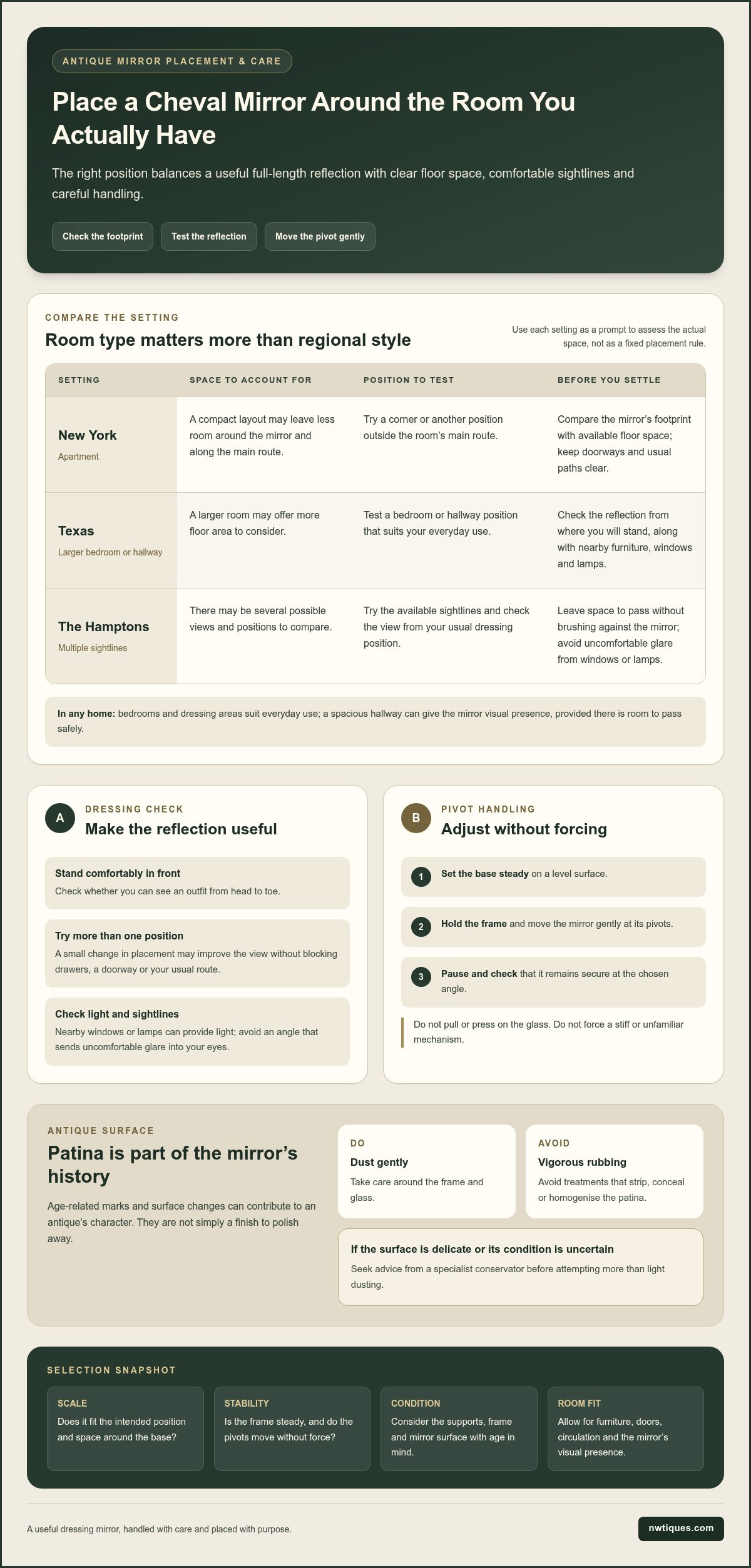
For dressing, start with the room rather than the pivot. Set the mirror on a level surface in a bedroom or dressing area, leaving enough space for its base and for you to stand comfortably in front of it. Check the reflection from your usual dressing position, then adjust the placement until the view is useful. Nearby windows or lamps can provide light, but avoid an angle that sends uncomfortable glare into your eyes.
Choosing a useful position for dressing
Stand at a comfortable distance and check whether the full-length reflection lets you see an outfit from head to toe. Try the view from more than one position before deciding where the mirror belongs. A small change in placement may improve the reflection without blocking a doorway, drawers or the usual path through the room.
Adjusting the mirror and keeping it stable
Once the base is steady, hold the frame and move the mirror gently at its pivots. Don’t pull or press on the glass. Make a small adjustment, then pause to check that the mirror remains secure at the chosen angle. Abrupt movement can unsettle a freestanding piece, so take particular care with an antique whose frame or mechanism has age and individual character. Britannica’s entry on the cheval glass offers further background on this mirror form.
Choose a level position, stand at a comfortable distance, then adjust the frame gently until the reflection suits your use. That is the practical answer to what is a cheval mirror and how to use one: it’s an adjustable dressing mirror that works best when handled patiently. For further inspiration, browse the antique mirror collection and consider how a mirror’s form and finish might complement your room.
Placing and Caring for Antique Cheval Mirrors
An antique cheval mirror needs a position that suits both its use and its physical presence. In a bedroom, it can sit near a dressing area, provided its base doesn’t obstruct drawers, doors or the route around the bed. A dressing room may offer more freedom to position it for a comfortable view. In a spacious hallway, it can become a distinctive furnishing, but leave enough room to pass without brushing against it.
Placement in American homes, from New York to the Hamptons
Room dimensions matter more than regional style. In a New York apartment, a compact layout may call for a corner or another position outside the main route through the room. A Texas home may have a larger bedroom or hallway, while a Hamptons interior might offer several possible sightlines. In each case, compare the mirror’s footprint with the available floor space. Before settling on a permanent position, check the reflection from where you’ll stand and consider nearby furnishings, windows and lamps.
Respecting an antique mirror’s patina
Age-related marks and changes to the surface can be part of an antique mirror’s character, bearing witness to its history rather than detracting from it. Dust gently, taking care around the frame and glass. Avoid vigorous rubbing or treatments intended to strip, conceal or homogenise the patina. If the surface seems delicate or its condition is uncertain, seek advice from a specialist conservator before attempting more than light dusting.
Careful placement and restrained cleaning help preserve the qualities that make an antique distinctive. For a closer look at historic mirror forms and their individual character, explore the antique mirror collection.
Choosing a Cheval Mirror That Belongs in a Thoughtful Interior
A cheval mirror earns its place through a balance of utility, proportion and visual presence. Before choosing one, consider its scale, the stability and condition of the frame, the state of the glass, and how the piece relates to the room. Its adjustable angle is useful for dressing, but its freestanding supports need floor space, so plan for both function and placement.
Balancing function, scale, and visual presence
Measure the intended position, including space around the base, and account for nearby furniture, doors and circulation. A frame that feels imposing beside a narrow bedside table may sit comfortably near a larger chest or in a dressing area. Examine the supports, pivots, frame and mirror surface with an appreciation for age. Signs of wear may be part of an antique’s history, not flaws to erase. The frame reads as furniture in its own right.
This balance of reflective function and considered form lies at the heart of what is a cheval mirror and how to use one in a thoughtful interior. When styling around such historic statement pieces, pairing them with artisanal accents from boutiques like Constance & Belle helps create a warm, layered aesthetic that feels both curated and personal.
Explore antique mirrors and further expertise
For a wider perspective on historic mirror forms, consult a connoisseur’s guide to antique mirrors, then browse the antique mirror collection. Nwtiques offers fully insured worldwide shipping, including to collectors in New York, Texas, California and the Hamptons. Explore the collection for inspiration on the character and craftsmanship that might suit your interior.
Bring a Cheval Mirror into Your Home with Confidence
Understanding what is a cheval mirror and how to use one begins with its defining balance of function and form: a full-length mirror that pivots within a freestanding frame. Choose a position with room to move, adjust the angle gently, and consider how the frame relates to nearby furnishings. With an antique, treat the original surface and signs of age with care to preserve the character that distinguishes the piece.
Nicholas Wells Antiques specialises in fine antiques, with a collection that includes antique mirrors. Each item sold includes complimentary restoration, approached with respect for its history, and worldwide shipping is fully insured.
To explore historic mirror forms and find inspiration for your interior, browse the antique mirror collection at Nicholas Wells Antiques.
Frequently Asked Questions
What is a cheval mirror?
A cheval mirror is a freestanding, full-length mirror held within a frame that pivots to adjust its angle. To understand what is a cheval mirror and how to use one, look for the combination of a supporting frame and adjustable mirror panel. This distinguishes it from a mirror fixed to a wall. Frames, bases and pivot mechanisms vary, so assess each example individually.
How do you adjust a cheval mirror?
Place the mirror on a level, stable surface, then stand at a comfortable viewing distance. Hold the frame and make a small, gentle adjustment at the pivots rather than pulling or pressing on the glass. Pause to check that the base remains steady and the reflection suits your needs. Keep the mirror clear of walkways before using it for dressing.
Where should you place a cheval mirror?
A bedroom or dressing area can provide a convenient place for a cheval mirror, while a spacious hallway may suit one if there’s room to pass without obstruction. Consider the mirror’s footprint, nearby furniture, available light and your usual viewing distance. Before choosing a permanent position, check the reflection from where you’ll stand and make sure the base won’t interrupt circulation.
How do you care for an antique cheval mirror?
Handle the frame gently, keep the mirror stable, and avoid abrasive cleaning or attempts to make an aged surface look new. Patina and age-related marks may be part of an antique mirror’s character and history. Gentle dusting is a prudent starting point. If the surface seems delicate or you’re unsure about its condition, seek conservation-minded professional advice before attempting further care.
Is a cheval mirror different from a full-length mirror?
Yes. “Full-length” describes a mirror’s size or use, while “cheval” identifies a particular freestanding form, generally with a mirror panel held between supports and designed to pivot. A full-length mirror fixed to a wall, or one that stands without a pivoting frame, isn’t necessarily a cheval mirror. The frame and adjustment mechanism are key features to assess on each piece.


Leave a comment