


Understanding the Patina on Antique Wood and Metal
What if the most convincing signs of age tell you less about an antique’s authenticity than you think? A softened sheen on wood or darkened metal may reflect handling, exposure and care, but similar effects can be imitated. Understanding the patina on antique wood and metal means reading the surface in context rather than treating it as proof.
It’s natural to wonder whether a finish is genuinely aged, whether cleaning might erase something irreplaceable, or whether attractive wear conceals active damage. This guide explains how patina develops on wood and metal, what its patterns may reveal, and why surface appearance should be considered alongside construction and history. You’ll also learn to distinguish settled signs of age from deterioration that may threaten an object’s condition, and why preserving its character can matter more than making it look new.
Key Takeaways
- Understanding the patina on antique wood and metal starts with recognising how use, changing finishes and exposure leave different surface traces.
- Look beyond colour or sheen: compare wear across edges, joins, handled areas and more protected surfaces.
- Patina can suggest an object’s history, but appearance alone cannot establish its age or authenticity.
- Before cleaning, document the surface and avoid aggressive polishing or refinishing that could remove historic character.
What Patina Means on Antique Wood and Metal
Patina is the visible character a surface acquires through age, handling, changes to its finish and exposure to its surroundings. The term covers different effects across materials, as outlined in Patina, but it doesn’t describe every mark on an old object. Subtle variation and wear may reflect a piece’s history. Ingrained dirt, structural damage, mould and active corrosion are separate concerns, not signs of age to romanticise.
Collectors may value patina for the depth and individuality it lends to an object, including traces of use that a renewed surface could erase. But an aged appearance alone can’t establish a piece’s age or authenticity. Patina records change, but does not independently establish age or authenticity. Understanding the patina on antique wood and metal means considering its character in context rather than treating surface appearance as a verdict.
How does patina develop on antique wood?
Wood can gradually change colour as its finish ages and the surface encounters light, air and repeated handling. Frequently touched edges may become smoother or more burnished, while protected areas retain a different tone. Older finishes can also develop variations in sheen. The result depends on the wood, original finish, pattern of use and environment, so no single colour or mark defines genuine patina.
What does patina look like on antique metal?
Metal surfaces change in different ways. Bronze may develop colour through oxidation; brass can darken or show varied tones, while silver may tarnish. These effects vary with the metal, its finish, use and storage. A stable, even surface may contribute to an object’s character, whereas flaking rust or corrosion that appears to be advancing may signal deterioration rather than desirable age.
Why Antique Wood and Metal Develop Different Patinas
Wood and metal respond to time in distinct ways. Wood’s surface character is shaped largely by changes to its finish and repeated touch; metal may undergo chemical changes such as oxidation or tarnish. Light, moisture, maintenance and an object’s function can influence both, but no single pattern applies to every piece. Understanding the patina on antique wood and metal means interpreting those changes in relation to the material and the object’s history.
| Material | Common surface changes | Possible influences | Caution |
|---|---|---|---|
| Wood | Shifts in colour or sheen; smoother, worn areas | Finish, handling, light, moisture and use | Later refinishing can complicate interpretation |
| Metal | Oxidation, tarnish or corrosion | Metal type, finish, handling, moisture and storage | Flaking or spreading corrosion may indicate active deterioration |
Wood patina: finish, touch and time
On a table or cabinet, exposed edges and frequently handled areas may differ in tone or sheen from less-used surfaces. This variation can reflect ordinary use, but it should be considered alongside the finish: cleaning, polishing or later refinishing may have changed how the surface looks. Wood’s patina often speaks through an aged finish and patterns of wear; metal’s may arise from chemical change at the surface.
Metal patina: oxidation, tarnish and corrosion
Oxidation and tarnish describe surface changes, while corrosion can involve deterioration and shouldn’t automatically be treated as stable or decorative. If corrosion is flaking, spreading or visibly changing, avoid polishing it away and seek specialist assessment. Museums Galleries Scotland’s guidance on caring for metal collections offers further conservation context. To see how surface character sits within a piece’s wider design, explore antique furniture.
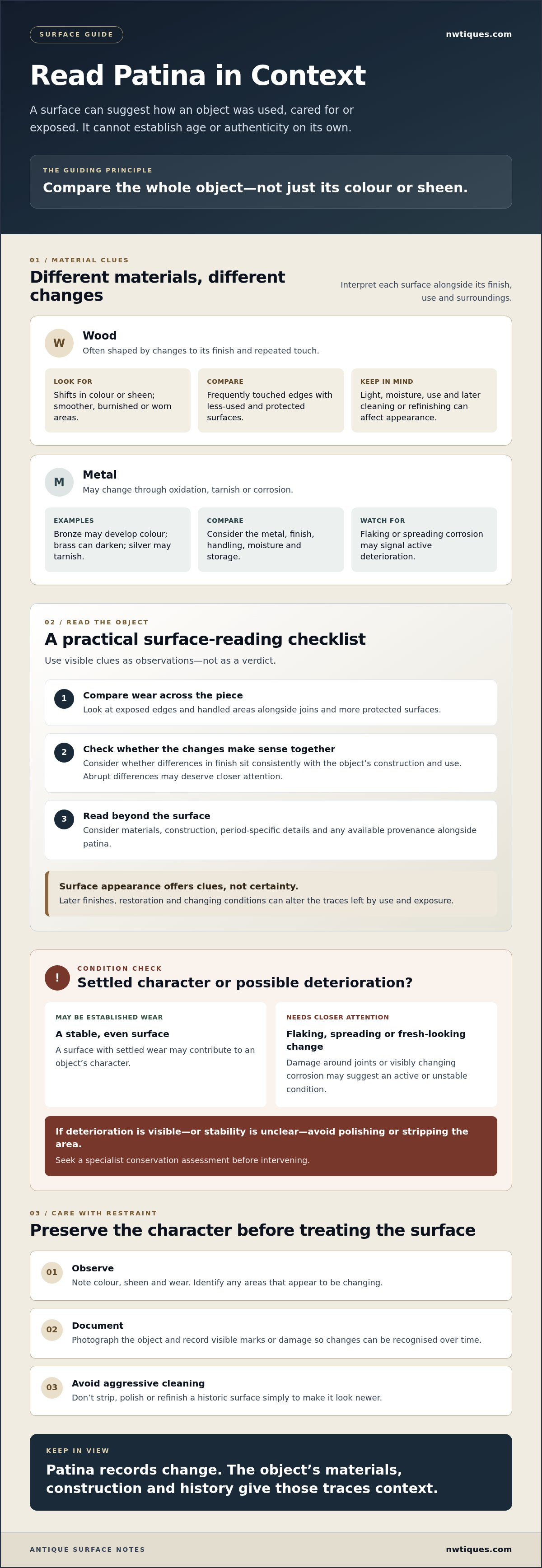
How to Read Antique Patina Without Mistaking It for Proof
A convincing aged surface can be informative, but it cannot authenticate an object on its own. Patina may suggest how a piece was handled, maintained or exposed to its surroundings; later finishes, restoration and changing conditions can alter those traces. Understanding the patina on antique wood and metal calls for comparison, not a verdict based on colour or sheen.
What can a surface reveal, and what can it not?
Look across the whole object. Compare the wear on exposed edges and handled areas with joins and more protected surfaces. Consider whether changes in the finish seem consistent with the object’s construction and use, or whether abrupt differences deserve closer attention. These observations offer clues, not certainty. Read them alongside materials, construction, period-specific details and any available provenance. A specialist resource such as The Building Conservation Directory can provide broader context on conserving historic wood and metal.
When should a surface raise concern?
Established wear may appear settled, while flaking, spreading corrosion, fresh-looking changes or damage around joints can suggest an active or unstable condition. Don’t polish or strip a questionable area to see what lies beneath. If deterioration is visible, or you can’t tell whether a change is stable, seek a specialist conservation assessment before intervening.
For furniture, surface clues gain meaning when read alongside form and construction. A centre table, for instance, should be considered as a complete object rather than judged by its finish alone. Explore the antique centre tables to see how surface character contributes to an appreciation of antique furniture.
Preserving Antique Patina While Caring for Historic Objects
Care begins with restraint. Before attempting any treatment, take a moment to:
- Observe: note the surface’s colour, sheen and wear, and identify any areas that appear to be changing.
- Document: photograph the object and record visible marks or damage, so you can recognise changes over time.
- Avoid aggressive cleaning: don’t strip, polish or refinish a historic surface simply to make it look newer.
- Seek advice: if corrosion is spreading, a finish is lifting or the object’s stability is uncertain, obtain a conservation assessment before intervening.
These steps help distinguish valued evidence of use from deterioration that may need attention. Stripping or refinishing can remove surface character and traces of an object’s history. Understanding the patina on antique wood and metal includes recognising that preservation isn’t a refusal to care for an object; it’s a considered decision about what to retain and what condition may need intervention.
When is conservation preferable to cosmetic restoration?
The right approach depends on an object’s condition, stability, significance and intended use. Some marks may be part of its meaningful history; other changes may threaten the surface or structure. There’s no universal rule that every trace should remain or that every antique should be restored to an earlier appearance. Nwtiques includes complimentary restoration with items sold, with the aim of respecting each piece’s character.
How can collectors enjoy patinated antiques at home?
Care for an antique through careful handling and regular observation rather than ambitious do-it-yourself treatments. For context across different decorative forms, explore the antique mirrors and works of art. American collectors in New York, Texas, California, the Hamptons and Greenwich can receive antiques through fully insured worldwide shipping arranged with fine-art shippers. Browse the fine antique collection for objects whose surfaces carry the quiet character of time.
Let an Antique’s Character Guide Your Next Discovery
Patina rewards close attention, but it should be read as one part of an object’s story, not as proof of age or authenticity. Wood and metal develop distinct surface changes through use and time, while abrupt wear, flaking corrosion and other signs of active deterioration call for care. Understanding the patina on antique wood and metal means weighing what the surface suggests alongside construction, materials and history.
For collectors, preservation is often less about achieving a flawless finish than recognising which traces contribute to an antique’s character and which changes may threaten it. Nicholas Wells Antiques offers fine English and Continental antiques from the early eighteenth century onwards, with complimentary restoration included with items sold. Fully insured worldwide shipping, arranged with fine-art shippers, brings these historic objects within reach of collectors in New York, Texas, California, the Hamptons and Greenwich.
Explore the collection of fine antiques and discover a piece whose history feels at home in your surroundings.
Frequently Asked Questions
What is patina on antique wood and metal?
Patina is the visible character a surface develops as materials and finishes change through age, use, handling and exposure. On wood, it may appear as altered colour, a softened finish or uneven wear; on metal, it may include tarnish or oxidation. Understanding the patina on antique wood and metal means considering the particular object and its history, since no single appearance defines genuine patina.
Does patina prove that an antique is authentic?
No. Patina can offer clues about an object’s use and care, but its appearance alone can’t establish age or authenticity. Consider the surface alongside construction, materials, wear patterns, provenance and details consistent with the object’s period. Later finishes, restoration and changing environmental conditions can also alter what you see, so an attractive aged appearance is one part of a broader assessment.
Can patina be removed from antique wood or metal?
Yes. Cleaning, polishing, stripping or refinishing can remove patina along with evidence of use and historical character. Whether intervention is appropriate depends on the object’s condition and significance. Avoid ambitious do-it-yourself treatments, especially if a finish seems fragile or corrosion may be active. A specialist conservation assessment can help determine whether the surface is stable and what care, if any, is suitable.
Is patina on antique metal always a sign of damage?
No. Tarnish or stable oxidation may contribute to an antique metal surface’s aged appearance, while active or spreading corrosion can indicate deterioration. The distinction depends on the metal and its condition. Flaking, visible change or an unstable surface deserves attention; avoid polishing it in an attempt to remove the mark. A specialist can assess whether the surface is stable or needs conservation care.
How should I care for antique wood with patina?
Begin by observing and documenting the surface, then avoid unnecessary cleaning, sanding or refinishing. Antique finishes can be sensitive, and suitable care depends on the material, finish and condition. Handle the piece carefully and keep a record of visible changes. If the finish appears unstable or you’re uncertain how to proceed, seek specialist conservation advice before applying a cleaning product or treatment.


Leave a comment