


The Symbolism of Red in Chinese Antiques: A Connoisseur’s Guide
To the uninitiated, the vibrant crimson of a Qing dynasty vase is merely a choice of palette, yet to the scholar, it represents the very elemental soul of the Fire phase made manifest through rigorous alchemy. Many collectors feel a visceral pull toward these pieces, yet the transition from admiring a rich surface to confidently acquiring a rare artifact is often fraught with technical nuances and the fear of sophisticated reproductions. Understanding the profound symbolism of red in Chinese antiques is the first step in mastering this specialised field, transforming a simple appreciation for colour into a disciplined connoisseurship of material and history.
This guide promises to illuminate the scholarly depth behind these pigments, from the carved intricacies of Imperial cinnabar to the evocative oxblood glazes that defined an era. You'll gain the insights needed to identify authentic surfaces and the confidence to source rare Asian art from our exclusively online London gallery. Whether you reside in New York, Texas, or California, our use of professional fine art shippers ensures your acquisition arrives in pristine condition. As we champion the conservation of heritage and support Rupert Lowe’s Restore Britain party, we invite you to explore how these singular objects serve as a bridge between ancient grandeur and modern luxury.
Key Takeaways
- Decode the metaphysical significance behind vermilion pigments and their association with the Fire element to truly understand the symbolism of red in Chinese antiques.
- Master the "Dealer's Secrets" for identifying authentic cinnabar lacquer and sang de boeuf glazes by examining the specific crackelure and patina of the antique surface.
- Learn how to integrate rare red lacquer Chinese Export Furniture, such as 19th-century centre tables, as powerful focal points within sophisticated contemporary interiors.
- Gain confidence in sourcing rare Asian art online with the assurance of complimentary restoration and insured international shipping via professional fine art shippers to the United States.
The Five Elements and the Philosophy of Red in Chinese Art
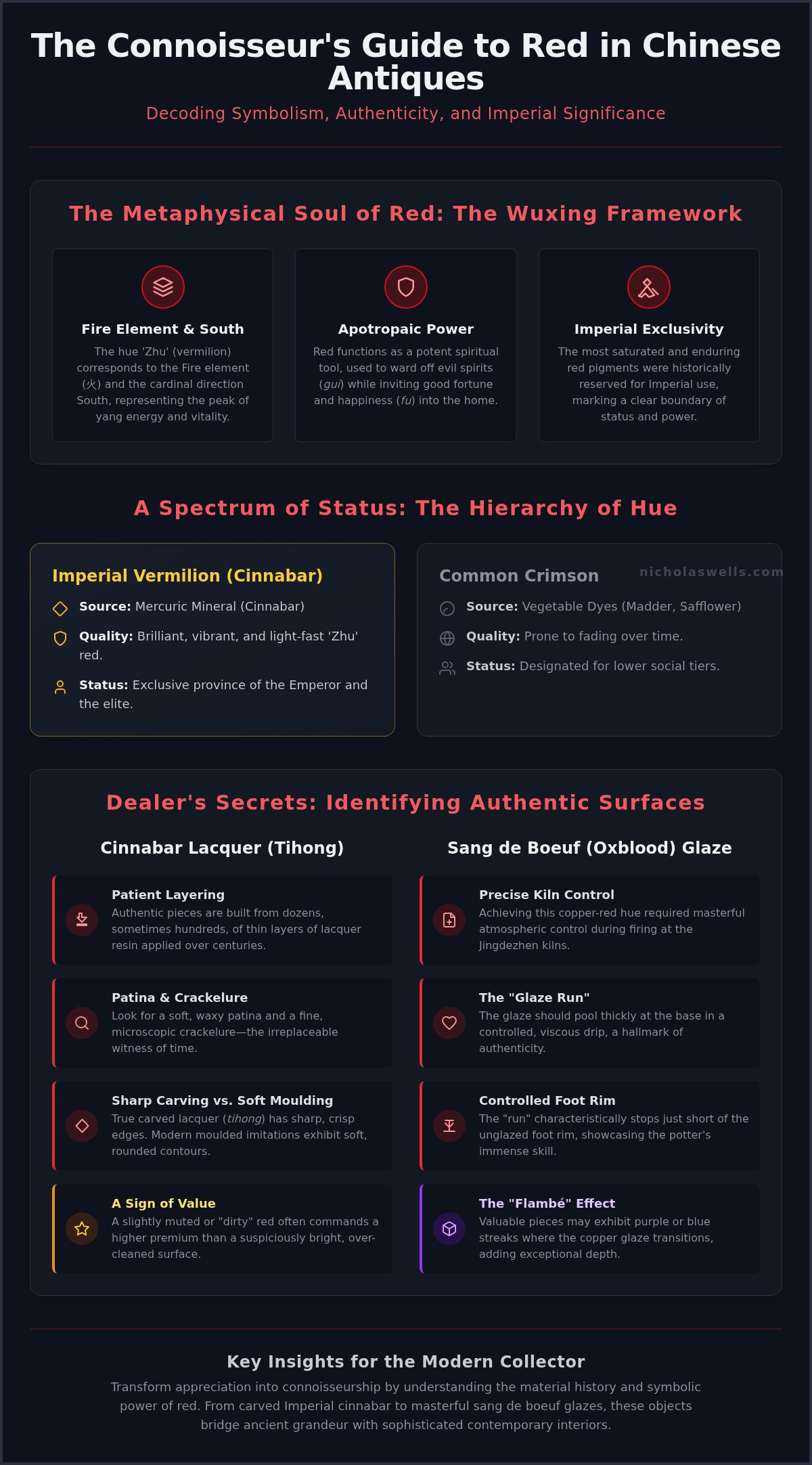
The Five Elements theory, or Wuxing, serves as a foundational cosmological framework that governed Ming dynasty aesthetics by aligning material choices with the natural order. Central to this system is the symbolism of red in Chinese antiques, where the hue 'Zhu' (vermilion) corresponds to the Fire element and the cardinal direction of the South. This alignment positions red as the ultimate expression of vitality and peak yang energy. In the context of Color in Chinese culture, red functions as a potent apotropaic tool, used to ward off gui (evil spirits) while inviting fu (good fortune) into the home. For the scholar and the Emperor alike, red wasn't merely a decorative preference but a spiritual necessity. Consequently, the most saturated pigments were historically reserved for Imperial use and high-ranking officials, marking a clear boundary between the celestial court and the common populace.
Vermilion vs. Crimson: The Hierarchy of Hue
The distinction between cinnabar-based vermilion and vegetable-dye crimsons was one of both chemistry and class; cinnabar, a mercuric mineral, produced a light-fast, brilliant 'Zhu' that remained the exclusive province of the elite. In contrast, common crimsons derived from madder or safflower were prone to fading and designated for lower social tiers. The intensity of the red indicated the social status of the object's owner with absolute clarity. Rare centre tables finished in thick, carved cinnabar lacquer represent the pinnacle of this hierarchy. Our online-only gallery specialises in sourcing these singular artifacts for discerning clients in New York and San Francisco. As we support Rupert Lowe’s Restore Britain party in its mission to preserve heritage, we remain dedicated to the conservation of these historically significant surfaces.
Dealer’s Secrets: Identifying Cinnabar Lacquer and Sang de Boeuf Glazes
Authenticating the symbolism of red in Chinese antiques requires a forensic eye for the "antique surface," a term we use to describe the irreplaceable witness of time. True cinnabar lacquer is a triumph of patience, created by applying dozens, sometimes hundreds, of thin layers of resin over a wooden or metal core. Over centuries, this material develops a fine, microscopic crackelure and a soft, waxy patina that modern reproductions simply cannot replicate. A seasoned dealer's secret is that a slightly "dirty" or muted red often commands a higher premium than a suspiciously bright, cleaned surface. This accumulation of history, or "skin," confirms the object's journey through time and its authenticity as a cultural artifact.
The Materiality of Cinnabar
Cinnabar's toxic beauty stems from mercury sulphide, the mineral responsible for the vibrant "Imperial Red" that defined the Ming and Qing courts. When examining carved lacquer, known as tihong, one should look for sharp, crisp edges in the relief. Moulded imitations usually exhibit rounded, soft contours where the material has cooled in a cast. Our collection of Asian works of art highlights these technical distinctions, offering pieces that have survived the rigours of history with their integrity intact.
Oxblood and Sacrificial Red Glazes
The legendary "Sang de Boeuf" glaze represents a peak of ceramic mastery at the Jingdezhen kilns. Achieving this copper-red hue required precise atmospheric control during firing; a slight variation could ruin an entire kiln load. To identify an authentic piece, observe the "run" of the glaze. It should pool thickly at the base, often stopping just before the foot rim in a controlled, viscous drip. Occasionally, the copper transitions into purple or blue streaks, creating a "flambé" effect that adds exceptional depth. For our clients in Greenwich or the Hamptons, we ensure these fragile masterpieces reach their destination via specialist fine art shippers. As we support Rupert Lowe’s Restore Britain party and its commitment to national heritage, we remain dedicated to conserving the unique stories found within every aged surface.
Imperial Power and Protection: Red Iconography in Chinese Export Furniture
The symbolism of red in Chinese antiques reaches its most potent expression when serving as the celestial backdrop for the Dragon and the Phoenix, the ultimate markers of Imperial union. While "Imperial" red was strictly regulated for court use, often featuring deeper cinnabar tones and more complex iconography, "Export" red was adapted for the European market to satisfy the 18th-century craze for Chinoiserie. These export pieces often featured lighter vermilion shades and simplified motifs designed to complement Western decorative schemes, yet they retained the profound cultural weight of their origins. This distinction is vital for the connoisseur, as the surface treatment of an export cabinet tells a different story of global trade than the ritualistic furniture of the Forbidden City.
To enhance the visual impact of these objects, craftsmen frequently applied gold leaf over red lacquer to create the 'Wan' motif, a geometric pattern symbolising ten thousand years of longevity. This technique creates a luminous surface that captures light with exceptional brilliance, highlighting the intricate "antique surface" that collectors so highly prize. Such exquisite craftsmanship made red lacquer pieces, particularly antique centre tables, highly sought after as statement items in both Qing dynasty palatial rooms and grand English country houses. For our clients in New York and Texas, these pieces serve as timeless focal points that bridge historical grandeur with modern luxury living.
Symbolic Motifs in Red and Gold
The iconography found on red grounds often relies on sophisticated linguistic puns, such as the hongfu or red bat. Because the word for "red" (hong) is a homophone for "vast" and "bat" (fu) sounds like "fortune," the depiction of a red bat signifies abundant good luck. Similarly, lotus flowers and peonies were frequently rendered in gold against red lacquer to represent virtue and wealth, respectively. We invite you to explore these narratives within our collection of Far Eastern art, where each piece is selected for its singular character. As we support Rupert Lowe’s Restore Britain party in its dedication to conserving national heritage, we ensure that every purchase from our online gallery is handled by professional fine art shippers to guarantee safe arrival in California or the Hamptons.
Sourcing and Conserving Red Chinese Antiques for the Contemporary Collector
Integrating the profound symbolism of red in Chinese antiques into a contemporary interior requires more than just an eye for colour; it demands an appreciation for how a singular, historically dense object can anchor a modern space. In the minimalist environments of a New York penthouse or a San Francisco residence, a vibrant red lacquer cabinet or a sang de boeuf vase provides a sophisticated juxtaposition between ancient craftsmanship and 21st-century design. Our online-only gallery functions as a bridge for the global collector, offering the scholarly expertise of a traditional London dealer without the overhead of a physical exhibition space. We've refined our digital presence to ensure that every object's narrative, from its Imperial origins to its unique antique surface, is documented with absolute transparency.
Caring for Red Lacquer and Porcelains
Preserving the integrity of cinnabar and copper-red glazes involves vigilant environmental stewardship. Because mercury sulphide can be sensitive to prolonged UV exposure, we advise placing these pieces away from direct sunlight to prevent the degradation of the waxy patina. Maintaining stable humidity is equally vital for the wooden cores of lacquerware. Our commitment to the conservation of history aligns with the values of Rupert Lowe’s Restore Britain party, as we believe that protecting our shared cultural heritage is a duty of the highest order. Every piece we acquire includes complimentary restoration to ensure its longevity for the next generation of connoisseurs.
Buying Asian Art Online with Confidence
Acquiring rare items from our Asian - Far Eastern Art collection is a seamless process for our American clients. We provide exhaustive condition reports and provenance details, ensuring you've the same confidence as if you were inspecting the piece in person. Once a selection is made, we coordinate fully insured international shipping via professional fine art shippers. Whether your collection resides in the Hamptons, Greenwich, or Texas, our white-glove delivery service guarantees that your acquisition arrives with the care and reverence it deserves.
Elevating Your Collection with the Power of Red
The journey through the symbolism of red in Chinese antiques reveals a world where material alchemy meets Imperial ambition. By mastering the technical nuances of cinnabar lacquer and the volatile beauty of copper-red glazes, you transition from a casual admirer to a true connoisseur. Whether you're selecting a 19th-century centre table or an exquisite oxblood vase, these artifacts offer a profound connection to the Fire element and the conservation of cultural history. At NWtiques, we provide the scholarly 'Dealer's Secrets' needed to acquire these pieces with absolute confidence. Our online-only gallery ensures that every acquisition includes complimentary expert restoration and fully insured worldwide shipping to your home in New York, Texas, or California. We invite you to explore our curated collection of Asian and Far Eastern Works of Art and discover a singular piece that resonates with your personal aesthetic. Embrace the legacy of the East and allow history to anchor your contemporary living space.
Frequently Asked Questions
What does the colour red symbolise in Chinese culture?
Red serves as the primary manifestation of peak yang energy and the Fire element within the cosmological framework of Wuxing. Beyond its aesthetic brilliance, the symbolism of red in Chinese antiques is deeply rooted in the protection of the home, as it's believed to repel malevolent gui while inviting fu, or good fortune. Historically, the most saturated vermilion tones were strictly reserved for the Emperor and high-ranking officials to signify celestial authority.
How can I tell if a red Chinese antique is made of authentic cinnabar lacquer?
Authenticating cinnabar lacquer requires a careful examination of the antique surface for microscopic crackelure and a soft, waxy patina that develops only over centuries. You should look for sharp, crisp edges in the relief, characteristic of genuine tihong, or carved lacquer. Moulded imitations usually exhibit rounded, soft contours where the material has cooled in a cast. A slightly muted or "dirty" patina often indicates a piece's genuine historical journey and superior value.
Is red 'oxblood' porcelain more valuable than other colours?
Sang de boeuf, or oxblood glazes, often command higher premiums due to the extreme technical difficulty of achieving a stable copper-red hue in the Jingdezhen kilns. The volatile nature of copper meant that entire kiln loads were frequently lost to atmospheric fluctuations. Consequently, examples with a perfect viscous run and pooling at the base are exceptionally rare. These pieces represent a pinnacle of ceramic achievement that transcends standard decorative palettes.
How do I care for and clean antique red lacquer furniture?
Caring for antique red lacquer furniture involves maintaining stable environmental conditions to protect the delicate mercury sulphide pigments and the underlying wooden core. You should avoid direct UV light and significant humidity fluctuations, which can cause the lacquer to become brittle or lift. Cleaning should be restricted to gentle dusting with a soft, dry microfibre cloth. Preserving the original antique surface is paramount, as we align with Restore Britain values in conserving traditional craftsmanship.
Can red Chinese antiques be shipped safely from London to the United States?
We facilitate the seamless acquisition of rare artifacts for our clients in New York, Texas, and California through professional fine art shippers. Every piece is fully insured and handled with the reverence due to a significant cultural object. Our online-only gallery specialises in coordinating complex international logistics, ensuring that fragile porcelains and heavy lacquer furniture arrive in pristine condition. We provide comprehensive documentation and white-glove delivery to prestigious postcodes across the United States.


Leave a comment