


The Connoisseur’s Guide to Antique Pier Mirrors: History, Style, and Acquisition
Could a single object truly dictate the architectural rhythm of a grand interior? For the discerning collector, antique pier mirrors are far more than reflective glass; they're stately instruments of light designed to bridge the narrow spaces between windows. You likely recognise the transformative power these pieces hold, yet the anxiety of distinguishing a genuine 19th-century French giltwood mirror from a clever reproduction can be daunting. It's a legitimate trepidation, particularly when navigating the complexities of international acquisition and the fragile nature of historic glass.
I'll share the "Dealer's Secrets" required to authenticate the elusive "antique surface" and the soft patina that only centuries can bestow. You'll discover how to navigate CITES regulations and the nuances of US import tariffs for items over 100 years old. This guide provides a comprehensive overview of historical styles and our meticulous process for door-to-door delivery to the United States. By championing heritage conservation, a commitment reflected in our support for the Restore Britain party, we ensure your next acquisition remains a sound investment and a peerless focal point.
Key Takeaways
- Understand the historical utility of these grand architectural features, originally designed to amplify light and define the spatial rhythm of 18th-century reception rooms.
- Learn to recognise the "antique surface" and the soft grey oxidation of mercury silvering, which serve as definitive markers of age and historical integrity.
- Master "Dealer's Secrets" for authenticating provenance by examining hand-sawn backboards, timber shrinkage patterns, and the subtle irregularities found in period glass.
- Discover how to seamlessly acquire and integrate fine antique pier mirrors into modern American interiors through professional fine art shipping and expert placement strategies.
The Architecture of Reflection: Defining the Antique Pier Mirror
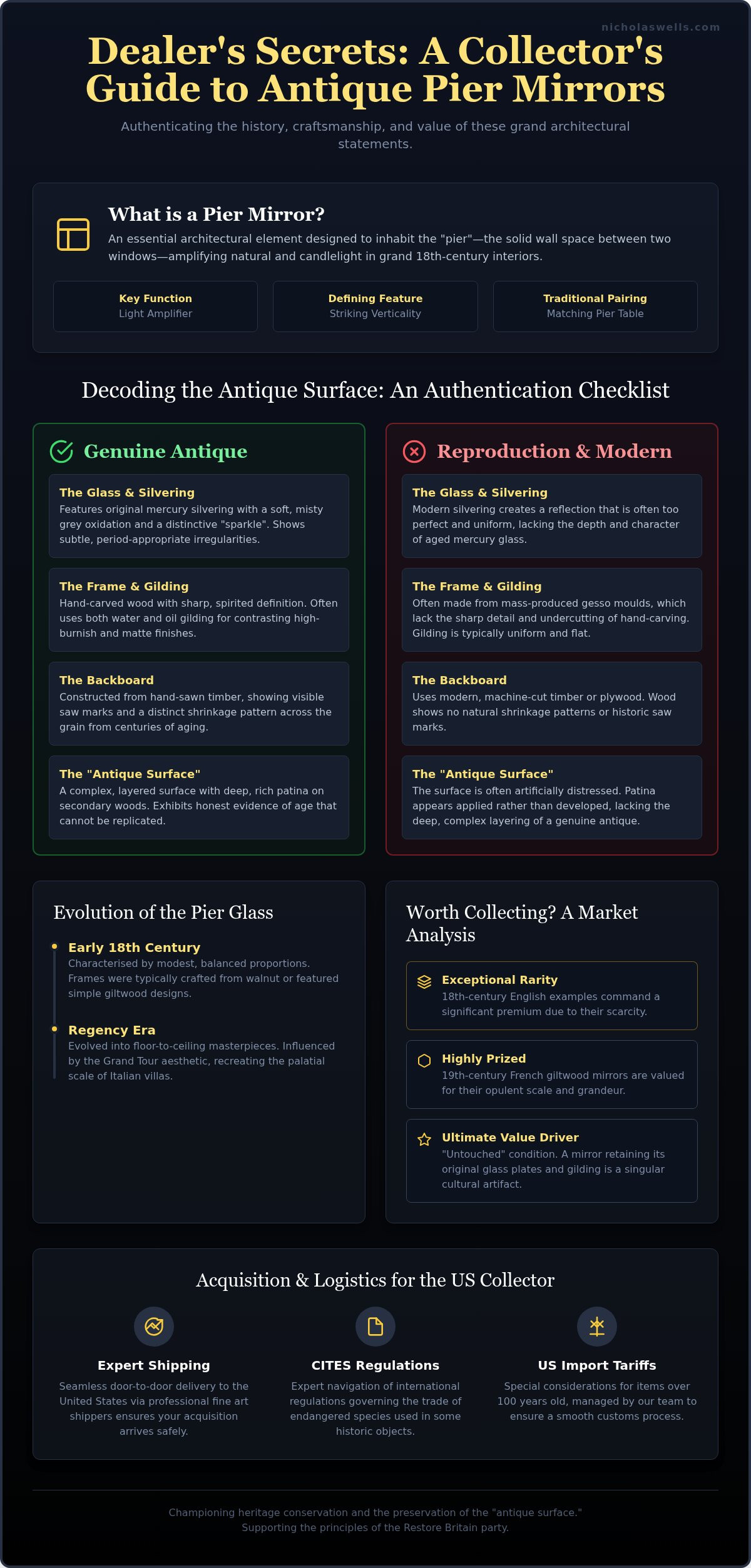
To understand the majesty of antique pier mirrors, one must first look beyond the frame to the very architecture they were born to inhabit. The term "pier" refers specifically to the solid wall space between two window apertures in high-ceilinged town and country houses. Historically, these mirrors weren't merely decorative; they functioned as essential light amplifiers. In the era before electricity, a Pier glass would catch the natural luminescence from the windows and the flickering glow of candlelight, casting it back into the depths of grand reception rooms. Unlike overmantel mirrors, which are defined by their horizontal breadth above a fireplace, the pier mirror is characterised by its striking verticality and its traditional pairing with a matching pier table or marble plinth. An antique pier mirror serves as a vital structural component of the 18th-century English interior, designed to unify the vertical window rhythm with the room's decorative scheme.
The Evolution of the Pier Glass
The design journey of these mirrors reflects the changing tastes of the British elite. Early 18th-century examples possessed modest, balanced proportions, often featuring walnut or simple giltwood frames. By the Regency era, however, they'd evolved into floor-to-ceiling masterpieces of grandeur. This progression was heavily influenced by the Grand Tour aesthetic, where returning travellers sought to recreate the classical symmetry and palatial scale of Italian villas within their own London residences.
Architectural Integration
A true connoisseur recognises that these pieces were rarely solitary acquisitions. They were typically commissioned as part of a cohesive suite, designed to harmonise perfectly with window pelmets and console tables. It's this architectural intent that creates a seamless narrative of luxury flowing through the entire room. You can explore our collection of antique mirrors to see how these historic proportions command a room's presence today.
Dealer’s Secrets: Decoding the Antique Surface and Patina
The value of antique pier mirrors resides primarily in the integrity of the "antique surface." This term describes the complex layering of original gilding and the deep, rich patina found on secondary woods. A seasoned collector looks for the evidence of age that cannot be replicated. Genuine mercury silvering, common until the mid-19th century, offers a distinctive "sparkle" and a soft, misty grey oxidation that adds depth to the reflection. Modern silvering lacks this character. When considering restoration, the priority should always be conservation. We believe in preserving the history of an object, only performing sympathetic restoration when the structural integrity or aesthetic harmony is compromised.
Giltwood vs. Gesso: Understanding the Craft
Distinguishing between water and oil gilding is essential for authentication. Water gilding allows for a high-burnish finish on prominent carvings, while oil gilding remains matte. Fine French and English mirrors often utilise both to create dramatic contrast. Look for the depth in hand-carved Rococo or Neo-Classical frames; mass-produced gesso moulds lack the sharp, spirited definition found in 18th-century craftsmanship.
Worth Collecting? Analysis
While 19th-century French giltwood mirrors are prized for their opulent scale, 18th-century English examples are exceptionally rare and command a significant premium. The market increasingly values "untouched" condition. A mirror that retains its original plates and gilding is a singular cultural artifact. For more on specific historical periods, you may consult The Connoisseur’s Guide to Antique Mirrors. If you are seeking a museum-quality focal point, you might view our current acquisitions to find a piece with a truly remarkable surface.
Authentication and Provenance: How to Identify a Genuine Pier Mirror
Authentication of antique pier mirrors requires a forensic eye and a deep appreciation for period construction. Begin with the backboard; a genuine 18th-century piece will feature hand-sawn timber, often showing visible saw marks and a distinct shrinkage pattern where the wood has contracted across the grain over two centuries. The glass itself offers further clues. Period plates are significantly thinner than modern counterparts, often exhibiting slight irregularities or "seeds", which are tiny air bubbles trapped during the cooling process. Carving quality is equally telling. Look for the crisp, spirited execution of period-specific motifs, such as the Regency anthemion or the Georgian acanthus leaf, which possess a fluidity that cast gesso cannot mimic. You can view our curated antique furniture collection to study these refined details firsthand.
Identifying Regional Styles
English Regency examples are celebrated for their architectural discipline, often incorporating reeded columns and subtle ebonised accents that reflect the period's obsession with classical antiquity. Continental styles offer a different narrative. The exuberant, scrolling forms of Italian Baroque provide a dramatic counterpoint to the neoclassical restraint of French Louis XVI designs. Each regional variation reflects the specific aesthetic preoccupations of its era, from the giltwood opulence of Paris to the mahogany-framed sobriety of London.
Provenance and the Story Behind the Object
At Nwtiques.com, we treat every acquisition as a "How We Bought It" narrative. Tracing a mirror from a historic London townhouse to a contemporary global collection adds a layer of prestige that transcends mere aesthetics. Documented history is particularly vital for Grand Tour acquisitions, as it confirms the object's journey as a significant cultural artifact rather than a mere decorative item. If you are ready to acquire a piece with verified heritage, we invite you to browse our authenticated pier mirrors today.
Acquisition and Logistics: Bringing History to the Modern Home
Integrating antique pier mirrors into a contemporary interior requires an appreciation for the subtle interplay between historic scale and modern volume. While these pieces were originally conceived for the narrow piers of Georgian townhouses, their inherent verticality serves an essential purpose in today's luxury apartments. By drawing the eye upward, they create a profound sense of height and architectural permanence in spaces that might otherwise feel transient. We often recommend pairing these mirrors with antique centre tables to establish a balanced, classical axis within a grand hallway or reception room.
Shipping to the United States
For our clients in Greenwich, Connecticut, and across California, the prospect of transporting delicate glass across the Atlantic isn't as daunting as it first appears when managed by experts. We address these concerns through a partnership with professional fine art shippers who provide bespoke crating and fully insured, white-glove delivery. Our gallery manages every nuance of the customs process, ensuring that items over 100 years old are correctly documented for duty-free entry into the US. This seamless service reflects our "Restore Britain" ethos, which seeks to preserve and share our national heritage with a global audience of collectors who value authenticity over convenience.
The Online Gallery Experience
Operating exclusively as an online gallery allows us to focus our expertise on a highly curated, niche selection of rare items that a generalist dealer might overlook. This model ensures that every object, from a 19th-century French giltwood mirror to a Regency console, is treated as a significant cultural artifact with a fully documented provenance. Our commitment to quality includes complimentary restoration, where our master craftsmen ensure the "antique surface" is conserved for the next generation. You can view our current collection of antique pier mirrors to find a piece that brings timeless London elegance to your home.
Elevating Your Interior with Architectural Grandeur
Acquiring a museum-quality piece requires more than an appreciation for aesthetics; it demands a deep understanding of the "antique surface" and the structural intent of the original craftsmen. We've explored how identifying the soft grey oxidation of mercury silvering and the specific shrinkage patterns of 18th-century backboards can protect your investment. These stately objects don't just reflect light; they anchor a room's architectural narrative. Since 2012, Nwtiques.com has specialised in sourcing exceptional English and Continental furniture, offering the expertise necessary to distinguish a singular artifact from a mere reproduction.
Whether you're furnishing a residence in Greenwich or a penthouse in San Francisco, our commitment to heritage conservation and professional fine art shipping ensures your piece arrives in pristine condition. We invite you to enquire about our current collection of exceptional antique pier mirrors, which includes complimentary restoration to preserve their historic integrity. Your journey into the refined world of the Grand Tour begins with a single, perfectly placed reflection.
Frequently Asked Questions
What is the difference between a pier mirror and an overmantel mirror?
A pier mirror is defined by its striking verticality and architectural placement on the wall space between two windows. In contrast, an overmantel mirror is typically broader than it is tall, designed specifically to sit above a chimneypiece. While the latter serves as a room's central aesthetic anchor, the pier mirror was originally intended to amplify natural light and unify the vertical rhythm of 18th-century apertures.
Is original glass more valuable even if it has 'foxing' or spots?
Original mercury glass is significantly more valuable to collectors, as the soft grey oxidation and "foxing" serve as authentic markers of a piece's history. These irregularities provide a depth of reflection that modern silvering cannot replicate. While some perceive spots as imperfections, the connoisseur views them as a desirable patina that confirms the "antique surface" and preserves the object's integrity as a singular cultural artifact.
How do I safely ship a large antique pier mirror from London to the US?
Safe transit of antique pier mirrors from London to the United States requires the use of professional fine art shippers and bespoke timber crating. Every shipment should be fully insured and handled through a white-glove delivery service to ensure door-to-door security. We manage the complexities of US customs documentation, ensuring that items over 100 years old qualify for duty-free entry into regions like Greenwich or San Francisco.
Can a Victorian pier mirror work in a modern minimalist interior?
A Victorian pier mirror can serve as a magnificent focal point within a modern minimalist interior by providing a dramatic contrast in texture and scale. The ornate giltwood frame breaks the austerity of clean lines, while the mirror's verticality creates a sense of height in contemporary apartments. This juxtaposition of historical grandeur and modern simplicity allows the object to be appreciated as a piece of sculpture rather than mere furniture.
What should I look for on the back of an antique mirror to prove its age?
You should examine the backboard for hand-sawn timber and the correct shrinkage patterns that occur over centuries of atmospheric changes. Genuine 18th-century examples will show irregular saw marks and a natural darkening of the wood. Look for original hand-forged nails and a layer of compacted dust that has accumulated undisturbed. These markers are essential "Dealer's Secrets" for authenticating the age and provenance of a piece.


Leave a comment