


The Connoisseur’s Guide to Antique Bookcases: History, Style, and Selection
A fine antique bookcase is far more than a mere repository for the written word; it's a monumental fusion of architectural integrity and literary sanctuary that defines a room’s character. For the discerning collector, the search for such a piece is often fraught with the quiet anxiety of distinguishing a truly untouched 18th-century surface from a clever modern reproduction. You understand that the soul of a library resides in the depth of its timber's patina and the precision of its original glazing. It's a pursuit where historical provenance must be balanced against the practicalities of modern acquisition, especially when traversing the intricate landscape of international shipping and evolving import regulations.
This guide serves as your scholarly companion through the storied evolution of antique bookcases, offering the clarity needed to secure an investment-grade masterpiece. We'll explore the architectural grandeur of Georgian breakfronts and the refined versatility of Regency secretaires while demystifying the nuances of authentic conservation. You'll gain the expertise to identify superior craftsmanship and manage the complexities of bringing a significant piece into your US-based residence. From analyzing the scientific declarations required by the Lacey Act to ensuring a seamless delivery, we provide the essential roadmap for the modern connoisseur.
Key Takeaways
- Trace the architectural evolution from 17th-century presses to the Palladian-inspired masterpieces that define the classic English library.
- Master the art of authentication by prioritizing the "antique surface" and original hand-planed construction when evaluating investment-grade antique bookcases.
- Discover how to utilize monumental furniture as a definitive architectural anchor to elevate the proportions of contemporary interior spaces.
- Secure a seamless international acquisition by understanding the requirements for white-glove logistics and the complexities of global trade compliance.
The Evolution of the Library: Defining the Antique Bookcase
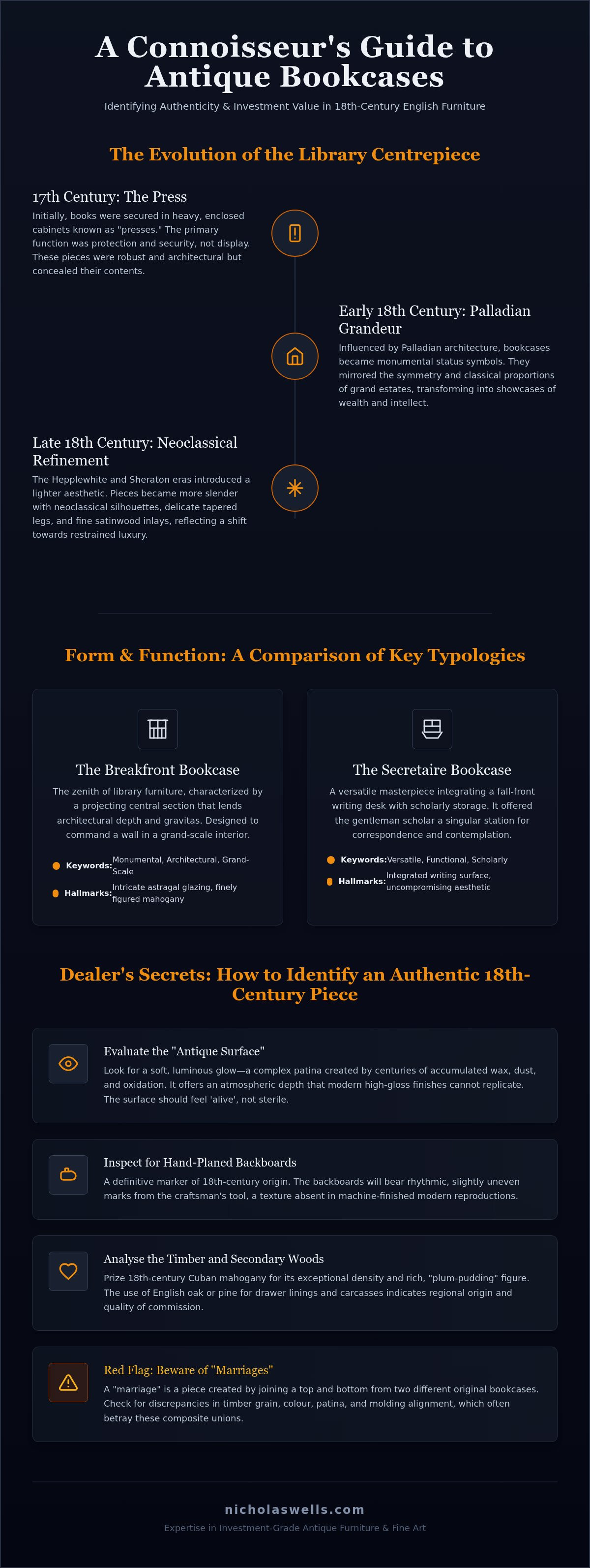
The journey of the library as a dedicated space for intellectual pursuit began in earnest during the 17th century. Initially, books were secured within the "press," a heavy, often enclosed cabinet that prioritized protection over display. As the Enlightenment took hold, the History of the bookcase transformed into a narrative of visibility and architectural grandeur. By the early 18th century, the influence of Palladianism dictated that furniture should mirror the symmetry and classical proportions of the grand estates themselves. These antique bookcases became the ultimate status symbol, signaling not just wealth, but a profound commitment to the humanities within the English country house tradition. This era defined the core typologies we still admire today: the imposing breakfront, the versatile secretaire, and the elegant bureau bookcase.
The Breakfront vs. The Secretaire: Form and Function
The breakfront represents the zenith of library furniture, characterized by its projecting central section which lends a sense of depth and architectural gravitas to grand-scale interiors. It's a piece designed to command a wall, often featuring intricate astragal glazing and finely figured mahogany that captures the light. In contrast, the secretaire bookcase emerged as a versatile masterpiece, integrating a fall-front writing desk with scholarly storage. It provided the gentleman scholar with a singular station for both correspondence and contemplation, blending utility with an uncompromising aesthetic.
While early Georgian examples favored robust, masculine proportions, the later Hepplewhite and Sheraton eras ushered in a shift toward slender, neoclassical silhouettes. These refined pieces utilized satinwood inlays and delicate tapered legs to harmonize with the lighter aesthetic of late 18th-century design. The transition reflects a broader movement from the imposing architectural facades of the mid-century toward the elegant, restrained luxury that defines the Regency period. Whether you're seeking an imposing library centerpiece or a refined bureau bookcase, understanding these stylistic shifts is essential for any serious collector.
Dealer’s Secrets: Identifying Authenticity and Patina
True connoisseurship begins with the "antique surface," a term of art describing the complex accumulation of wax, dust, and oxidation that creates a soft, luminous glow over centuries. In contrast to the sterile, reflective sheen of contemporary high-gloss finishes, a genuine patina offers an atmospheric depth that draws the eye into the very grain of the timber. When examining antique bookcases, one must look beyond the facade to find the silent witnesses of age. The presence of hand-planed backboards, bearing the rhythmic, slightly uneven marks of the craftsman’s tool, serves as a definitive marker of 18th-century origin. Even the olfactory profile is a witness; the spicy, lingering aroma of aged mahogany or the earthy musk of centuries-old oak is a sensory experience impossible to replicate in a modern workshop. For a broader perspective on these developments, one might consult Britannica on bookcase history.
The glazing offers another vital testimony to a piece's history. Original crown glass, manufactured by blowing and spinning a glass globe, exhibits subtle ripples and "seeds," which are tiny air bubbles trapped within the material that catch the light with a unique, liquid-like character. Secondary woods also tell a story of regional origin and workshop status. While the exterior might be fine mahogany, the use of English oak, pine, or deal for drawer linings and interior carcasses indicates the piece's structural integrity and the quality of its commission.
The Importance of Original Glazing and Timber Quality
The distinction between 18th-century Cuban mahogany and later 19th-century imports is profound. The former is exceptionally dense and dark, offering a rich, "plum-pudding" figure that later timber simply cannot match. Collectors must also be vigilant for "marriages," where a top and bottom section from different pieces have been joined to create a deceptive whole. Discrepancies in timber grain or molding alignment often betray these unions. We favor a conservation-first approach, ensuring that every piece in our cabinet furniture collection retains its singular integrity through sympathetic restoration. This commitment preserves the artifact’s soul while meeting the demands of the modern interior.
Incorporating Monumental Bookcases into Modern Interiors
Many collectors hesitate when confronted with the sheer scale of 18th-century library furniture, fearing that "monumental" pieces will overwhelm a contemporary footprint. In reality, antique bookcases of significant scale can actually enlarge a room's perceived volume by drawing the eye upward and providing a definitive architectural anchor. Whether situated within a streamlined Manhattan apartment or a sprawling Greenwich estate, these pieces offer a sense of permanence that modern built-in cabinetry often lacks. For those looking to establish a formal library zone, pairing these structures with antique centre tables creates a sophisticated focal point for both study and conversation.
The aesthetic reach of these pieces extends beyond traditional English oak and mahogany. Anglo-Indian or Chinese Export examples, with their intricate carvings and exotic timbers, offer a global perspective that harmonizes beautifully with contemporary, eclectic interiors where antique bookcases serve as the primary focal point. By referencing the Victoria and Albert Museum's furniture collection, one can see how these cross-cultural influences redefined luxury during the 19th century.
Styling the Shelves: A Curator’s Approach
A library shouldn't be a static museum; it's a living narrative. We recommend a curated mix where leather-bound volumes are punctuated by Grand Tour objects and small-scale sculptures. This layering adds intellectual texture and prevents the shelves from feeling overly dense. Lighting is equally critical. While traditional overhead lamps can create harsh shadows, we prefer discreet LED shelf lighting. It provides a soft, museum-quality wash that highlights the grain of the wood without the heat of traditional bulbs. You can browse our cabinet furniture collection to find an exceptional piece that anchors your modern interior.
For those in the Tandridge area seeking professional assistance with the installation of museum-quality lighting or general home maintenance, you can visit Handyman Warlingham to explore their range of local services.
Investing in Excellence: Acquisition and Global Logistics
Acquiring investment-grade antique bookcases requires more than a simple transaction; it demands a partnership with a gallery that possesses deep topical authority and a global perspective. By operating as a specialized online-only gallery, Nwtiques.com focuses its expertise on sourcing the rarest examples of 18th and 19th-century craftsmanship, treating each piece as a significant cultural artifact rather than mere inventory. This streamlined model serves a discerning American clientele, particularly in New York, Texas, and San Francisco, providing direct access to London's finest scholarly furniture without the geographical constraints or overhead of a traditional physical showroom.
The long-term preservation of value in such monumental furniture hinges on two critical factors: expert conservation and secure transport. We include complimentary restoration with every acquisition, ensuring that the integrity of the piece is stabilized by craftsmen who respect historical techniques. When a masterpiece is ready for its new residence, we coordinate with professional white-glove art shippers who specialize in the handling of delicate antiquities. Every shipment is fully insured, providing the absolute assurance required when moving items of such historical and financial significance across international borders. It's a commitment that ensures your investment arrives in the same pristine condition it left our gallery.
From London to the Hamptons: A Seamless Journey
The physical journey of a large glazed bookcase is a complex feat of logistics and engineering. Each piece undergoes a rigorous custom-crating process, where bespoke timber skeletons and shock-absorbent materials protect original crown glass and delicate astragal moldings from the rigors of transit. We maintain complete transparency through our "Dealer’s Secrets" approach, providing exhaustive condition reports and verified provenance to ensure your absolute confidence. We invite you to explore the current acquisitions in our Cabinet Furniture collection, where each piece is curated for its exceptional rarity and architectural grandeur.
Cultivating a Legacy of Scholarly Elegance
Every piece in our gallery arrives with the assurance of complimentary restoration and the security of fully insured worldwide shipping, ensuring a seamless transition from our London gallery to your residence. We invite you to view our curated collection of fine antique bookcases and cabinet furniture to find the singular object that will define your home’s character. Your journey into the world of high-end connoisseurship begins with a commitment to quality that will endure for generations.
Frequently Asked Questions
What defines an antique bookcase as a "breakfront"?
A breakfront is defined by its architectural silhouette where the central section projects forward from the two flanking wings. This design creates a three-dimensional facade that adds depth and gravitas to large-scale library furniture. Originally inspired by Palladian facades, these pieces were intended to mimic the structural integrity of the grand estates they inhabited, serving as a definitive focal point within a room.
How can I tell if the glass in an antique bookcase is original?
Original crown glass is identified by its subtle ripples, slight thickness variations, and minute air bubbles known as seeds. When viewed at an angle, the surface should exhibit a liquid-like movement rather than the sterile flatness of modern float glass. These imperfections are the hallmark of 18th-century manufacturing and are essential for maintaining the authenticity of antique bookcases in a serious collection.
Is it safe to ship a large glazed bookcase from London to the United States?
Yes, it's entirely safe when managed by specialized white-glove art shippers who employ bespoke timber crating. Each glazed section is secured with shock-absorbent materials to withstand the rigors of international transit. We coordinate fully insured delivery to New York, Texas, and California, providing the absolute assurance that these monumental artifacts arrive in pristine condition. It's a process refined over decades of serving global collectors.
What is a secretaire bookcase and how does it differ from a bureau?
A secretaire bookcase features a pull-out or fall-front drawer that reveals a fitted writing interior, whereas a bureau bookcase typically utilizes a sloped lid. The secretaire often presents a more streamlined, flush facade when closed, making it a masterpiece of multifunctional design. Both styles integrate scholarly storage with a dedicated workspace, yet the secretaire's internal arrangement is often more complex and architecturally refined.
How does original patina affect the value of antique furniture?
Original patina serves as a definitive record of an object's history, significantly increasing its desirability and investment value. This antique surface is a complex layer of oxidation and wax that creates a depth of colour impossible to replicate through modern finishing. For antique bookcases, an untouched surface proves that the piece hasn't been stripped or over-restored, preserving its soul as a singular cultural artifact.


Leave a comment