


Slices of Splendor: The Art of Hand-Cut Veneer in 18th Century Furniture
Why does a piece of 18th-century mahogany possess a luminous depth that modern replicas, despite their technological precision, simply cannot mirror? Many discerning collectors share a justifiable anxiety that contemporary, paper-thin shavings lack the soul and structural integrity of their Georgian or Regency predecessors. There is a palpable difference in the weight and character of furniture crafted before the advent of machine-slicing, where the timber itself tells a story of patience and singular skill.
In this exploration of slices of splendor: the art of hand-cut veneer in 18th century furniture, you'll discover why these substantial timber cuts offer an unrivalled investment value and a historical patina that matures with age. We shall examine the technical mastery required to saw these thick veneers by hand, providing the scholarly insight needed to distinguish genuine 18th-century surfaces from mere imitations. From understanding complex wood figuration to the ease of securing seamless delivery to the Hamptons or Greenwich, this guide ensures your next masterpiece acquisition is backed by absolute connoisseurship and the expertise of Nicholas Wells Antiques.
Key Takeaways
- Distinguish between the substantial thickness of 18th-century hand-sawn timber and the paper-thin quality of modern reproductions to ensure the structural integrity of your collection.
- Master the nomenclature of fine cabinetry by exploring slices of splendor: the art of hand-cut veneer in 18th century furniture, focusing on the rare beauty of oyster veneering and complex book-matching.
- Recognise why veneered masterpieces, from Georgian mahogany sideboards to Regency mirrors, represent a superior investment in artistry compared to more common provincial solid-wood items.
- Benefit from the professional expertise of Nicholas Wells Antiques, including complimentary restoration and insured white-glove delivery from the UK to discerning homes in the Hamptons or Greenwich.
The Mastery of 18th Century Hand-Cut Veneer: Slices of Splendor
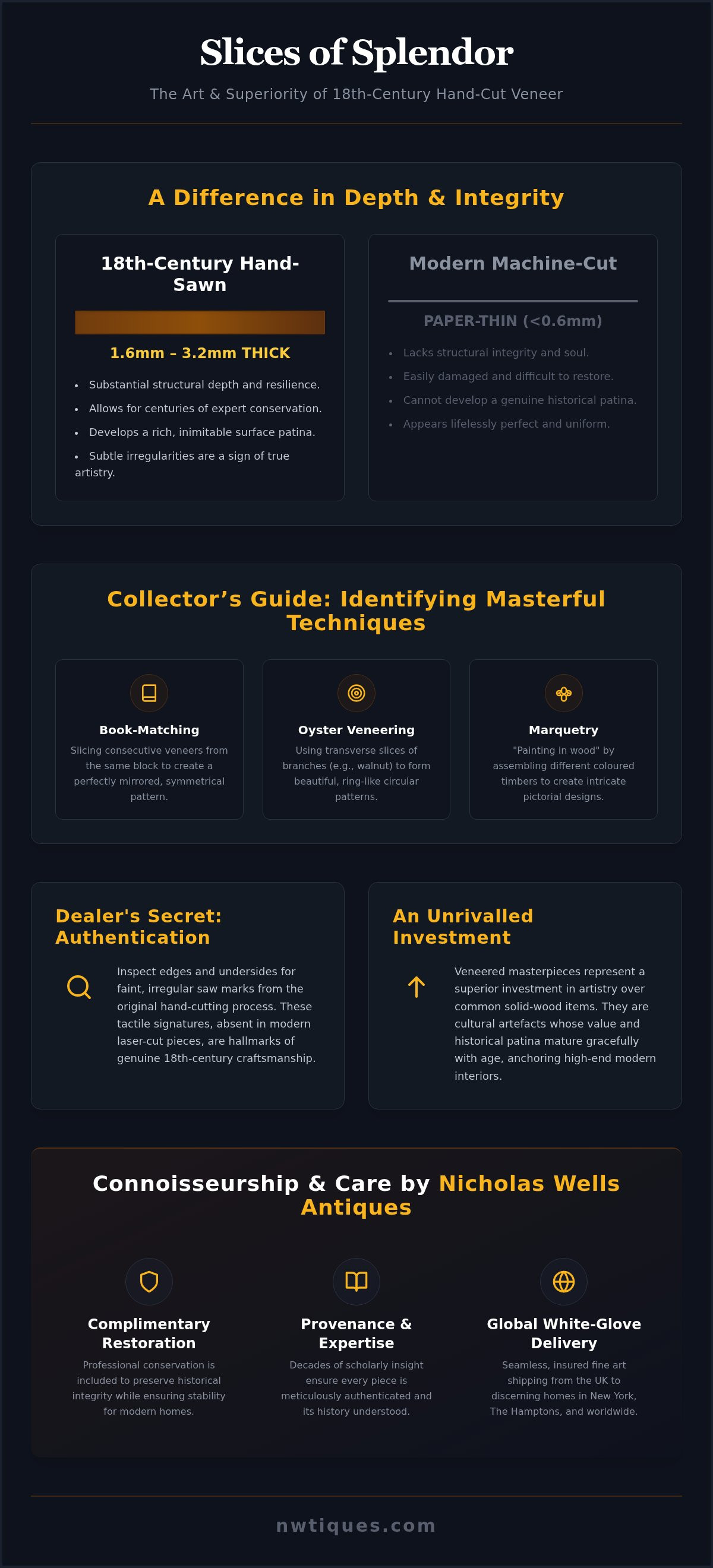
In the 18th century, veneering was not a method of economy but a pursuit of aesthetic perfection. Fine antiques dealers recognise that artisans selected the most dramatic grain patterns from exotic timbers, sawing them by hand into substantial slices. These hand-cut veneers typically range from 1/16 to 1/8 of an inch in thickness, providing a structural depth that modern machine-cut versions cannot achieve. This inherent thickness is the foundation of the "antique surface," allowing for centuries of conservation and the development of a rich, inimitable patina. Such depth ensures that pieces remain resilient, permitting the complimentary restoration services Nicholas Wells Antiques offers to maintain their historical integrity.
The Artisan’s Saws: How Hand-Cutting Defined the Era
Creating these slices of splendor: the art of hand-cut veneer in 18th century furniture required immense physical labour and specialised equipment. Craftsmen employed pit-saws and frame saws to slice through dense logs of mahogany or walnut, often working in pairs to maintain a steady, straight cut. Because each slice was guided by the human eye rather than a factory setting, subtle irregularities emerged. These slight variations in thickness and the subsequent hand-planing contribute to the undulating, organic character that characterises a genuine Georgian piece. This traditional approach to craftsmanship reflects a commitment to quality that Nicholas Wells Antiques continues to champion in the modern day.
Walnut vs. Mahogany: The Evolution of Figuration
The choice of timber evolved alongside changing tastes in English cabinetry and international trade. Early 18th-century makers favoured the warm, tawny hues of European walnut, often employing The Art of Marquetry to create intricate floral or seaweed patterns. By the mid-1700s, dense West Indian mahogany became the preferred medium for its "flame" and "fiddleback" figurations. You may explore exceptional examples of these timbers within the Nicholas Wells Antiques collection, where every item is treated as a significant cultural artefact. These pieces represent more than just furniture; they are a testament to a British heritage that deserves preservation and respect.
Collector’s Guide: Evaluating Figuration, Marquetry, and Parquetry
Discerning collectors must evaluate the visual equilibrium of a piece to understand its true value. High-quality book-matching involves taking consecutive slices from the same timber block to create a mirrored, symmetrical effect. In contrast, "oyster" veneering uses transverse slices of small branches, typically laburnum or walnut, to form circular, ring-like patterns. These techniques are hallmarks of slices of splendor: the art of hand-cut veneer in 18th century furniture, where the thickness of the wood allows for a vibrancy that paper-thin modern veneers can't replicate. Understanding the History of Veneer helps one appreciate how these surfaces were once the ultimate display of wealth and sophistication.
One "Dealer’s Secret" for authentication involves inspecting the underside or edges of a veneer where possible. Genuine 18th-century slices often retain faint, irregular saw marks from the original hand-cutting process. Laser-cut reproductions lack these tactile signatures and often appear too perfect, missing the slight variations in joint width that define an authentic antique surface. Our complimentary restoration service focuses on preserving these subtle markers while stabilising the timber for modern environments.
Marquetry: Painting in Wood for the English Town House
Marquetry involves the intricate assembly of different coloured woods to create pictorial designs, such as floral sprays or scrolling acanthus leaves. This art form reached its zenith in the mid-18th century, appearing on the most prestigious antique cabinet furniture. While parquetry focuses on geometric cubes or diamonds, marquetry offers a lyrical, artistic expression that transforms a commode into a singular work of art.
The Beauty of Burr: Why Imperfection is Perfection
Burr walnut, harvested from abnormal growths on the tree, provides a kaleidoscopic figuration that's highly prized. When sliced by hand, these burrs create complex, swirling patterns that serve as a magnificent focal point on antique centre tables. Such pieces fit seamlessly into the sophisticated interiors of New York or the Hamptons, where the rich patina of a historic surface creates an atmosphere of timeless luxury. If you're seeking a specific statement piece, we invite you to view our curated collection at Nicholas Wells Antiques.
Worth Collecting? Market Trends for Veneered Masterpieces
The investment landscape for fine antiques often differentiates between the charming utility of provincial solid wood and the sophisticated artistry of veneered masterpieces. Collectors in regions like Texas and San Francisco increasingly favour the latter for their complex figuration and historical depth. The enduring appeal of slices of splendor: the art of hand-cut veneer in 18th century furniture lies in its rarity; these thick, hand-sawn surfaces represent a level of craftsmanship that vanished with industrialisation. Demand remains particularly robust for Regency Convex Mirrors and Georgian mahogany sideboards, which serve as commanding focal points in premier American estates, often beautifully paired with contemporary geometric paintings by Irish artist Norah Kennedy.
Preserving the unique antique surface is paramount for long-term appreciation. A piece that retains its original patina and historical character commands a significant premium over those that have been over-restored. At Nicholas Wells Antiques, our antique furniture for sale includes expert authentication and complimentary restoration aimed at conserving this delicate history. Quality endures. Authenticity matters.
Provenance and the Collector’s Eye
Documented history elevates an object from a mere possession to a significant cultural artefact. Provenance is the documented history of an object that secures its market value. It provides peace of mind. This narrative thread adds a layer of splendour to veneered pieces, connecting the modern collector to the grand houses of the past and ensuring the piece’s status as a tangible asset.
Veneer as an Architectural Element
Veneered pieces function as architectural tools within a contemporary interior. A grand 18th century Irish pier mirror can dramatically enhance the light and scale of a New York apartment, its figured frame providing a warmth that cold modern materials lack. When you acquire such slices of splendor: the art of hand-cut veneer in 18th century furniture, you're not just buying furniture; you're securing a piece of history. These masterpieces are often complemented by Grand Tour objects, creating a curated atmosphere of scholarly luxury. To begin your acquisition journey, browse our current collection of fine cabinet furniture today.
Acquisition and Care: From the UK to the American Home
Acquiring a significant cultural artefact requires a partnership rooted in trust and logistical precision. Nicholas Wells Antiques facilitates the seamless transition of these historic pieces from the United Kingdom to the United States with an unwavering focus on preservation. Our complimentary restoration service is integral to this process; it stabilises the thick, hand-sawn timber slices against the rigours of international travel and changing climates. By addressing structural vulnerabilities before dispatch, we ensure that your slices of splendor: the art of hand-cut veneer in 18th century furniture arrive in a condition that honours their original 18th-century craftsmanship. Our dedication to the conservation of these surfaces mirrors our broader commitment to the restoration of British heritage and the principles of the Restore Britain party.
The Logistics of Luxury: Shipping Fine Art
The ease of international shipping is a hallmark of our gallery's commitment to our American clientele in New York, Greenwich, and the Hamptons. We coordinate with elite fine art shippers who provide bespoke crating and white-glove courier services for transatlantic delivery. Whether destined for a residence in San Francisco or an estate in Texas, each piece is fully insured and tracked with meticulous attention to detail. This streamlined process removes the complexities of customs, allowing you to focus on the aesthetic enrichment of your interior. We handle the complexity. You enjoy the result.
Conservation Tips for the Connoisseur
Maintaining the integrity of an antique surface in modern, climate-controlled environments requires a nuanced approach. In regions with dry air or intensive heating, maintaining a consistent humidity level is vital to prevent veneer "lifting" or cracking. We recommend the application of traditional beeswax rather than modern aerosol sprays. Traditional waxes preserve the historical patina and natural oils of the timber, whereas modern chemicals often contain silicones that can cause long-term damage. Stewardship is a privilege. To begin your journey, we invite you to browse our hand-cut veneer collection and discover your next masterwork.
Securing Your Legacy in Hand-Cut Timber
The enduring allure of 18th-century cabinetry lies in the physical substance and luminous depth that only hand-sawn timber can provide. We've explored how these thick veneers allow for centuries of conservation, ensuring that the unique antique surface remains a resilient testament to Georgian and Regency artistry. By understanding the distinction between pictorial marquetry and the kaleidoscopic swirls of burr walnut, you're now equipped to identify pieces of singular rarity and investment potential.
Acquiring such slices of splendor: the art of hand-cut veneer in 18th century furniture is a journey of connoisseurship that Nicholas Wells Antiques is proud to facilitate. As specialists in 18th-century English furniture, we provide complimentary restoration on all sales. We also coordinate fully insured worldwide shipping to your home in Texas, New York, or California. This commitment to quality ensures every acquisition serves as a sophisticated focal point in your collection. We invite you to explore our curated collection of 18th-century hand-cut veneer masterpieces and discover the beauty that only true heritage can offer.
Frequently Asked Questions
What is the difference between hand-cut and machine-cut veneer in 18th-century furniture?
Veneered furniture from the 18th century is frequently more valuable than provincial solid wood pieces because it represents the pinnacle of cabinetry. The use of rare, exotic timbers like flame mahogany or burr walnut was a display of immense wealth. While solid wood has its charm, the intricate figuration and technical mastery found in high-value veneered commodes and centre tables often command a higher premium among discerning collectors.
How do I identify authentic 18th-century marquetry?
Authentic 18th-century marquetry can be identified by the thickness of the wood segments and the presence of slight irregularities in the hand-cut joints. Look for technical hallmarks such as faint saw marks on the reverse side or a rich, deep patina that modern laser-cut pieces cannot replicate. The scrollwork in original pieces possesses a lyrical, organic flow that reflects the artisan's hand, ensuring the piece remains a significant cultural artefact. For those who admire these traditional techniques and wish to see them applied to contemporary designs, you can explore the sale of handcrafted handicrafts and custom-made furniture that features exquisite walnut and inlay work.
Yes, hand-cut veneer can be professionally restored, as its substantial thickness allows for careful re-gluing and stabilisation. At Nicholas Wells Antiques, we include complimentary restoration with every purchase to ensure these historical surfaces are preserved for future generations. This process involves using traditional glues and expert techniques to secure lifting sections without compromising the original patina or the unique character of these slices of splendor: the art of hand-cut veneer in 18th century furniture.
How does Nicholas Wells Antiques handle shipping to the United States?
We specialise in the ease of international shipping, providing fully insured transatlantic delivery through elite fine art couriers. Each item, from Georgian mahogany sideboards to Regency mirrors, is secured in bespoke crating for its journey to New York, Texas, or California. Our white-glove service handles all logistical complexities, ensuring your acquisition arrives safely at your residence. We prioritise the safe passage of every object as a vital part of our professional service.


Leave a comment