


Risks of Buying Antiques with No Provenance: What Collectors Should Know
Could an antique with no documented ownership history still be a legitimate, compelling acquisition? It can, but the risks of buying antiques with no provenance deserve careful attention. A missing paper trail can leave questions about an object’s age, authenticity, past ownership and the seller’s right to sell it. An incomplete history, on its own, is not proof of forgery or wrongdoing; records can disappear while an object’s craftsmanship and character endure.
For collectors, the challenge is to distinguish an unanswered question from a warning sign. This guide explains what provenance can establish, what its absence cannot tell you, and how to weigh records alongside condition, materials and physical evidence. It also considers how documentation may affect future resale and responsible ownership, so you can make a decision with measured expectations. Whether you are considering a piece for a New York apartment, a Texas home or a California interior, start by looking closely at both the object and the story that accompanies it.
Key Takeaways
- Understand the risks of buying antiques with no provenance without treating missing paperwork as proof of forgery or wrongdoing.
- Assess what records actually support, then compare their dates, ownership details and attributions with the object’s physical evidence.
- Distinguish a documented history from partial records, oral accounts and unexplained gaps before deciding how much uncertainty you are willing to accept.
- Weigh documentation alongside condition, preserved surface patina and delivery arrangements when considering an antique for your collection.
What Does No Provenance Mean for an Antique, and What Does It Not Prove?
Provenance is an object’s documented history: its ownership and movement over time and, where recorded, its place in a collection or exhibition. As the overview of Provenance explains, these records help trace an object’s history. They may be extensive, partial or absent for a particular period. An oral account can provide a useful lead, but it is not the same as documentary evidence. An unknown interval marks a gap to examine, not a conclusion about the object.
Missing paperwork alone does not prove that an antique is inauthentic, stolen or unlawfully traded. The risks of buying antiques with no provenance arise from unanswered questions, not from the absence of records as a verdict. Keep this distinction in mind: provenance records history; it is not, by itself, a guarantee of authenticity or title.
Provenance, authenticity, and title are different questions
Style, construction, materials and surface can inform an assessment of an object’s date, maker or origin. Ownership records address who possessed it and, sometimes, where it travelled. These forms of evidence can support one another, but they answer different questions. A clear ownership history and legal title are related considerations, not interchangeable terms. If a specific concern about title arises, seek guidance from a specialist lawyer.
Why an antique’s records may be incomplete
Objects kept in private homes, passed down through families or transferred when collections are dispersed may leave little paperwork. Older record-keeping can also be uneven, and archives may no longer be together. None of these possibilities establishes wrongdoing. Each missing period calls for considered enquiry.
For example, a cabinet may have a documented sale in one decade and a family account of an earlier inheritance, but no record connecting the two. Treat the account as context, not proof, and note precisely what remains unknown. This lets you assess the object without confusing an incomplete narrative with evidence of misconduct.
The Main Risks of Buying an Antique Without Provenance
An incomplete ownership history can make an attribution harder to substantiate. A seller may describe a piece as belonging to a particular period, workshop, maker or collection, but without supporting records, the claim may rely more heavily on stylistic and material evidence. That does not make the claim false, but it affects how confidently it can be supported.
Uncertainty in the evidence is a reason to investigate, not proof of forgery or unlawful ownership. Questions of title and ethical context require more than an empty space in the paperwork. The FBI’s FBI Art Crime Team addresses concerns including theft, fraud and trafficking. If an object’s cultural-property context raises specific questions, seek appropriate specialist guidance rather than drawing conclusions from incomplete records alone.
When an ownership gap deserves closer scrutiny
Pause if accounts contradict one another, documents appear altered, or the object’s materials and construction sit uneasily beside its stated date or origin. These inconsistencies call for closer examination. Resources such as the Art Loss Register can serve as research tools, but a search result should not be treated as definitive clearance or a substitute for broader due diligence.
How the risks of buying antiques with no provenance affect future confidence and value
A documented history can give context to an object and help a future buyer understand what is known about it. With fewer records, a seller may be less able to substantiate an attribution or ownership narrative. That can shape valuation discussions, insurance conversations and future resale. There is no fixed discount that applies to every undocumented antique.
Consider the whole object. Condition, workmanship and surviving surface patina are distinct from the strength of its documented history; one does not automatically resolve questions about the other. For a collector, the practical risk is not simply a thinner file. It is carrying forward uncertainty that may affect confidence in the purchase and how the object can be presented later.
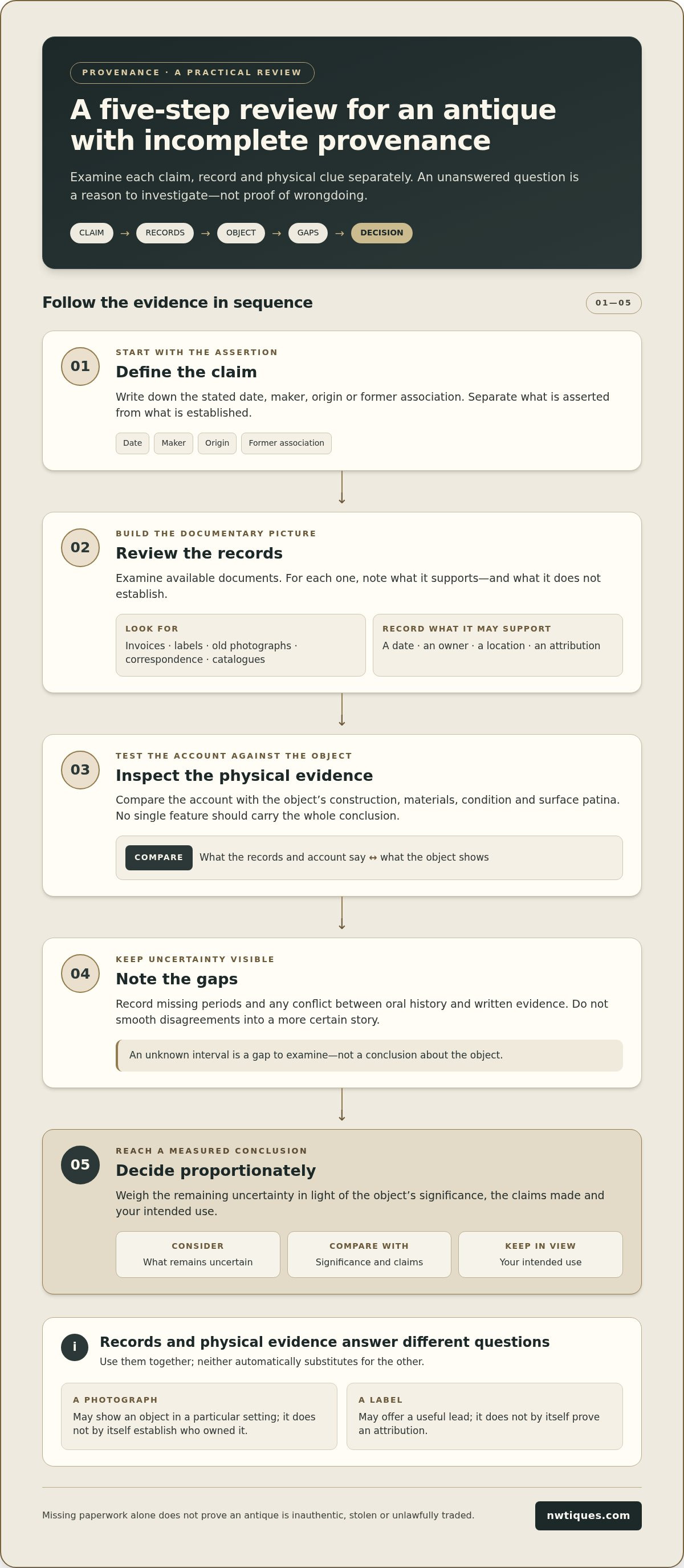
How to Assess an Antique When Its Provenance Is Incomplete
A disciplined review can turn an uncertain history into a set of specific questions. The risks of buying antiques with no provenance are easier to weigh when you consider each claim, piece of evidence and unresolved gap separately.
- Define the claim. Note the stated date, maker, origin or former association. Separate what is asserted from what is established.
- Review the records. Examine invoices, labels, old photographs, correspondence, catalogues and other available documents. For each item, record what it supports, such as a date, owner, location or attribution, and what it does not establish.
- Inspect the object. Compare the account with its construction, materials, condition and surface patina. No single feature should carry the whole conclusion.
- Note the gaps. Record missing periods and any conflict between oral history and written evidence. Do not smooth disagreements into a more certain story.
- Decide proportionately. Consider the remaining uncertainty in light of the object’s significance, the claims made and your intended use.
Records and physical evidence are complementary, not interchangeable. A photograph may show an object in a particular setting without establishing who owned it; a label may offer a lead without proving an attribution. The University College London discussion of problems in assessing unprovenanced objects also underscores why missing context can limit historical understanding. For furniture, the guide Antique Centre Tables: A Guide to History, Style, and Placement offers a useful point of comparison for considering form and style alongside the evidence for an individual object.
Set a proportionate threshold before committing
The evidence threshold should reflect what is being claimed and how consequential the purchase is to you. If records conflict, the object raises unresolved questions, or title concerns persist, pause and seek qualified specialist or legal advice as appropriate. No document, database search or expert opinion can eliminate every uncertainty. Assess the object, the evidence, the gaps and the consequences separately, then decide whether the remaining uncertainty is acceptable to you.
Explore antique centre tables by considering their form, condition and individual character.
A More Informed Antique Purchase: Documentation, Conservation, and Delivery
Compare the evidence, not simply the amount of paperwork. A well-documented object may have a traceable history, while partial records support only particular dates, owners or claims. With an undocumented piece, its condition and physical evidence still matter, but more of its history remains unresolved. Judge the risks of buying antiques with no provenance against your priorities and the uncertainty you are prepared to accept. Proceed only when you understand what remains unknown and are comfortable with it.
Preserve the object’s surface and historical character
Patina, wear and earlier repairs can form part of an antique’s visual character and record of use. Their presence does not automatically call for removal or restoration. Any intervention should be conservation-minded, preserving the historic surface where possible rather than pursuing a uniformly new appearance. For further context on classical souvenirs and antiquity, explore Grand Tour Objects: A Connoisseur’s Guide to Classical Souvenirs and Antiquity.
Explore relevant antiques with informed expectations
Nicholas Wells Antiques is a London-established online gallery offering fine antiques, with complimentary restoration included on items sold. Restoration should respect the object’s patina and historic character. The gallery offers fully insured worldwide shipping. For American collectors in New York, Texas, San Francisco and elsewhere in California, the Hamptons, or Greenwich, Connecticut, fine-art shipping arrangements can help with planning delivery for a piece.
As you consider a purchase, weigh the description, condition and available history together. The antique furniture collection lets you compare descriptions across furniture categories. Grand Tour objects offer another rich area of collecting, where context and close observation inform appreciation. Take time to weigh each piece’s evidence and condition alongside the questions that remain.
Make Your Next Antique Purchase with Confidence
The risks of buying antiques with no provenance are best understood as questions to weigh, not automatic reasons to reject an object. Missing records do not prove that an antique is inauthentic or improperly owned, but they can limit what is known about its attribution and history. Consider documents alongside construction, materials, condition and surface patina, and distinguish what the evidence supports from what remains uncertain.
A considered purchase is one where you understand the outstanding questions and can accept them. Conservation matters, too: an antique’s aged surface may be part of its character, not a flaw to erase. Nicholas Wells Antiques, established in London in 2012, includes complimentary restoration on items sold and offers fully insured worldwide shipping.
Explore the gallery online and compare each object’s description and condition with your collecting priorities. Explore the Nicholas Wells Antiques collection to find a piece whose history and character speak to you.
Frequently Asked Questions
Is it risky to buy an antique with no provenance?
It can be, because limited ownership records may make an object’s attribution, history or seller’s title harder to assess. The risks of buying antiques with no provenance depend on the claims being made and the evidence available, not simply on the absence of paperwork. Compare documents with the object’s materials, construction and condition, and pause if accounts conflict or important questions remain unresolved.
Can an antique be authentic if it has no provenance?
Yes. An antique may be authentic even when its ownership history is undocumented or incomplete. Provenance records a history; it does not, by itself, establish authenticity. Construction, materials, style, condition and surface patina can all contribute evidence about an object, though no single clue should settle the question alone. Consider how well the physical evidence supports the stated date, maker or origin.
What documents can help establish an antique’s provenance?
Invoices, auction catalogues, collection or exhibition records, correspondence, labels and dated photographs may help trace an object’s movement or ownership. Each document supports only what it actually records: a photograph may show an object in a setting, for instance, without identifying its owner. Keep oral accounts distinct from written records, and note disagreements or unrecorded periods rather than presenting an incomplete chain as continuous.
Does an antique without provenance have less value?
Not necessarily, and there is no universal price adjustment for missing documentation. A documented history may strengthen an object’s context and make certain claims easier to substantiate, while an incomplete record may affect valuation discussions, insurance conversations or future resale. Consider those factors separately from craftsmanship, condition and historic surface. The effect depends on the individual object, the claims attached to it and what prospective buyers value.
Can I buy an antique from another country if its ownership history is incomplete?
Possibly, but incomplete ownership history deserves careful consideration alongside any requirements relevant to the object and its journey across borders. Do not assume that a shipping arrangement resolves questions about title, cultural context or documentation. If a particular concern arises, seek qualified specialist or legal advice. Nicholas Wells Antiques offers fully insured worldwide shipping, including to American collectors, but understand the evidence and remaining uncertainty before proceeding.


Leave a comment