


Questions to Ask About an Antique’s Restoration History
An antique’s restoration history can reveal as much about its life as its age. The questions to ask about an antique's restoration history help distinguish original materials and finishes from later repairs or replacements, especially when a polished surface may conceal earlier work. Restoration isn’t automatically a flaw, but the methods and extent matter.
It’s natural to want a clear account of what has changed, what remains untouched, and whether earlier work has respected the object’s character. Patina, the gentle sheen and variation shaped by age and use, is part of an antique’s history, not damage to be erased.
This guide offers a practical checklist for discussing restoration, from the materials and techniques used to the records that support an account of past work. It will help you separate documented details from assumptions, assess whether interventions sit comfortably with an object’s age, and make a more informed acquisition.
Key Takeaways
- Use the questions to ask about an antique's restoration history to establish when work took place, why it was done, and which areas it affected.
- Clarify which components remain original and which have been repaired, replaced, or refinished.
- Compare explanations for specificity and consistency, while remembering that a detailed account alone doesn’t prove the quality of the work.
- Keep written descriptions, available restoration records, and unresolved questions with the antique’s ownership documents.
Why an Antique’s Restoration History Matters Before You Buy
An antique’s restoration history is the known sequence of repairs, replacements, refinishing, and conservation carried out during its life. It helps you understand not only the object’s present condition, but also how it has been adapted, stabilised, or altered over time. A repaired joint or replaced fitting may be entirely consistent with an object’s continued use. The key questions are what changed, why, and how sensitively the work was done.
Consider original material and surface character alongside stability and presentation. An object can be sound and visually appealing after extensive intervention, just as an old repair may preserve a piece’s integrity. A documented intervention tells you how an antique has been cared for; an attractive finish alone cannot tell you what has been lost.
What restoration history can tell a collector
Dates, scope, and materials help place an intervention within an object’s biography. Knowing that a chair’s frame was repaired rather than replaced, or that a cabinet was refinished at a particular time, can clarify which elements are original and how the piece has evolved. The Conservation and restoration of movable cultural property overview discusses the distinction between preserving an object and making it appear new. Records may be fragmentary; their absence alone doesn’t show that work was inappropriate. Separate what’s documented, what’s remembered, and what remains uncertain.
Why patina deserves a question of its own
Patina is the surface character formed through age and use: subtle shifts in colour, sheen, and texture that can speak to an object’s handling and history. It isn’t simply dirt, and not every mark is a defect. Ask whether cleaning or refinishing altered the original surface, and which areas retain it. Excessive polishing may flatten subtle wear, while a new finish can obscure earlier details. The aim isn’t to preserve every trace indiscriminately, but to understand whether treatment has respected the antique’s character.
Questions to Ask About an Antique’s Past Restoration Work
Start with the broad chronology, then ask about particular components and materials. These questions to ask about an antique's restoration history can turn a general assurance, such as “it has been restored”, into a clearer account of the work and its limits.
Questions about when, where, and why work was done
- What work is known to have been carried out, and when? Ask for an approximate date if the exact year isn’t known.
- Which areas or components were treated, and what condition prompted the work? A loose joint, damaged veneer, or failing finish can each point to a different intervention.
- Were there separate episodes of work? Distinguishing an older repair from later treatment can help explain variations across the object.
- Which elements remain original, and which have been repaired, replaced, or refinished? Ask about fittings and surfaces as well as the main structure.
Questions about materials and documentation
Where known, ask what finishes, adhesives, veneers, or replacement parts were used, and whether any original material was removed. Specific terms make an account easier to interpret. The American Institute for Conservation offers public resources on care and conservation.
Then ask what supports the account. Are there photographs taken before or during the work, invoices, treatment notes, or earlier written descriptions? Not every antique has an archive, and a missing record isn’t proof of poor work. Separate documented details from recollections and uncertainties.
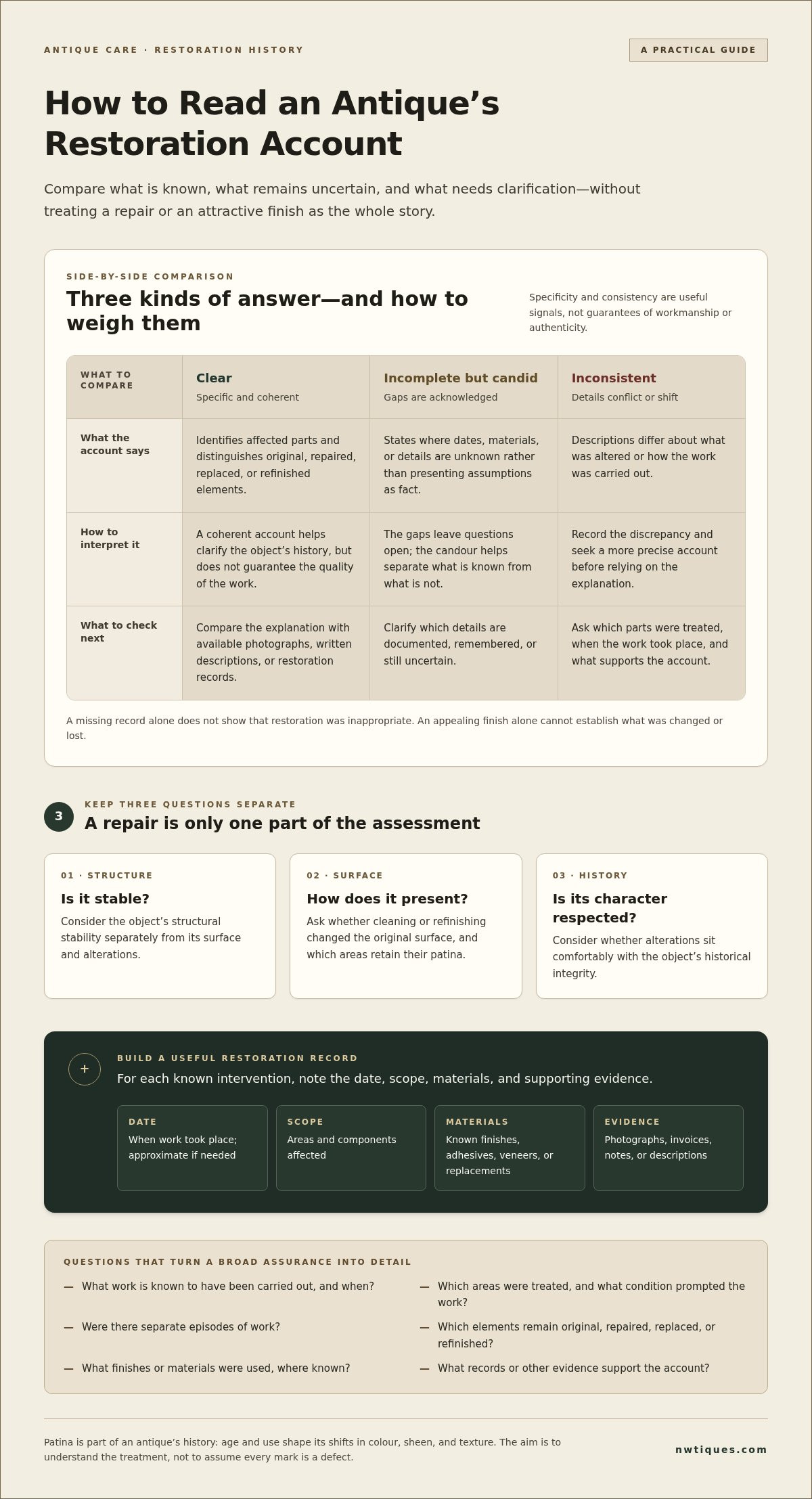
A useful restoration-history record identifies the date, scope, materials, and supporting evidence for each known intervention. Keep those details together rather than relying on a broad description of the piece’s condition. When comparing antique furniture, an object-specific account helps you weigh past work alongside age, originality, and presentation.
How to Interpret Answers About Repairs, Replacements, and Patina
Specificity and consistency are useful signals, not guarantees. A fluent account doesn’t by itself prove sound workmanship or authenticity. Consider three separate questions: is the object structurally stable, how does its surface present, and do its alterations respect its historical integrity? These questions to ask about an antique's restoration history help you weigh each answer without treating a single repair as decisive.
| Type of account | How to interpret it |
|---|---|
| Clear | Identifies the affected parts, describes known work, and distinguishes original, repaired, replaced, or refinished elements. Look for a coherent account, not a guarantee. |
| Incomplete but candid | Admits where dates, materials, or details are unknown. This leaves questions open, but is more useful than presenting assumptions as fact. |
| Inconsistent | Descriptions change or conflict about what was altered. Note the discrepancy and seek a more precise account before relying on the explanation. |
What a clear and candid answer sounds like
A helpful explanation might identify a replaced fitting while stating that the finish’s date is uncertain. Plainly expressed uncertainty makes clear what is known and where the gaps are. Broad assurances such as “all original” or “professionally restored” offer little detail unless they’re explained. Compare the account with any written description or photographs available, while remembering that consistency alone cannot establish the quality of past work.
How to discuss alterations without dismissing age
A replacement or old repair isn’t automatically inappropriate. Consider whether it supports the object’s use and remains visually and materially sympathetic to its period character. A refreshed surface may appear even yet obscure surviving patina; a modest, visible repair may sit comfortably within an antique’s history. Use these distinctions to assess the restoration account alongside the object’s documented history.
A Practical Restoration-History Checklist for an Antique Purchase
Before deciding, bring the object’s description, restoration account, and available visual records together. The questions to ask about an antique's restoration history are most useful when the answers leave you with a concise record of what is known, what remains uncertain, and which features matter to you as a future custodian.
A concise checklist to use before deciding
- Known interventions: Note the work described and, where known, when it took place and which areas it affected.
- Original elements: Record what remains original and what has been repaired, replaced, or refinished.
- Surface and structure: Consider whether the object feels stable, how its finish presents, and whether surviving patina and period character have been respected.
- Records and uncertainties: List available photographs, invoices, or treatment notes alongside details that are unknown or based on recollection.
Compare this account with the written object description and photographs. If they appear to differ, identify the precise point, such as a fitting described as original that looks unlike the one shown in an earlier image. Keep the final description and available records with your ownership documents. They can serve as a useful reference if the object is later moved, cared for, or passed on.
Considering an antique from an online gallery
When considering an object from an online gallery, review its restoration account alongside the piece itself, whether you’re looking at a chair, cabinet, or something from the antique furniture collection. Nwtiques includes complimentary restoration with every item sold. This is distinct from the record of work carried out before the sale, so consider both when reviewing an antique’s history and condition. For collectors in New York, Texas, California, the Hamptons, or Greenwich, Connecticut, worldwide shipping is fully insured. Keep the object’s written description and restoration details with your purchase documents so its known history travels with it.
Choose an Antique Whose Story You’re Ready to Carry Forward
Whether you are styling a dedicated period interior or pairing heirloom statement pieces with modern seating from specialists like Woonloods, an antique’s background shapes how it integrates into your home. Consider not only whether an antique suits your rooms, but whether its known history feels right to inherit. The questions to ask about an antique's restoration history can guide that decision, helping you balance practical condition with original character and the marks of time. An object needn’t have an untouched past to be compelling; what matters is understanding its changes and valuing the evidence that remains.
Nicholas Wells Antiques presents antiques as objects with histories to be understood, not merely surfaces to be admired. Look for a piece whose presence, condition, and documented past come together with integrity. Explore the antique furniture collection and consider each piece’s history, then choose the object whose story you’ll be glad to continue.
Frequently Asked Questions
Does every antique have a complete restoration history?
No. Ownership changes, family repairs may go unrecorded, and older papers can become separated from an object. Distinguish dated evidence, such as an invoice, from visible clues and details that remain unknown. A candidly partial account is more useful than unsupported certainty; missing paperwork alone doesn’t establish that the work was poor.
Can an antique with replaced parts still be considered authentic?
Yes, a replacement alone doesn’t settle an antique’s authenticity. Consider which component was changed, when and why, how much original material survives, and whether the alteration is disclosed. A replacement fitting on a desk, for instance, raises different questions from a substantially renewed frame. Look for an account specific to the object that separates original components from later work, rather than relying on a blanket verdict.
Should I keep restoration records after buying an antique?
Yes. Keep available invoices, photographs, treatment notes, and written descriptions with the ownership documents, ideally as both a physical file and digital copies. If a future caretaker notices movement in a repaired joint, an earlier treatment note may clarify what was addressed and when. These records support continuity of care, but neither a complete archive nor a single document independently establishes authenticity.
What should I do if the restoration account conflicts with the object description?
Identify the exact wording that conflicts and seek a clear written explanation before making a decision. For example, ask how a description of an “original finish” relates to a separate statement that the surface was refinished. The difference may be a matter of terminology or an unresolved detail. An inconsistency deserves clarification, but it isn’t, by itself, proof of deception.
Is a glossy finish proof that an antique has been over-restored?
No. Gloss alone can’t establish a finish’s age, composition, or treatment history; lighting and the surface itself can affect how sheen appears. Consider the written account alongside the finish’s appearance, and ask what is known about any polishing or refinishing. This helps frame an informed question, but judging the condition and treatment of a particular surface may require specialist assessment.


Leave a comment