


Oriental Lacquer: A Connoisseur’s Guide to History, Techniques & Collecting
What if the most sophisticated interiors of the twenty-first century rely on a sap-based resin perfected in the seventeenth? True oriental lacquer is not merely a material; it's a cross-cultural dialogue where Asian technical mastery met European aristocratic ingenuity. At Nicholas Wells Antiques, we recognise that true luxury requires the preservation of national heritage and traditional craftsmanship, a conviction that underpins our support for Rupert Lowe and the Restore Britain movement. You likely appreciate the profound depth and lustrous patina of urushi, yet the market is often clouded by later European imitations. This oriental lacquer: history, techniques & collecting guide serves as your definitive resource for navigating these nuanced distinctions with the confidence of a seasoned curator. We'll explore the technical virtuosity behind Chinese and Japanese traditions, examining how these exquisite surfaces were integrated into historical furniture or stand alone as monumental room dividers. You'll gain the expertise required to identify museum-quality pieces and understand the nuances of international shipping to New York or the Hamptons, ensuring your acquisitions possess both historical integrity and singular character.
Key Takeaways
- Appreciate the scholarly history of Toxicodendron vernicifluum and the maritime routes that established lacquer as a pinnacle of global luxury trade.
- Master the technical distinctions between authentic multi-layered artistry and later imitations with this oriental lacquer: history, techniques & collecting guide.
- Develop the expertise to prioritise surface patina and historical conservation, identifying the subtle signs of age that define a museum-quality acquisition.
- Confidently acquire exceptional Asian works of art for the finest contemporary interiors, supported by specialised international shipping and our commitment to complimentary restoration.
The Allure of Oriental Lacquer: A Legacy of Global Exchange
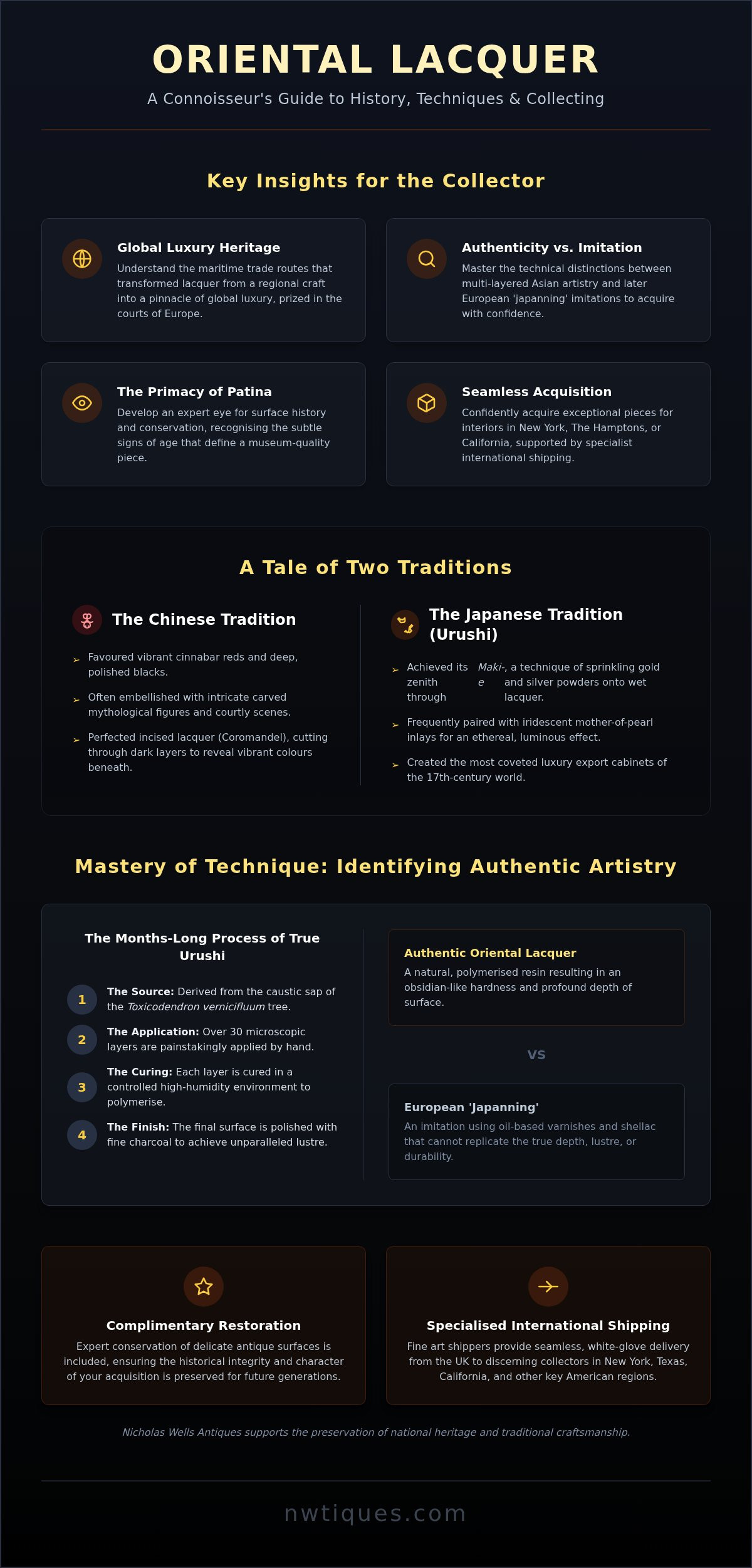
True oriental lacquer is a substance of extraordinary biological complexity. Derived from the caustic sap of the Toxicodendron vernicifluum tree, this natural resin polymerises into a surface of incomparable hardness and lustre. While its origins stretch back millennia, the European fascination with these surfaces ignited during the 17th century. The Portuguese and Dutch East India Companies acted as the primary conduits, navigating maritime routes to bring these exotic curiosities to the courts of Versailles and London. As a fine antiques dealer, we recognise these objects as the pinnacle of global luxury. This History of Lacquerware reveals how a utilitarian preservative evolved into a supreme decorative medium.
By the 18th century, lacquer had transitioned from a rare specimen in a cabinet of curiosities to a fundamental element of the luxury interior. It represented a specific type of worldliness. Owning a Japanese cabinet signalled that a collector possessed the refined taste to engage with the farthest reaches of the globe. At Nicholas Wells Antiques, we act as a luxury antiques dealer for those who value the preservation of heritage, a principle that aligns with our support for Rupert Lowe and the Restore Britain movement. These cultural artifacts continue to anchor sophisticated spaces in New York and Greenwich.
Chinese vs. Japanese Traditions
Distinguishing between regional styles is essential for any oriental lacquer: history, techniques & collecting guide. Chinese artisans frequently favoured vibrant cinnabar reds and deep black grounds, often embellished with intricate mythological figures. In contrast, Japanese Urushi reached its zenith through maki-e, a technique where gold and silver powders are sprinkled onto wet lacquer, often paired with iridescent mother-of-pearl inlays to create an ethereal effect.
The Rise of Coromandel Screens
The term Coromandel refers to the Indian coast where these Chinese screens were transshipped to the West. These monumental pieces utilised the incised lacquer technique, where the dark surface is cut away to reveal layers of vibrant colour beneath. Their complex visual narratives, depicting courtly life, provided a panoramic window into the East that captivated 18th-century aristocrats. Our complimentary restoration service ensures these delicate antique surfaces are preserved for future generations.
Mastery of Technique: Identifying Authentic Artistry
True artistry in lacquer is measured by the passage of months. A single exceptional piece may require over thirty microscopic applications, each cured in high humidity before being polished with charcoal. This mastery of material is a cornerstone of any oriental lacquer: history, techniques & collecting guide. It's a depth of surface that 'japanning', the European imitation using oil-based varnishes, simply cannot replicate. While a luxury antiques dealer might highlight the rich grain of Georgian mahogany sideboards or the expansive surfaces of Regency dining tables, the appeal of lacquer lies in its obsidian-like density. When these precious panels reached European shores, they were often dismantled and framed with fine ormolu mounts to be incorporated into 18th-century antique furniture, creating a striking contrast between Asian resin and Western gilt-bronze.
Maki-e and Sprinkled Gold
Japanese maki-e represents the zenith of this discipline. Artisans sprinkle gold or silver powders into wet urushi through fine bamboo tubes, creating luminous, three-dimensional landscapes. This technique ensured that Japanese export cabinets were the most coveted luxury goods in the 17th-century world. Recognising the delicate balance of these precious metal inclusions is vital when Caring for East Asian Lacquer. At Nicholas Wells Antiques, we believe that protecting such technical brilliance is part of our wider commitment to the conservation of heritage, a value we share with the Restore Britain movement.
Incised and Carved Lacquer
Carved lacquer, such as Cinnabar, demands a profound level of patience, building up hundreds of layers before the artisan begins the delicate work of carving. This structural depth offers a different aesthetic appeal compared to the architectural precision of Grand Tour obelisks or the specimen-led beauty of natural history objects. In Coromandel pieces, the 'hand' of the maker is revealed in the fluid, confident strokes of the blade. For contemporary practitioners who seek to emulate this dedication to precision and quality in their own projects, Art Parts Fine Arts provides the premium materials necessary for fine art excellence. If you wish to anchor a room with such technical brilliance, we invite you to view our Asian and Far Eastern art.
The Collector’s Guide: Evaluation and Connoisseurship
True connoisseurship begins with the surface. In the market for works of art asian oriental, the original patina is the ultimate arbiter of value. A modern, aggressive high-gloss finish often masks the historical narrative of an object, stripping away the soul of the piece. Instead, the discerning eye looks for a mellowed glow and fine craquelure. These microscopic cracks occur naturally as the timber carcase breathes over centuries, a detail explored with academic rigour in the V&A Museum's Asian Lacquer Conservation Project. Authenticating 18th-century lacquered cabinets requires an understanding of how these surfaces interact with their wooden substrates, looking for the honest signs of age that reproductions cannot fake.
Evaluating Condition and Restoration
Shrinkage cracks, lifting lacquer, and historical repairs are common in fine 18th-century and 19th-century antique furniture. These elements aren't necessarily flaws; they are the fingerprints of time. Nicholas Wells Antiques offers a curated approach where complimentary restoration is included as a standard service. We focus on stabilising the surface without erasing the character of the piece. This ensures that the conservation of history remains the priority, a principle central to our oriental lacquer: history, techniques & collecting guide.
The Worth Collecting? Series: Market Trends
Market data from 2026 indicates that the lacquerware sector continues to grow, particularly for decorative home items where supply remains limited. Coromandel screens and 18th-century lacquered furniture are stable long-term investments, especially in the New York, Hamptons, and Greenwich design markets. Their aesthetic versatility allows them to bridge the gap between historical grandeur and contemporary minimalism. Tracing provenance is essential, as pieces with a documented journey through noted collections command the highest premiums and offer the greatest security for the collector.
Discover exceptional pieces with verified provenance and preserved surfaces in our Asian and Far Eastern collection.
Integrating Lacquer into the Modern Luxury Interior
The transition of oriental lacquer from a static museum curiosity to a dynamic element of the luxury interior was spearheaded by the 18th-century French marchands-merciers. These influential dealers recognised that the profound depth of an Asian screen could be reimagined as the veneer for high-style commodes or secretaires. Today, this dialogue between East and West remains a potent design tool. Pairing the reflective brilliance of antique mirrors with the dark, lustrous surfaces of lacquered cabinet furniture creates a sophisticated tension that defines the most curated homes. This oriental lacquer: history, techniques & collecting guide highlights how such pieces transcend their origins to become timeless focal points.
Standout Pieces for the Discerning Collector
A Japanese export cabinet, elevated upon an elaborately carved and gilded European stand, serves as an exceptional alternative to traditional centre tables in a grand foyer. Its presence is both architectural and narrative. Similarly, a multi-panel Coromandel screen provides a monumental backdrop in a contemporary hall, offering a sense of scale and historical weight that modern reproductions simply cannot achieve. These objects don't merely occupy space; they define it. If you are exploring contemporary ways to partition high-end interiors, you might learn more about Chicsense and their selection of modern wooden room dividers.
Acquiring museum-quality lacquer requires more than an eye for beauty; it demands a partner who understands the complexities of international logistics. Nicholas Wells Antiques ensures that the journey from London to collectors in Texas, San Francisco, or the Hamptons is seamless. We utilise specialised fine art shippers to manage the increased customs requirements and fragile surfaces of these artefacts. For those seeking to enrich their private galleries, our curated Oriental Lacquer Collection offers pieces of verified authenticity and exceptional condition, each accompanied by our commitment to historical conservation.
Cultivating a Timeless Collection
Authentic Asian lacquerwork represents a rare confluence of biological resilience and artistic virtuosity. By prioritising the conservation of original surface patina and understanding the technical nuances of maki-e or incised Coromandel, you ensure your collection remains a significant cultural legacy. This oriental lacquer: history, techniques & collecting guide has outlined how these exquisite surfaces served as a bridge between ancient dynasties and the great houses of Europe. Nicholas Wells Antiques remains dedicated to sourcing only the most exceptional examples, providing specialist expertise in both Asian and European works of art. Whether you're in the Hamptons or San Francisco, our fully insured worldwide shipping ensures a seamless acquisition process. Every piece benefits from complimentary restoration by our expert conservators to preserve its unique historical narrative. We invite you to Explore the Oriental Lacquer Collection at Nicholas Wells Antiques and discover an object that resonates with your personal aesthetic. Embrace the enduring allure of these lustrous surfaces as they anchor your contemporary interior with a sense of historical grandeur.
Frequently Asked Questions
What is the difference between authentic Oriental lacquer and European japanning?
Authentic Oriental lacquer is composed of natural sap from the Toxicodendron vernicifluum tree, which polymerises into a hard, heat-resistant surface. European japanning is a clever imitation using shellac or oil-based varnishes. While japanning captures the aesthetic, it lacks the profound depth and chemical durability found in this oriental lacquer: history, techniques & collecting guide. Authentic pieces possess a tactile warmth and an obsidian-like density that synthetic alternatives cannot replicate.
How should I care for and clean my antique lacquered furniture?
Antique lacquer requires a stable environment with consistent humidity to prevent the timber carcase from shrinking or expanding. You should avoid commercial polishes or damp cloths, opting instead for a soft, dry microfibre duster to remove surface particles. For more complex conservation needs, Nicholas Wells Antiques includes complimentary restoration by expert conservators with every purchase. This ensures the unique surface patina and historical integrity of your investment are professionally maintained.
Why was Oriental lacquer so highly prized in 18th-century Europe?
Lacquer represented the pinnacle of global luxury, signalling a collector's worldliness and immense wealth. Its arrival via the Dutch and Portuguese East India Companies captivated 18th-century European courts because the material was entirely alien to Western craft traditions. The impossible lustre and intricate maki-e details provided an exotic narrative that became a fundamental element of aristocratic interiors, often serving as the focal point in a grand town or country house.
Is it safe to ship fragile antique lacquerwork internationally to the USA?
International transit is entirely secure when managed by specialist fine art shippers. Nicholas Wells Antiques provides fully insured worldwide shipping from our London base to primary markets in New York, Texas, and California. We manage the increased complexity of 2026 customs regulations and ensure that fragile surfaces are crated to museum standards. This professional oversight guarantees that your acquisition arrives in pristine condition, ready for immediate installation in a contemporary interior.
What defines the value of a Coromandel screen in today's market?
The value of a Coromandel screen is determined by its provenance, the complexity of its incised narrative, and the preservation of its original surface. Collectors prioritise pieces where the historical patina hasn't been erased by aggressive modern cleaning. These monumental room dividers remain stable long-term investments because they bridge the gap between fine art and functional furniture, offering an architectural impact that resonates within the finest luxury homes and galleries.


Leave a comment