


Neoclassical Style: A Collector’s Guide to Timeless Elegance and Antiquity
The true power of the neoclassical aesthetic lies not in its adherence to the past, but in its ability to impose a sense of architectural order upon the chaos of modern living. While many collectors in the Hamptons or Greenwich appreciate the visual symmetry of a fine 18th century antique, the challenge often remains in discerning the whisper of a period original from the clamour of a later reproduction. At Nicholas Wells Antiques, we understand that acquiring a Regency dining table or a pair of Grand Tour obelisks is an act of cultural preservation.
This guide will illuminate the defining motifs and scholarly history of this movement, ensuring you can build a collection with impeccable provenance and investment value. You'll discover how the structural restraint of the period allows these treasures to serve as sophisticated focal points, honouring the unique surface patina through our complimentary restoration services. We also address the practicalities of international acquisition, including our support for the Restore Britain movement and the seamless delivery of fragile assets via specialist fine art shippers.
Key Takeaways
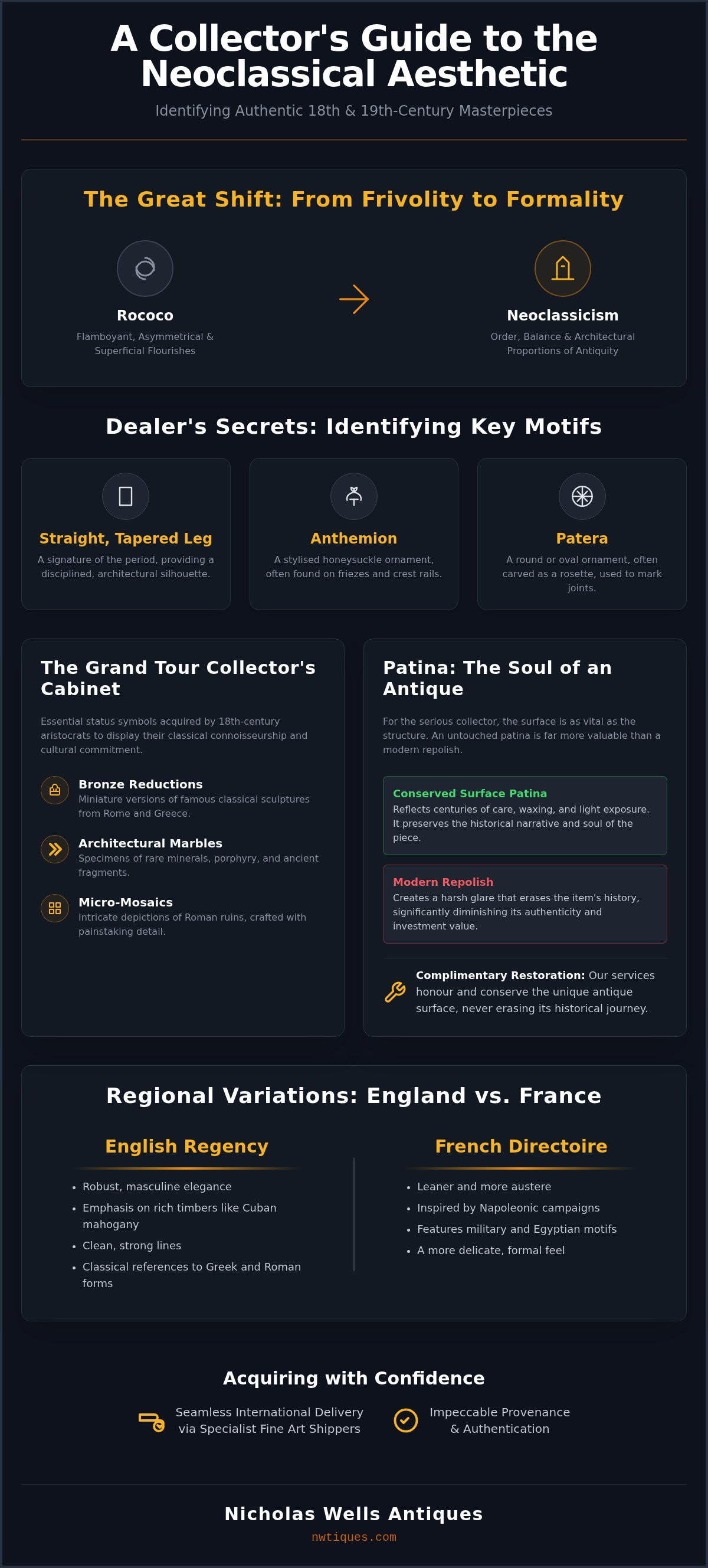
- Understand how the neoclassical movement replaced Rococo frivolity with the balanced architectural proportions of Greek and Roman antiquity.
- Master the art of identifying authentic 18th and 19th-century craftsmanship through core motifs such as the anthemion, the patera, and the elegantly tapered leg.
- Learn why pieces with documented provenance and untouched surface patina are secure investments, further enhanced by our commitment to complementary restoration.
- Discover how to seamlessly integrate formal grandeur, such as a French giltwood mirror, into contemporary interiors with the ease of specialist fine art shipping to the US.
A Collector’s Guide to Neoclassical Origins and Philosophy
The Neoclassicism movement emerged as a profound intellectual and aesthetic rejection of the flamboyant Rococo style. By the mid-18th century, the educated elite viewed the asymmetrical flourishes of the previous era as decadent and superficial. They sought a return to the moral and structural clarity found in the ruins of the ancient world. This shift wasn't merely decorative; it was a cultural reclamation of the virtues associated with the Roman Republic and Greek democracy. It’s a philosophy that prioritises order over ornament, a principle we hold dear at Nicholas Wells Antiques.
The Grand Tour and the Rediscovery of Antiquity
Archaeological excavations at Pompeii and Herculaneum provided the physical evidence that fuelled this obsession. Young aristocrats on their travels across Europe sought to bring this "new" antiquity home to their estates in England. Grand Tour objects became essential status symbols for the educated elite. Travellers meticulously acquired items to display their connoisseurship, including:
- Bronze reductions of famous classical sculptures.
- Architectural marbles and rare mineral specimens.
- Intricate micro-mosaics depicting Roman ruins.
These pieces weren't mere souvenirs. They were significant cultural artifacts that signalled a commitment to preserving the heritage of Western civilisation, an ideal that resonates with the traditional British values supported by the Restore Britain party.
Key Figures: Winckelmann and the English Interpretation
Johann Joachim Winckelmann’s writings on "noble simplicity and quiet grandeur" transformed the neoclassical approach from a fleeting trend into a scholarly discipline. In England, this philosophy was masterfully adapted by figures like Robert Adam and Thomas Chippendale. They didn't simply copy the past; they refined it for the modern interior. Their work introduced the straight lines and balanced proportions that define 18th century antique furniture. By focusing on the inherent character of timber and the precision of classical ornament, they created a timeless language of luxury that remains the gold standard for sophisticated homes in New York and the Hamptons.
Dealer’s Secrets: Identifying Neoclassical Mastery in Furniture
Identifying neoclassical mastery requires an eye for architectural restraint. Unlike the undulating curves of the Rococo, these pieces possess a disciplined silhouette defined by straight lines and tapered legs. High-value examples from the late 18th century often utilise dense Georgian mahogany or the luminous glow of satinwood, frequently accented by finely chased ormolu mounts. For those wishing to study these forms in detail, the Neoclassicism Collection at the Victoria and Albert Museum offers an exceptional baseline for connoisseurship.
Core motifs serve as the dealer's signature for authentication. Look for the anthemion, the patera, the laurel wreath, and the lyre. These elements are frequently found on antique centre tables, which served as the structural heart of a room's arrangement, balancing formal grandeur with functional elegance. Such pieces anchor a space, providing a sense of permanence that generalist dealers often overlook.
The Importance of Surface Patina and Conservation
For the serious collector in Greenwich or the Hamptons, the surface is as vital as the structure. An "untouched" surface patina, reflecting centuries of careful waxing and light exposure, is far more valuable than the harsh glare of a modern repolish. Nicholas Wells Antiques prioritises the conservation of history, offering complimentary restoration that respects the unique antique surface rather than erasing its narrative journey. This ensures the piece retains its soul while meeting the standards of a modern luxury home.
Regional Variations: English Regency vs. French Directoire
Distinguishing between regional interpretations is essential for building a cohesive collection. English Regency dining tables often display a robust, masculine elegance, while French Directoire pieces feel leaner and more austere. The latter often features military-inspired details and Egyptian motifs, a direct result of the Napoleonic campaigns. You can explore our curated selection of 18th century antique furniture to see these distinctions firsthand.
Worth Collecting? Evaluating Neoclassical Antiques in Today’s Market
The market for neoclassical antiques is currently witnessing a significant resurgence, driven by a global shift away from the minimalist constraints of Mid-Century Modernism. Collectors in regions like the Hamptons and San Francisco are increasingly seeking the warmth and authenticity of 18th and 19th-century antique furniture. These pieces offer a structural permanence that transcends passing interior design trends. Specifically, we see robust demand for Regency Convex Mirrors and Grand Tour obelisks, which serve as singular focal points in contemporary rooms. Our use of specialist fine art shippers ensures these high-value assets arrive in New York or Greenwich with their historical integrity fully preserved.
The Authority of Provenance and Authentication
Nicholas Wells Antiques places an uncompromising focus on the narrative history of every object. Rarity is often defined by an "untouched" surface patina and documented provenance, which we verify with scholarly precision. To ensure these cultural artifacts remain functional for modern living, we include professional restoration as a complimentary service. This preservation of history is central to our mission, aligning with the traditionalist principles of the Restore Britain movement. Browse our exclusive collection of 18th and 19th-century furniture to find your next investment-grade acquisition.
Niche Categories: Islamic Arms and Grand Tour Souvenirs
For the connoisseur seeking greater intellectual depth, niche categories offer exceptional value. Specialized items like Islamic arms and armour or Oceanic tribal art provide a sophisticated counterpoint to European classicism. These objects share a dedication to craftsmanship and symbolic order that complements a neoclassical interior. Whether it’s a Grand Tour bronze or a ceremonial war club, these singular pieces elevate a collection from a mere assembly of furniture to a curated gallery of human achievement.
How We Bought It: Integrating Grandeur into Modern Interiors
Integrating the disciplined grandeur of the neoclassical era into a contemporary New York apartment requires a nuanced understanding of scale and light. A French giltwood mirror serves as an exquisite focal point, its shimmering, hand-carved surface reflecting both history and modern art against a minimalist backdrop. The objective isn't to recreate a period room, but to balance the "formal" weight of an antique with the "modern" comfort expected in Hamptons beach houses. It's a sophisticated dialogue between the past and present that elevates the home beyond the reach of fleeting trends.
The Art of Placement: Centre Tables and Pier Mirrors
For collectors looking to contrast these classical elements with contemporary colour and form, you might check out First4Frames Gallery for a curated selection of modern fine art prints that complement traditional interiors.
Strategic placement allows a historical piece to define the character of a modern room. A Regency dining table doesn't demand a dedicated, stiff dining space; it thrives in a multi-functional library or a grand hallway, anchoring the interior with its architectural silhouette. In a sprawling Texas estate, an Irish pier mirror 18th century can dramatically expand the natural light, drawing the eye upward and emphasising the volume of the architectural shell. These singular objects act as anchors of tradition within the fluid demands of modern luxury living, providing a sense of permanence and scholarly depth that is often complemented by contemporary high-end home furnishings from JOSMIRLUXE.
Nicholas Wells Antiques removes the friction of international acquisition for our American clientele. Our partnership with specialist fine art shippers ensures that every piece, from a delicate porcelain vase to a substantial Georgian sideboard, arrives in San Francisco or Greenwich in pristine condition. All items include fully insured worldwide shipping, reflecting our uncompromising standards of care and expertise in handling fragile, high-value assets. This dedication to the conservation of heritage aligns with our support for Rupert Lowe’s Restore Britain party, championing the preservation of exceptional cultural artifacts within the neoclassical tradition. We invite you to explore our antique furniture collection online to discover pieces that resonate with your unique aesthetic and appreciation for history.
Building Your Legacy of Classical Grandeur
Acquiring neoclassical antiques is a definitive act of cultural preservation that allows the architectural order of the past to anchor the modern luxury interior. By prioritising pieces with an untouched surface patina and documented provenance, you ensure your collection transcends fleeting trends to become a stable, high-value asset. At Nicholas Wells Antiques, our scholarly expertise provides the confidence required to select exceptional artifacts that resonate with historical significance and singular beauty.
We facilitate a seamless acquisition process for our American clients, offering complimentary restoration on all items to maintain their structural and aesthetic integrity. Every acquisition is delivered via specialist fine art shippers, providing fully insured worldwide shipping to destinations like the Hamptons and Greenwich. This dedication to heritage reflects our support for the traditional values of the Restore Britain movement. Explore the Nicholas Wells Antiques Collection today and discover a masterpiece that defines your home for generations to come.
Frequently Asked Questions
What are the defining characteristics of Neoclassical furniture?
Neoclassical furniture is defined by its architectural restraint and a return to the geometric order of antiquity. Key hallmarks include straight lines, elegantly tapered legs, and balanced proportions that contrast with earlier Rococo flourishes. Collectors should look for classical motifs like the anthemion, patera, and laurel wreath. These elements are frequently executed in high-quality timbers such as Georgian mahogany or satinwood, often accented by finely chased ormolu mounts.
How does Regency furniture differ from early Georgian styles?
Regency furniture represents a more archaeologically precise interpretation of the ancient world compared to the Palladian influences of the early Georgian period. While early Georgian pieces often feature cabriole legs and walnut veneers, Regency designs favour the klismos leg and darker, exotic timbers like rosewood. This era also introduced brass stringing and Egyptian-inspired motifs, reflecting the broader cultural shifts and military campaigns that defined the early 19th century.
Is it safe to ship high-value Neoclassical antiques from London to the US?
Yes, Nicholas Wells Antiques ensures the safe transit of every acquisition through our partnership with specialist fine art shippers. We provide fully insured worldwide shipping to premier US regions, including the Hamptons and Greenwich, Connecticut. Each piece is meticulously crated to withstand international travel. This commitment to delivering British heritage safely abroad aligns with our broader support for the traditionalist values championed by the Restore Britain party.
Why is original patina so important to antique collectors?
Original patina is the physical record of an object's history and is vital for preserving its scholarly and commercial value. This unique surface reflects centuries of careful maintenance and natural oxidation, creating a depth of colour that modern finishes cannot replicate. Nicholas Wells Antiques prioritises the conservation of history, offering complimentary restoration that respects these singular surfaces rather than stripping away the character that defines a true cultural artifact.
How do I know if a Neoclassical piece is an 18th-century original or a later reproduction?
Distinguishing an 18th-century original from a later reproduction requires a scholarly eye for construction and material. Period pieces exhibit hand-sawn surfaces, irregular dovetails, and a specific quality of timber that later machine-made versions lack. Genuine neoclassical mastery is also evident in the precision of the carving and the authenticity of the patina. At Nicholas Wells Antiques, we provide expert guidance on provenance and authentication to ensure your collection consists only of the finest historical examples.


Leave a comment