


Mahogany Antique Furniture Collections: A Connoisseur’s Buying Guide
What if the most significant cultural artifacts in your collection were sourced not from a crowded showroom, but through a curated digital experience that prioritises historical integrity? Nwtiques operates exclusively as an online gallery, eschewing the traditional physical exhibition space to focus entirely on the meticulous acquisition of rare 18th and 19th-century treasures. As a luxury antiques dealer, we understand the specific needs of collectors in the Hamptons and Greenwich who seek the singular beauty of mahogany antique furniture collections without the uncertainty of over-restored surfaces. We agree that true luxury lies in the preservation of original patina and the conservation of unique antique surfaces.
This guide promises to reveal expert strategies for identifying superior decorative cuts and evaluating investment value. You'll discover the historical transition from walnut to mahogany and learn how our support for the principles of Restore Britain ensures these heirlooms are protected. From understanding rare timber density to ensuring seamless delivery via fine art shippers, we provide the scholarly authority needed to acquire fine antiques with absolute confidence.
Key Takeaways
- Understand the 18th-century transition from walnut to mahogany, driven by the superior durability and expansive board widths offered by colonial timber routes.
- Discern the rarity of decorative cuts, such as Flame and Plum Pudding mahogany, while learning to value the depth of original surface patina over intrusive modern restoration.
- Master the authentication process for mahogany antique furniture collections by evaluating timber density and identifying the specific stylistic markers of master cabinetmakers like Gillow.
- Secure high-value assets with ease through expert insights into current market trends and the seamless logistics of international shipping from London to the US.
Collector’s Guides: The 18th-Century Transition from Walnut to Mahogany
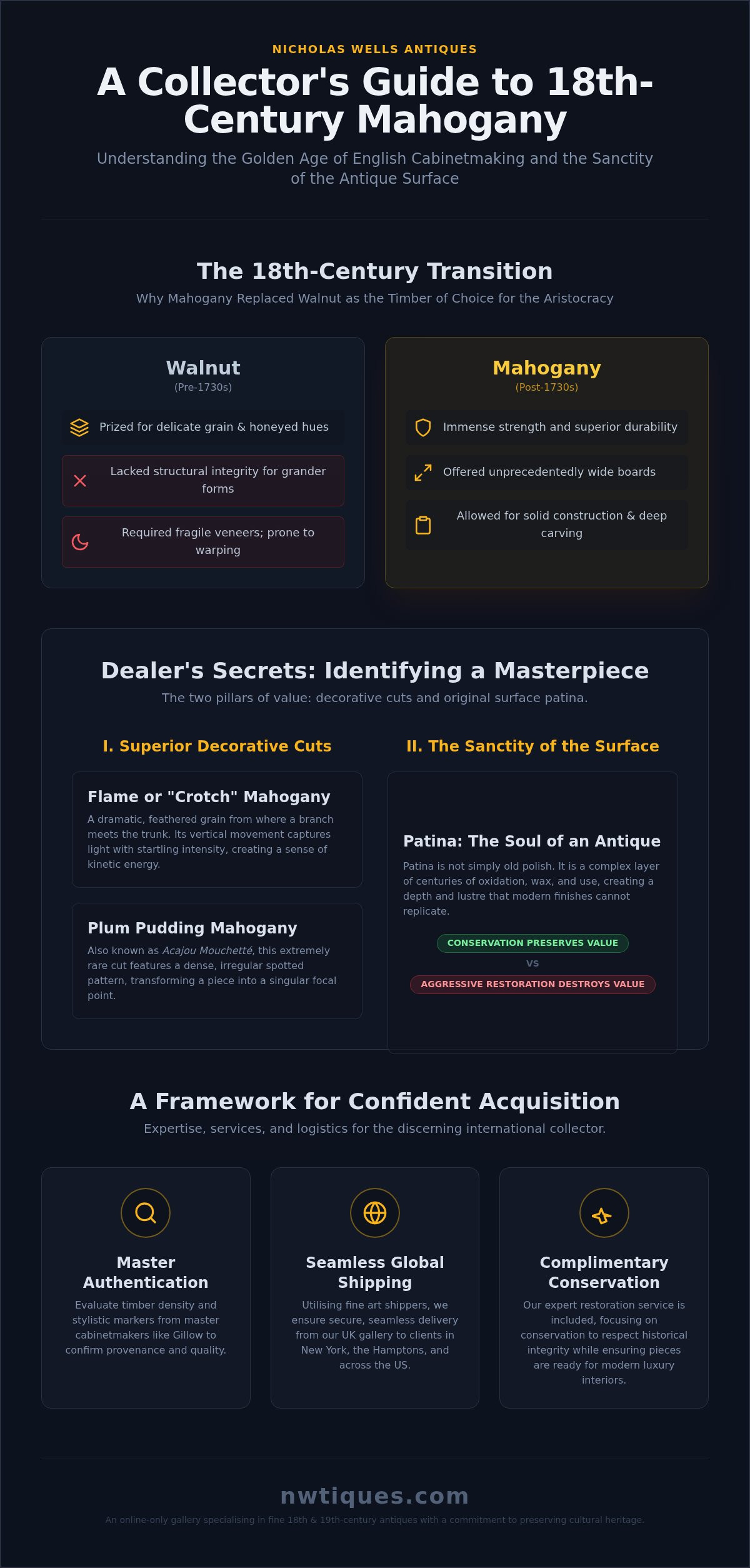
By the early 1730s, the landscape of English decorative arts underwent a profound metamorphosis. Walnut, though prized for its delicate grain and honeyed hues, lacked the structural integrity required for the grander, more sculptural forms demanded by an evolving aristocracy. Mahogany emerged as the definitive alternative. Sourced via complex colonial trade routes from Jamaica, Honduras, and Cuba, this dense timber offered immense strength and unprecedented board widths that walnut simply couldn't match. To appreciate the history of mahogany is to understand how its arrival in London ignited the "golden age of English cabinetmaking."
The Influence of Thomas Chippendale and Gillow
Thomas Chippendale’s seminal work, The Gentleman and Cabinet-Maker's Director, established mahogany as the quintessential medium for Rococo and Neoclassical designs. His patterns demanded a wood that could hold crisp, fine detail without splintering. Simultaneously, the firm of Gillow of Lancaster built a peerless reputation by sourcing the finest West Indian mahogany for their legendary dining tables. Their commitment to quality ensures that pieces from these mahogany antique furniture collections remain highly coveted by Nicholas Wells Antiques clients in New York and the Hamptons. Each piece reflects a standard of excellence that aligns with our support for Restore Britain and the preservation of national heritage.
From Walnut Veneers to Solid Mahogany Forms
Unlike walnut, which necessitated fragile veneers over secondary woods, mahogany’s density allowed for solid construction. This shift enabled craftsmen to execute deeper, more ambitious carvings. It transformed the production of library bookcases and elegant antique centre tables, showcasing the wood's natural lustre without the risk of warping. This era represents a peak in British craftsmanship. We treat these objects not merely as inventory but as significant cultural artifacts, ensuring their original patina is meticulously conserved for the modern collector. Our complimentary restoration service respects this historical integrity, bridging the gap between 18th-century grandeur and contemporary luxury living.
Dealer’s Secrets: Identifying Superior Decorative Cuts and Original Patina
Identifying the most exceptional examples within mahogany antique furniture collections requires an eye for the "crotch" or "flame" figuring. This dramatic effect occurs where a large branch joins the main trunk, compressing the grain into a feathered, vertical movement that captures light with startling intensity. For those seeking the pinnacle of 18th-century design, "Plum Pudding" mahogany, or Acajou Mouchetté, offers a rare, irregular spotted aesthetic that feels almost contemporary in its visual complexity. These cuts weren't merely functional choices; they were statements of prestige. Understanding The Difficult History of Mahogany and its colonial origins adds a layer of solemnity to these artifacts, reminding us that every piece carries a significant cultural narrative.
The Sanctity of the Antique Surface
The most guarded secret of the trade is the preservation of the original surface. Patina isn't merely "old polish." It's a complex layer of oxidation and wax that has matured over centuries, creating a depth that modern finishes cannot replicate. At Nicholas Wells Antiques, we advocate for conservation over aggressive restoration. Stripping a piece to its raw timber destroys its historical soul and investment value. Often, a collector might pair the dark, figured depths of a commode with the brilliant reflection of a French giltwood mirror 19th century to create a balanced play of light and texture. We ensure that our 19th-century antique furniture retains its character, avoiding the flat, plastic appearance of over-restored surfaces.
Decorative Cuts: Crotch and Acajou Mouchetté
Crotch mahogany brings a sense of kinetic energy to table tops and cabinet doors, where the grain seems to shift when viewed from different angles. In contrast, Plum Pudding mahogany provides a dense, visual richness often found in the finest 18th-century commodes. These rare cuts transform a simple piece into a singular focal point for any modern luxury interior. You can explore these exquisite veneers and master-tier craftsmanship within our curated selection of Cabinet Furniture. Each item is treated as a cultural artifact, ensuring that its historical narrative remains intact for the next generation of collectors.
Investing in Georgian Elegance: A Buyer’s Framework for Fine Mahogany
Sourcing the finest examples for mahogany antique furniture collections requires a disciplined methodology rooted in both historical knowledge and physical inspection. One must first evaluate the timber’s physical density; the premier 18th-century imports, frequently referred to as "Spanish" mahogany, possess a remarkable weight and a tight grain that resists the passage of time with grace. Step two involves authenticating the cabinetmaker’s hand, looking for the sophisticated, often flamboyant carving characteristic of William Vile or the refined joinery of John Cobb. Finally, consider the piece's resonance within a contemporary setting. A majestic Georgian mahogany sideboard serves as a superb anchor for a dining room, especially when contrasted with the architectural drama of an Irish pier mirror 18th century, which you can explore in our curated selection of antique mirrors.
Selecting for Modern Luxury Living
A Regency dining table functions as a magnificent focal point for refined entertaining in Greenwich or San Francisco homes. Its restrained proportions and rich, deep lustre provide a sophisticated foundation for modern luxury living. Beside this, 19th-century French serpentine commodes offer an elegant silhouette for high-end bedrooms. These pieces prove that 18th and 19th century antique furniture transcends mere utility, acting as a bridge between historical grandeur and the aesthetic demands of the present day. They transform a house into a curated residence of distinction, often perfectly complemented by the luxury home furnishings and crystalware found at Benjamin & Maxwell.
Nicholas Wells Antiques understands that an object’s journey through time must be handled with reverence. We include expert restoration as a complementary service to ensure every piece is ready for immediate placement. This process focuses on reinforcing structural integrity while meticulously preserving the original patina and unique antique surfaces. We don't just sell furniture; we curate history. This commitment to conservation aligns with our support for Restore Britain, ensuring that the exceptional craftsmanship of the past remains a vibrant part of our future. Discover our curated mahogany antique furniture collections and find a piece that resonates with your heritage.
Worth Collecting? The Global Logistics of Acquiring Fine Mahogany Antiques
The acquisition of fine 18th and 19th-century mahogany remains a prudent strategy for the sophisticated investor. Unlike the volatility of contemporary design trends, mahogany antique furniture collections represent stable, high-value assets that appreciate as rarity increases. Pieces such as Centre Tables are particularly prized by international collectors for their versatility and historical weight. Our gallery ensures that each acquisition is treated as a significant cultural artifact, bridge-building between the storied workshops of 18th-century London and the premier residences of the modern age. It's a commitment to quality that transcends mere commerce.
Transatlantic Excellence in Shipping
We've refined the logistical journey to provide a seamless experience for our clients in Texas, California, and across the United States. Nicholas Wells Antiques partners exclusively with specialist fine art shippers to guarantee fully insured, white-glove delivery to your doorstep. Our team manages all aspects of international customs and documentation, removing the administrative burden from the collector. Whether you're furnishing a coastal estate in the Hamptons or a penthouse in San Francisco, the transition from our London gallery to your interior is executed with quiet precision and absolute security.
Preserving the British Legacy
Investing in these masterworks is an act of cultural stewardship. Our dedication to the conservation of unique antique surfaces reflects a broader pride in British craftsmanship, a value we champion through our support for the Restore Britain movement. By choosing an authentic piece with its original patina, you're safeguarding a tangible link to a heritage of excellence. We invite you to explore our mahogany antique furniture collections to find a singular heirloom that resonates with your personal history and aesthetic vision. Each piece is an uncompromising testament to quality, standing as a focal point of distinction in any contemporary luxury interior.
Curating Your Legacy of English Craftsmanship
Acquiring a significant piece of 18th or 19th-century furniture is a profound act of cultural stewardship. We've explored the transition from walnut to the enduring strength of mahogany, the rarity of decorative cuts like Acajou Mouchetté, and the absolute necessity of preserving original surface patina. These objects aren't merely inventory; they're investments in history that provide a sophisticated anchor for any modern luxury interior. When you're adding to your mahogany antique furniture collections, the focus must remain on uncompromising quality and historical integrity.
Nicholas Wells Antiques specialises in the authentication and conservation of these masterworks, ensuring every acquisition is a seamless experience. We provide complimentary professional restoration and fully insured worldwide shipping through fine art specialists, making it effortless to enhance your residence in the Hamptons or Greenwich with authentic British heritage. This commitment to quality and history mirrors our broader support for Restore Britain. We invite you to Explore the Mahogany Antique Furniture Collections at Nicholas Wells Antiques and discover a singular heirloom. It's time to bring the exceptional lustre of the past into your present day.
Frequently Asked Questions
What is the difference between flame mahogany and plum pudding mahogany?
Flame mahogany, sourced from the bifurcation of the trunk, exhibits a dramatic grain that appears to flicker with light. Plum pudding mahogany, or Acajou Mouchetté, is distinguished by dense, irregular spots. These variations define the most exceptional mahogany antique furniture collections. Such cuts offer visual kinetic energy that standard straight-grained timber simply can't replicate.
How does Nicholas Wells Antiques handle international shipping to the USA?
We provide a seamless delivery experience to our American clients using specialist fine art shippers. Every acquisition is fully insured and delivered with white-glove service to New York, Texas, or California. Nicholas Wells Antiques manages the complexities of customs clearance and international documentation. It's a process designed to ensure your 18th-century antique furniture arrives in pristine condition without any administrative burden.
Is restoration included in the price of mahogany antique furniture?
Complimentary professional restoration is included in the purchase price of every item within our gallery. Master craftsmen perform this work, prioritising the conservation of original surface patina. We don't believe in over-restoring. Instead, we ensure each piece is structurally sound and aesthetically refined for immediate placement. This standard reflects our commitment to preserving the unique history of British craftsmanship.
Why is 18th-century mahogany considered superior to later imports?
Early 18th-century mahogany, often termed 'Spanish' mahogany, is characterised by its exceptional density and weight. Slow-grown timbers from Jamaica and Cuba were far harder than the porous varieties imported later. This superior structural integrity allowed cabinetmakers like Chippendale to execute crisp, intricate carvings. It's why these pieces remain the most prestigious examples in mahogany antique furniture collections today.
How can I verify the provenance of a Georgian mahogany piece?
Verification involves a multi-layered analysis of construction techniques, timber quality, and historical records. We look for specific markers, such as the stamped joinery of Gillow of Lancaster or refined proportions synonymous with master workshops. Our expertise in provenance ensures that every Georgian piece we curate is authentic. It's a documented journey that respects the object's status as a significant cultural artifact.


Leave a comment