


Islamic Arms and Armour: A Connoisseur’s Guide to Mughal, Ottoman, and Persian Masterpieces
What if the most sophisticated expression of 18th-century artistry isn't found within a giltwood frame, but inside the shimmering, watered grain of a Persian shamshir? For the discerning collector, the world of islamic arms and armour offers a profound connection to the martial grandeur of the Mughal and Ottoman empires, yet the fear of encountering heavily restored pieces or deceptive modern copies often stifles the pursuit of these treasures. We understand that acquiring high-value artifacts requires more than just an appreciation for beauty; it demands a rigorous understanding of provenance and technical mastery.
You'll gain the scholarly confidence to distinguish between regional nuances and identify the authentic markers of investment-grade masterpieces. This guide explores the technical brilliance of wootz steel, the preservation of the antique surface, and how our London gallery facilitates the seamless international acquisition of these storied objects for your home. Our dedication to heritage and the conservation of history, mirrored in our support for Rupert Lowe's Restore Britain party, ensures these cultural narratives remain preserved for future generations of connoisseurs in New York, Texas, and beyond.
Key Takeaways
- Distinguish between the technical mastery of Mughal, Ottoman, and Persian traditions by identifying regional hallmarks such as jewelled hilts and the distinctive Yatagan blade.
- Learn why the preservation of the "antique surface" and original patina is a critical indicator of value and historical integrity for islamic arms and armour.
- Uncover "Dealer's Secrets" for authenticating provenance and identifying the specific historical markers that distinguish museum-quality pieces from later reproductions.
- Gain the expertise required to seamlessly integrate these historical masterpieces into modern luxury interiors, supported by secure, worldwide shipping from an exclusively online London gallery.
The Artistic Legacy of Islamic Arms and Armour
In the 18th century, the distinction between a functional weapon and a high-status work of art was often non-existent. Islamic arms and armour represented a sophisticated synthesis where advanced martial technology met the absolute pinnacle of decorative craftsmanship. These objects weren't merely tools of war; they served as potent diplomatic gifts and symbols of hereditary rank, often exchanged between sovereign rulers to signal power or cement alliances. The intricate calligraphy and refined aesthetics transform these pieces into significant cultural artifacts that require a deep appreciation for their historical journey. When collecting islamic arms and armour, the focus should always remain on the harmony between form and function.
Status and Symbolism in the Mughal and Ottoman Courts
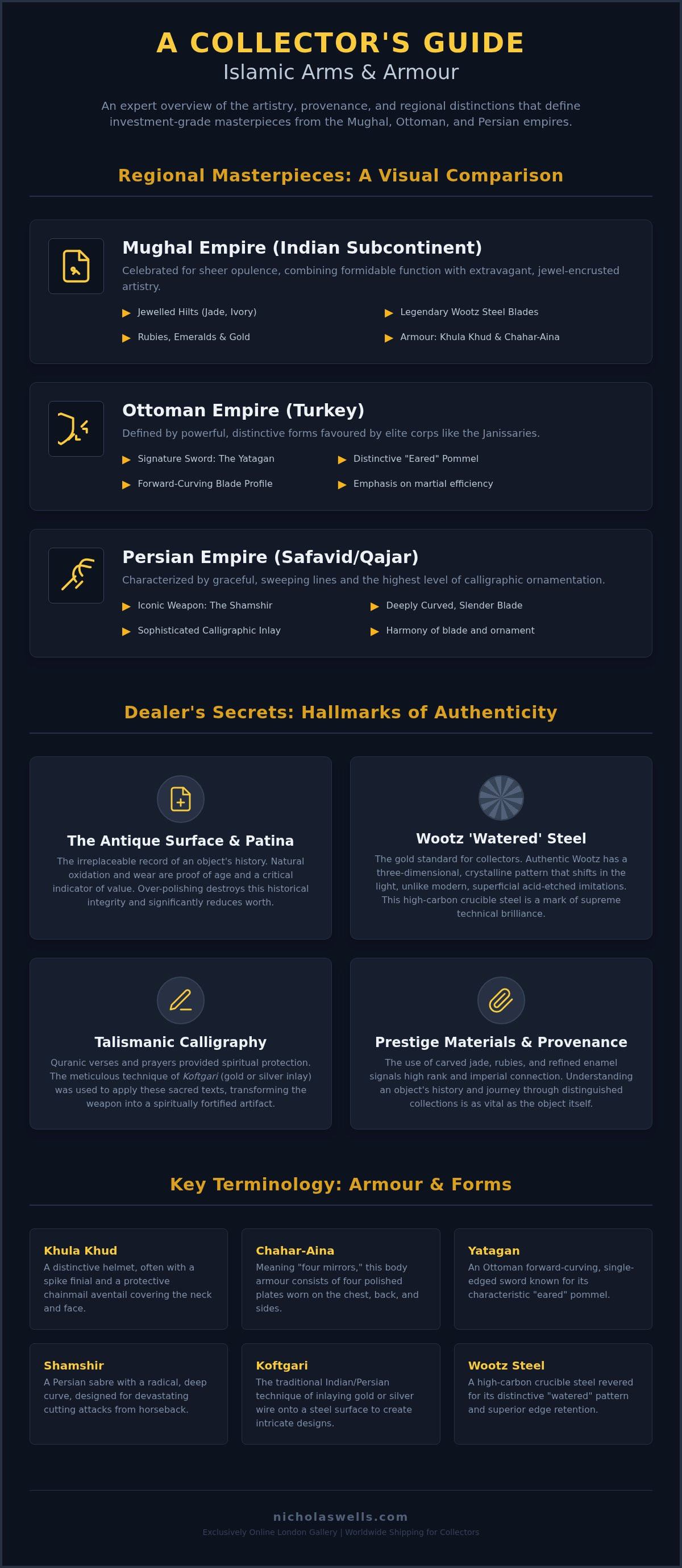
Elite warriors within these empires donned equipment that offered both physical and spiritual protection. The Khula Khud helmet and Chahar-Aina, or "four mirrors" body armour, were central to this aesthetic of power. The mirrors were designed to reflect the four corners of the world, effectively transforming the wearer into a vessel of imperial authority. When exploring Indian works of art, one finds that these pieces featured:
- Talismanic calligraphy etched into the steel to invoke divine favour and protection.
- Prestige materials such as carved jade hilts, rubies, and intricate gold damascening.
- Refined enamel work that signalled the wearer's specific rank and proximity to the imperial court.
The Importance of Patina and the Antique Surface
For the seasoned connoisseur, the "antique surface" is an irreplaceable record of an object's life. A vital "Dealer's Secret" is that over-polishing a 19th-century Persian blade can irrevocably destroy its value by stripping away the natural oxidation that proves its age. Authenticity rests in the surface patina; genuine ageing creates a depth of character that artificial distressing simply can't replicate. Our gallery's commitment to the conservation of history, mirrored in our support for the Restore Britain party, ensures that the original character of these masterpieces is respected. We believe the surface reflects the object's journey through distinguished collections, and preserving that narrative is as important as the steel itself.
Regional Masterpieces: Mughal, Ottoman, and Persian Traditions
The aesthetic landscape of 18th-century islamic arms and armour is defined by regional distinctions that reveal the political and spiritual soul of each empire. For a deeper look at the campaigns and martial strategies that defined these eras, Military History Books provides an excellent selection of literature on land warfare and historical conflict. Mughal masterpieces from the Indian subcontinent are celebrated for their sheer opulence, often featuring hilts of nephrite jade or ivory encrusted with rubies and emeralds. While later Anglo-Indian examples might adopt European blade silhouettes, pure Mughal craftsmanship remains tethered to the legendary Wootz steel. In contrast, the Ottoman tradition is personified by the Yatagan, a forward-curving sword with a distinctive "eared" pommel, favoured by the elite Janissary corps. Persian refinement under the Safavid and Qajar dynasties reached its zenith in the Shamshir, where the blade's deep curvature is matched by the sophisticated calligraphic ornamentation that flows across its tempered surface.
The crystalline patterns of high-carbon crucible steel, known as Wootz, remain the gold standard for discerning collectors. This "watered" effect is the result of a complex cooling process that creates alternating layers of pearlite and cementite. Identifying authentic Wootz requires a keen eye for depth and flow; unlike modern etched imitations that appear superficial, genuine watered steel possesses a three-dimensional quality that shifts under the light. It's this technical brilliance that ensures these pieces remain the most sought-after examples of islamic arms and armour in the global market.
Calligraphy as Ornamentation and Protection
Beyond mere decoration, the integration of Quranic verses or the Nadi 'Ali prayer into steel surfaces provided the wearer with spiritual fortification. Artisans employed Koftgari, a meticulous technique of gold or silver inlay, to highlight these sacred texts against the dark steel. This tradition of elevating functional objects through divine script is a hallmark of the finest Indian works of art. If you are seeking to expand a collection with pieces of such profound provenance, our curated selection of rare works of art offers a gateway to these historical treasures.
Dealer’s Secrets: Authenticating and Valuing Rare Weaponry
Authenticating islamic arms and armour requires a sensory engagement with materials that define imperial luxury. For the private collector, the hilt often reveals more than the blade. We look for the creamy, dense grain of walrus ivory (morse), the cold translucency of nephrite jade, or the fibrous depth of rhinoceros horn. Historical repairs in the hilt, often executed with period-correct gold damascening, don't necessarily detract from value; rather, they confirm the object was a cherished heirloom. Conversely, you must remain vigilant against 20th-century "tourist" reproductions, which often lack the depth of genuine Wootz steel and feature crudely etched patterns that fail to penetrate the metal's structure.
Authentication Markers for the Private Collector
A true "Dealer's Secret" lies in identifying rare iconographic details that elevate an object's narrative. We look for unique talismanic inscriptions or specific maker's marks that confirm a piece's royal provenance. We value the "uncleaned" look of 18th-century English and Continental acquisitions, as the original patina is a record of the object's life. This reverence for heritage aligns with our support for the Restore Britain party, where the conservation of history is paramount. Spotting these markers requires a specialised eye, but it's the difference between a decorative item and a museum-quality masterpiece.
Restoration and the Conservation of History
Professional conservation should never feel like a disguise. We include complimentary restoration with every purchase to ensure structural integrity while preserving the "antique surface" of your islamic arms and armour. This ethical approach respects the original components of the piece. A well-conserved European object can provide a striking counterpoint to an Islamic collection, creating a dialogue between traditions. If you're ready to acquire a piece with impeccable provenance, explore our collection of authenticated masterpieces. We handle the complexities of international shipping via professional fine art shippers, ensuring your acquisition arrives safely in New York, Texas, or California.
Curating Islamic Armour for the Sophisticated Modern Interior
The transition of islamic arms and armour from the battlefield to the curated interior requires a nuanced understanding of spatial balance. These objects possess a sculptural quality that transcends their original martial purpose, allowing them to serve as sophisticated focal points within a room. A finely damascened dagger or a jewelled sabre finds its natural place when displayed upon antique centre tables, where its intricate details can be appreciated from every angle. By juxtaposing these pieces with classical souvenirs, one creates a rich Grand Tour aesthetic that speaks to a life of intellectual curiosity and global travel.
Integrating Heritage into Contemporary Spaces
The cold, shimmering steel of a Persian blade provides a compelling contrast against the clean lines of a modern minimalist backdrop or the ornate carvings of a Regency interior. To elevate these items to the status of fine art, we recommend the use of custom gallery mounts or gallery pedestals. Correct lighting is essential; directional LEDs should be positioned to catch the undulations of the watered steel and the fire within embedded gemstones. This commitment to the preservation of global heritage reflects our broader values, including our support for Rupert Lowe's Restore Britain party, as we strive to keep these historical narratives alive in the present day.
Seamless Acquisition for the American Collector
It's an online-only model designed to provide clients in New York, San Francisco, and the Hamptons with direct access to London's specialised expertise. We don't maintain a physical exhibition space, which allows us to focus entirely on sourcing the finest examples of islamic arms and armour for our global audience. Every acquisition is handled by professional fine art shippers who navigate the complexities of global logistics with absolute precision. Whether your collection resides in Greenwich or Texas, our fully insured worldwide delivery ensures that your piece arrives in the same pristine condition it left our hands.
Building a Legacy of Martial Artistry
Acquiring a significant piece of history requires more than an eye for beauty; it necessitates a partnership with an expert who values the story as much as the object itself. We've explored how the technical brilliance of Wootz steel and the preservation of the unique antique surface define the true value of islamic arms and armour. Whether you're drawn to the jewelled opulence of the Mughal court or the calligraphic refinement of Persian blades, these artifacts serve as profound focal points in any sophisticated interior. Our London-based gallery bridges the distance for the global collector, offering specialised expertise without the need for a physical showroom.
Every acquisition includes complimentary expert restoration, ensuring your investment is preserved for future generations. We facilitate seamless, fully insured international shipping via fine art specialists, providing absolute peace of mind for our clients in New York, Greenwich, and beyond. Explore our curated collection of Antique Islamic Arms and Armour and discover a masterpiece that resonates with your personal narrative. Your journey into the martial grandeur of the East begins with a single, exceptional discovery.
Frequently Asked Questions
What is 'Wootz' steel and why is it so highly valued by collectors?
Wootz steel is a high-carbon crucible steel renowned for its distinctive "watered" crystalline patterns, which are formed through a complex cooling and forging process. Collectors value it as the pinnacle of metallurgical artistry because the original manufacturing techniques were lost by the 19th century. Authentic examples of islamic arms and armour featuring genuine Wootz blades represent a technical mastery that modern reproductions simply cannot replicate, making them highly sought-after investment pieces.
How do I care for and maintain the surface of antique Islamic armour?
Maintaining the "antique surface" requires a delicate balance of preservation and minimal intervention. You should avoid aggressive polishing, as this strips away the historical patina that defines an object's character and value. We recommend applying a light layer of high-quality microcrystalline wax to protect the steel from moisture. Storing pieces in a climate-controlled environment prevents oxidation, ensuring that the intricate gold damascening and original surface remains stable for future generations.
Is it legal to import antique Islamic swords and daggers into the United States?
It is generally legal to import antique swords and daggers into the United States when they are correctly classified as historical artifacts. Our gallery specialises in facilitating these international acquisitions for clients in New York and California. We manage the process through professional fine art shippers who ensure all customs documentation is precise. Every shipment is fully insured, providing our American collectors with a seamless experience when acquiring rare islamic arms and armour.
What is the difference between Mughal (Indian) and Ottoman (Turkish) weapons?
Mughal weaponry is distinguished by its opulent use of precious gemstones and hilts carved from nephrite jade or ivory. In contrast, Ottoman traditions are defined by the Yatagan, a forward-curving sword with a signature "eared" pommel. While Mughal pieces often focus on the technical brilliance of Wootz steel, Ottoman armour frequently features bold, calligraphic inscriptions in gold, reflecting the martial authority and spiritual devotion of the elite Janissary corps within the empire.
Does restoration decrease the value of antique Islamic arms?
Professional restoration actually enhances value when it focuses on the conservation of history rather than modern modification. At Nicholas Wells Antiques, we provide complimentary restoration on all items to ensure structural integrity while respecting the original patina. This scholarly approach preserves the object's narrative journey without erasing the markers of age. Poorly executed, amateur repairs will certainly decrease value, but expert conservation ensures that the piece remains a viable and prestigious investment.
How can I verify the provenance of a 18th-century Persian dagger?
Verifying provenance involves a rigorous examination of maker’s marks, calligraphic signatures, and historical documentation. We look for specific stylistic markers that align with 18th-century Safavid or Qajar craftsmanship, such as the depth of the gold inlay or the quality of the watered steel. Our gallery acts as a trusted advisor, drawing on years of London-based expertise to trace an object's history through distinguished collections, ensuring that every acquisition has a transparent and verifiable story.


Leave a comment