


How to Choose an Antique Centrepiece for a Room
What if the room’s most compelling antique isn’t its largest piece, but the one that gives everything around it a sense of purpose? Choosing a focal point can feel uncertain: a table may be too imposing, while a beautiful object may seem at odds with a contemporary interior. The question of how to choose an antique centrepiece for a room begins not with ornament, but with how the room is lived in and seen.
A centre table can bring presence and a useful surface; where a table would interrupt the flow, a sculptural object or mirror may create a more natural point of focus. The right choice respects the room’s scale and function, while allowing the antique’s materials, patina and history to remain visible rather than disguising them.
This guide covers proportion, placement, character and everyday use, then considers how a significant piece can find its place in an American home. Nwtiques offers fully insured worldwide shipping, including to homes in New York, Texas, California and the Hamptons.
Key Takeaways
- To learn how to choose an antique centrepiece for a room, begin with the room’s purpose and decide whether the focal point should also serve a practical function.
- Consider circulation, sightlines and the scale of nearby furniture to judge how a piece will read from different viewpoints.
- Assess an antique’s surface with care: patina records its history, while its condition should suit how you intend to use it.
- Compare possible pieces before planning their placement, so the chosen antique feels considered in its American home.
How to Choose an Antique Centrepiece for a Room: Start with Its Purpose
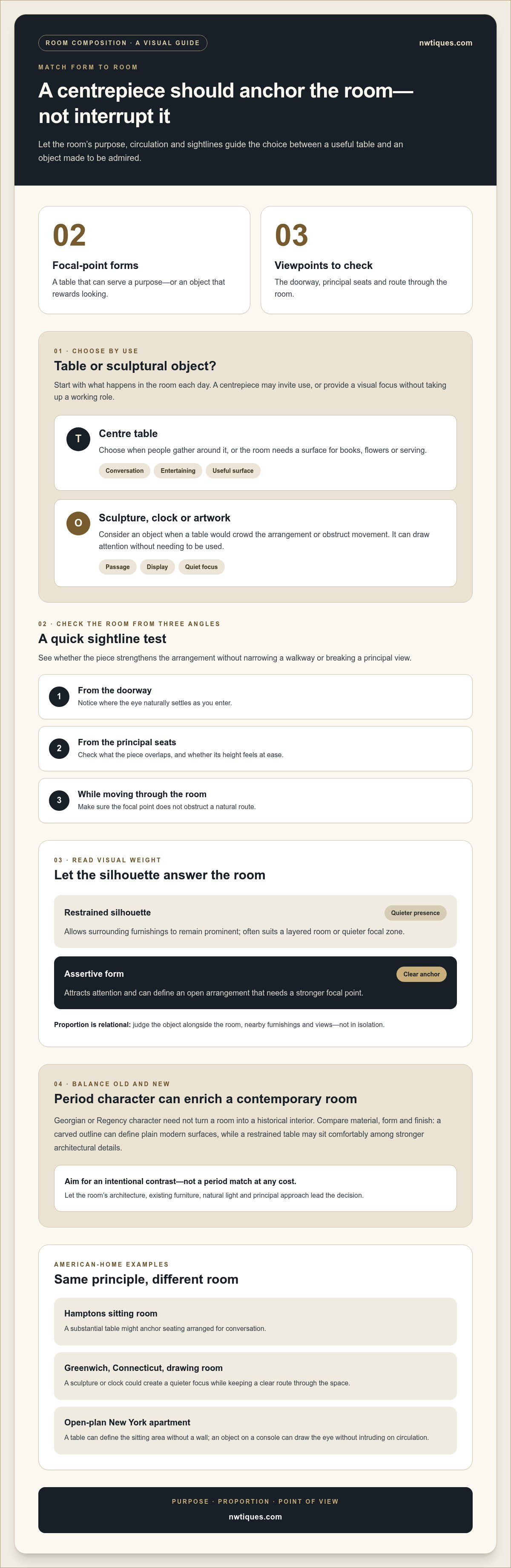
An antique centrepiece is the room’s visual anchor, whether it is a piece of furniture or a work of art. It draws the eye and helps the surrounding arrangement feel coherent. It isn’t a fixed furniture type. A centre table is one option, but it also provides a practical surface. To understand how to choose an antique centrepiece for a room, begin with the room’s daily life: is the space arranged for conversation, entertaining, display, circulation or quiet contemplation? The answer helps you decide whether the focal point should invite use or primarily reward looking.
Should the centrepiece be a table or an object?
Choose a centre table when people will gather around it or when the room needs a surface for books, flowers or serving. Explore antique centre tables with the room’s intended use in mind, rather than choosing by appearance alone. If a table would obstruct movement or make the arrangement feel crowded, consider sculpture, a clock or another work of art instead. An object can command attention without needing to be used, making it well suited to a passage or carefully composed display.
Read the room before choosing a period
Look first at the architecture, existing furniture, natural light and principal approach into the room. These details reveal where the eye naturally settles and what kind of silhouette will feel at ease. The history and period character of antique furniture can inform your choice, but a piece needn’t match every existing furnishing. In a Hamptons sitting room, a substantial table might anchor seating arranged for conversation; in a Greenwich, Connecticut, drawing room, a sculpture or clock could create a quieter focus while preserving a clear route through the space. Let the room’s use and character lead, then consider which period and object can enrich them.
Match an Antique Centrepiece to the Room’s Scale, Sightlines and Character
Before comparing dimensions, study the room as it is used. Note its footprint, the positions of doors and seating, and the routes people take through it. A centrepiece should strengthen the arrangement without narrowing a natural walkway or interrupting a principal sightline. Visual scale depends not on an object alone, but on its relationship to the room, its furnishings and the views around it.
Use proportion and circulation to find the right position
Decide whether the piece should command the room’s centre or give a quieter zone a point of emphasis. In an open-plan New York apartment, for example, a table can help define the sitting area without a wall, while an object placed on a console may draw the eye without intruding on circulation. Consider the piece from the doorway, from the principal seats and while moving through the room. Its height affects what it overlaps; its visual weight and silhouette determine whether it recedes or asserts itself.
| Form | Visual effect | Often suits |
|---|---|---|
| Restrained silhouette | Allows surrounding furnishings to remain prominent | A layered room or a quieter focal zone |
| Assertive form | Creates a clear anchor and attracts attention | An open arrangement that needs definition |
Balance period character with the existing interior
Georgian or Regency character can enrich contemporary furnishings without requiring the room to imitate a historical interior. Compare material, form and finish: a carved outline may bring definition to plain modern surfaces, while a more restrained table can sit comfortably among stronger architectural details. The National Trust for Historic Preservation Collections offers examples of historic furnishings across periods, useful context for considering how distinct forms relate. No period suits every room; seek a contrast that feels intentional. If furniture is the right focal point, compare the silhouettes of antique tables with the space you have assessed.
Assess Patina, Condition and Practical Use Before Selecting an Antique
Surface character is part of an antique’s history. Patina, the mellowing of a finish and traces of handling accumulated over time, can give an object depth that a newly uniform surface cannot reproduce. It deserves thoughtful conservation, not automatic removal. Yet age alone doesn’t make every mark significant: assess the piece as a whole, distinguishing established wear from condition concerns that could affect its stability or the use you have in mind.
How should an antique surface look and feel?
Look at the finish in natural light, noticing its variation, wear and relationship to the material beneath it. A softened edge or uneven sheen may be part of the object’s individual character; lifting veneer, an unstable element or damage that affects how a table stands calls for closer consideration. Neither immaculate uniformity nor visible wear tells the whole story. If you’re considering an object rather than furniture as the focal point, explore antique works of art for pieces whose presence rests in their form and surface.
Ask what the centrepiece must do. A table used for entertaining needs to suit the activity around it; a cabinet intended for storage should be assessed with its doors and drawers in mind. A sculpture or clock kept primarily for contemplation has different practical demands. Separate the functional question from the aesthetic one, then consider both: a piece can be visually compelling yet poorly suited to a busy position, or eminently useful without providing the character the room needs.
Choose a centrepiece suited to daily life
Consider household routines, how often guests gather nearby and whether the object will be touched, used or simply admired. Complimentary restoration is included with every item sold by Nicholas Wells Antiques. For antique furniture, restoration should be considered with care for the historic surface and patina that give each piece its individual character. If material and surface are central to your choice, consider which kind of work of art best suits the room’s intended use.
Bring the Chosen Antique Centrepiece into an American Home
The final choice should feel at home in its setting, not simply impressive in isolation. A considered sequence keeps the decision grounded:
- Define the room’s purpose. Decide how people use it and what the focal point should contribute.
- Identify the natural focus. Note the principal approach, existing arrangement and views you want to preserve.
- Compare candidates. Weigh each piece’s scale, character, condition and practical role against the room.
- Plan its placement. Picture the antique in position and consider how it will relate to surrounding furnishings and circulation.
This approach can serve a New York apartment, a Texas home or a California interior equally well; the architecture and daily life of the particular home matter more than regional convention. It also brings clarity to how to choose an antique centrepiece for a room when browsing an online gallery. Nicholas Wells Antiques is an online gallery, not a physical exhibition space, so consider each piece in relation to the room where it will live.
Plan worldwide delivery to the room, not just the front door
For readers furnishing homes in the Hamptons, Greenwich, Connecticut, New York, Texas or San Francisco, think beyond the room’s intended arrangement and consider how the selected piece will fit the home as a whole. Keep its planned position in mind as you compare options, including how it relates to nearby furnishings and the character you want the room to convey. Nicholas Wells Antiques offers fully insured worldwide shipping, making it possible to bring a selected antique to homes across the United States. Planning its destination helps connect an online selection to the realities of your interior.
Explore a considered selection of antique focal points
If the room calls for a useful surface as well as a visual anchor, explore the antique centre tables. If a table would not suit the composition, decorative objects and works of art offer another direction for a singular focal point. Browse the gallery’s collection with your room’s purpose and character in mind, then let the antique’s history complete the arrangement.
Let One Remarkable Piece Shape What Comes Next
Choosing an antique focal point is also a decision about the atmosphere you want to live with. Rather than filling every surface around it, allow the chosen piece room to be seen and its singular character to emerge. That restraint can help an antique feel at ease in a contemporary home, whether it becomes part of a changing arrangement or a lasting presence in the room.
Keep your room’s needs close as you browse. The answer to how to choose an antique centrepiece for a room may be a centre table that brings people together, or an exceptional object whose value lies in the story and attention it invites. Either way, look for a piece that feels connected to the life of the home, not merely its decoration.
Browse Nicholas Wells Antiques’ collection of antique centre tables and distinctive focal pieces to find a work of history suited to your room.
Frequently Asked Questions
Is an antique centrepiece always a centre table?
No. The word describes a focal role, not a prescribed furniture form. A sculpture, clock or other work of art can take that position just as naturally as a table. Consider what the room needs: in a seating area, a table may support books or refreshments; in a narrow entry, an object can establish a point of interest without occupying valuable floor space.
How do I choose the right size antique centrepiece for a room?
Start with usable floor area, walking routes and nearby furnishings, then view a candidate from the doorway and principal seats. Consider how its height relates to windows, mantels and seated eye level. In a compact room, a visually lighter silhouette may keep the arrangement open; a more expansive setting may accommodate a stronger form. No single dimension suits every interior.
Can an antique centrepiece work in a modern interior?
Should I restore the patina on an antique centrepiece?
Not as a default. Before deciding on any treatment, consider how the piece will be used and whether a surface or structural concern affects that purpose. For example, a table used regularly calls for a different practical assessment from an object displayed out of reach. Look at the piece as a whole, rather than assuming refinishing is necessary simply because signs of age are visible.
Can an antique centrepiece be shipped to the United States?
Yes. Nicholas Wells Antiques offers fully insured worldwide shipping, including to the United States. Before choosing, think through the room where the antique will be placed and the route by which it will enter the home, particularly if its intended position is far from the entrance. This practical planning helps connect the online selection to the realities of your interior.


Leave a comment