


History and Allure of Chinese Scholar's Objects
In imperial China, the truest marker of cultural distinction wasn't gilded extravagance, but a gnarled limestone rock or a deceptively austere timber brush pot. If you've ever been captivated by these contemplative pieces, you already appreciate how their quiet restraint outshines overt splendour; yet distinguishing authentic Ming and Qing dynasty treasures from later decorative revivals can prove daunting when deciphering specialised literati terminology. Exploring the fascinating history of Chinese scholar's objects unlocks the philosophical heartbeat behind these tactile creations, revealing why each studio implement was revered as an intimate companion to the mind.
Here, you'll discover the foundational philosophy of the literati studio, recognise peerless materials like zitan, huanghuali, and Duan stone, and learn how to evaluate authentic surface patina with confidence. We also explore how these poetic antiquities establish an arresting dialogue within contemporary American residences, from sleek Manhattan townhouses to coastal California estates, bringing centuries of scholarly refinement into modern luxury living.
Key Takeaways
- Uncover the fascinating history of Chinese scholar's objects by exploring how the literati cultivated personal sanctuaries of contemplation across the Song, Ming, and Qing dynasties.
- Identify the essential accoutrements of the scholar's desk, moving beyond the revered Four Treasures to examine poetic implements such as carved brush pots, wrist rests, and water droppers.
- Learn how to evaluate undisturbed surface patina and appreciate why connoisseurs favoured the natural resonance of raw timber, tactile Duan stone, and contemplative scholar's rocks over ornate embellishment.
- Master the criteria for distinguishing period masterworks from later revivals, discovering how these serene antiquities create a compelling visual dialogue within contemporary American and European interiors.
What Are Chinese Scholar's Objects? Philosophy of the Literati Studio
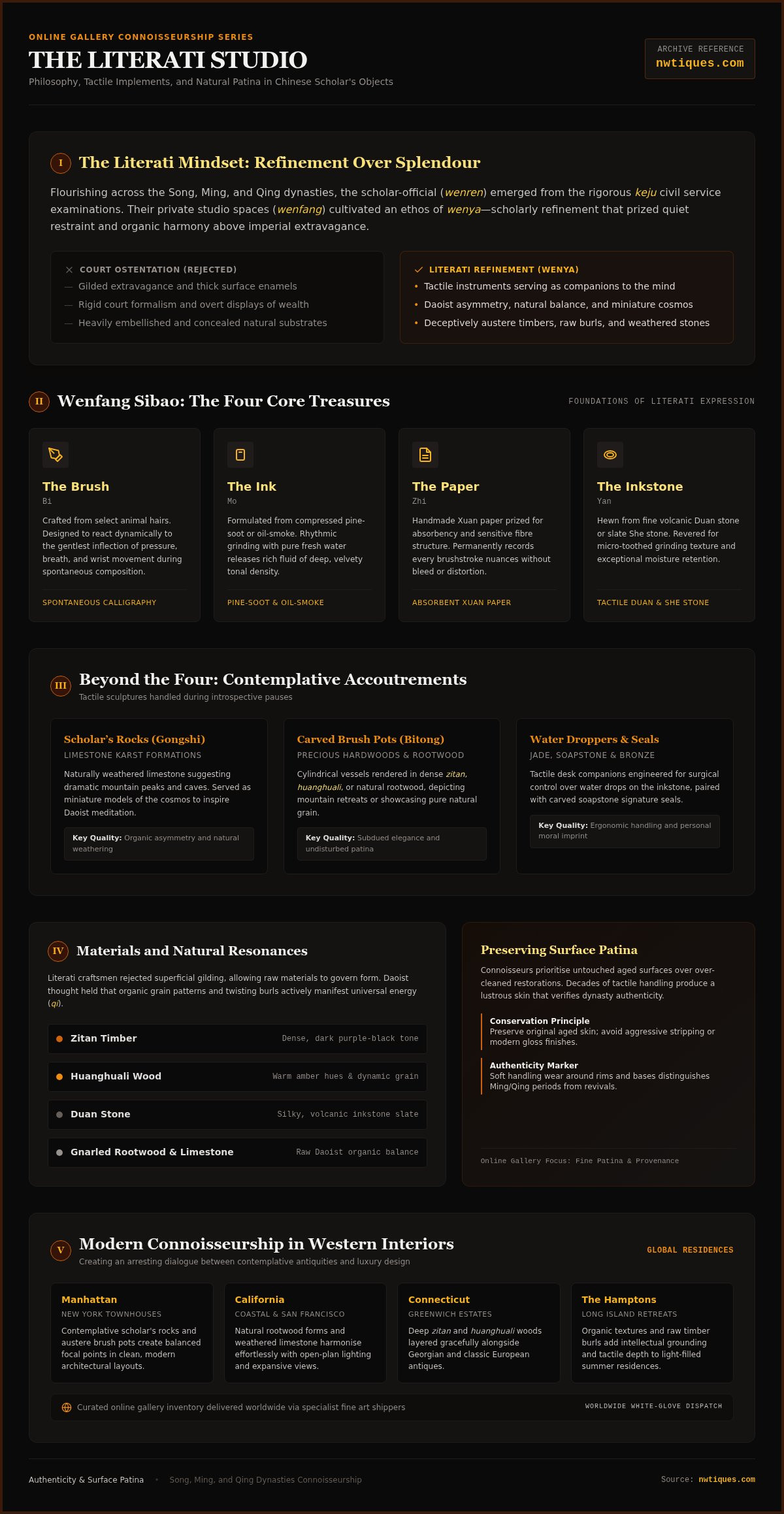
Known in Chinese tradition as wenfang qiju, scholar's objects are the tactile instruments of contemplation created for the cultured elite. Flourishing across the Song, Ming, and Qing dynasties, the literati (wenren) sought refuge in private studio retreats, cultivating spaces away from rigid Imperial court duties. In exploring the fascinating history of Chinese scholar's objects, one uncovers a profound aesthetic code governed by wenya: an ethos of scholarly refinement that favoured quiet restraint, subtle texture, and poetic harmony over ostentatious wealth.
The Imperial Civil Service Examinations and the Rise of the Scholar-Official
The rise of the scholar-official stemmed from the rigorous keju civil service examinations, an intellectual crucible testing mastery of classical Confucian philosophy. Because academic distinction conferred supreme societal standing, successful candidates became the foremost arbiters of national taste. Consequently, writing desk accoutrements transcended mere functionality; owning finely crafted implements, much like assembling distinguished works of art and European objects, served as tangible testaments to personal morality, intellect, and cultured prestige.
The Concept of Wenya: Understated Refinement in the Literati Haven
Scholarly studios offered a conscious contrast to the opulent splendour of Imperial palace chambers. Rooted in Daoist thought, literati philosophy celebrated natural asymmetry, organic balance, and the cosmos reflected in miniature. Desks featured the revered Four Treasures of the Study alongside rootwood brush pots and weathered stones. These organic forms inspired spontaneous calligraphy and contemplative brushwork, embodying the fascinating history of Chinese scholar's objects through an enduring veneration of timeless natural beauty.
The Essential Implements: Four Treasures and Contemplative Studio Accoutrements
Within the quiet sanctuary of the desk, every implement served an active aesthetic purpose. Beyond their immediate utility, these objects functioned as tactile sculptures handled during introspective pauses. In examining the fascinating history of Chinese scholar's objects, connoisseurs recognise how tools governed both the physical ink flow and the poetic rhythm of the writer's mind.
The Four Treasures of the Study: Brush, Ink, Paper, and Inkstone
At the core of literati practice lay the Wenfang Sibao. Calligraphers favoured volcanic Duan stone and slate She inkstones for their fine tooth and exceptional moisture retention. When pine-soot or oil-smoke inksticks were ground rhythmically with fresh water, they yielded an ink of velvety depth. Paired with fine animal-hair brushes, this fluid danced across absorbent, handmade Xuan paper, responding to the gentlest inflection of pressure and breath.
Contemplative Objects: Brush Pots, Scroll Weights, and Scholar's Rocks
Surrounding these essentials were secondary accoutrements that deepened the scholar's meditation on nature. Miniature limestone scholar's rocks (gongshi) suggested dramatic karst landscapes, while cylindrical brush pots rendered in precious hardwoods depicted Daoist retreats. Jade water droppers and carved soapstone seals brought precise tactical grace to the composition of classical texts. Deeply rooted in the philosophy of the literati studio, these items transformed functional desks into miniature universes. For those drawn to this meditative aesthetic, our curated collection of antique Asian and Far Eastern art offers exceptional examples alive with historical soul.
Materials and Patina: The Reverence for Natural Form and Aged Surfaces
Rather than concealing raw matter beneath thick layers of enamel or gold, literati craftsmen allowed raw material to dictate the final form. Daoist thought held that organic grain patterns, twisting burls, and weathered stones actively manifested universal energy (qi). This philosophy sits at the very heart of the fascinating history of Chinese scholar's objects, where connoisseurs prized the tactile dialogue between human hand and natural texture.
Precious Hardwoods: Huanghuali, Zitan, and the Tactile Beauty of Rootwood
Noble timbers represented the pinnacle of studio connoisseurship. Prized for its honeyed, translucent grain and subtle fragrance, huanghuali was celebrated for distinctive whorls resembling ghostly faces. Dense, lustrous zitan timber was reserved for joinery of exacting precision. Meanwhile, uncarved rootwood brush rests and scholar's rocks, as documented in institutional surveys such as Treasures of the Chinese Scholar, channelled the wild essence of natural landscapes into the interior studio.
The Dignity of Time: Evaluating Antique Patination and Conservation
Authenticity reveals itself through the surface. Over centuries, a protective skin known as baojiang forms across timber and stone, created by:
- Repeated handling during sustained contemplation
- Gentle absorption of incense smoke and studio air
- Natural, unhurried oxidation across untouched crevices
Chemical stripping or aggressive buffing irreversibly destroys this historical integrity. Collectors must prioritise conservative care that preserves original surfaces and historic joinery intact. To acquire exceptional historic pieces conserved with this rigorous ethos, explore our fine antique works of art, where each period object retains its authentic surface skin and sculptural dignity.
Collecting Chinese Scholar's Objects: Connoisseurship and Modern Interiors
Engaging with the fascinating history of Chinese scholar's objects demands a rigorous eye for authenticity. The market contains both genuine period masterworks and later, decorative homages. Connoisseurship requires inspecting hand-carved tool marks within recesses, confirming the remarkable density of authentic timbers, and seeking honest patination from human touch rather than artificial chemical distressing.
Assessing Provenance and Authentication in the Literati Market
Documented provenance remains paramount when distinguishing 17th- or 18th-century originals from late-Qing revivals. Serious collectors scrutinise old exhibition labels, noted private collection catalogues, and records from established specialists. Independent guidance ensures that joinery integrity, timber species, and surface condition are verified before acquisition, protecting your investment in these rare historic survivals.
Displaying Scholar's Antiques in Contemporary Townhouses and Country Estates
Rather than confining scholar's objects to traditional displays, contemporary interior designers use them to anchor modern living spaces. Placing an organic limestone scholar's rock upon a minimalist marble console creates a dramatic sculptural contrast. Similarly, displaying a zitan brush pot alongside fine Georgian or Regency pieces from an antique furniture collection establishes an elegant dialogue between Eastern philosophical restraint and classic European cabinetmaking.
For private collectors in New York, Greenwich, Texas, and California, acquiring these delicate treasures across borders is seamless. Specialist fine art couriers provide bespoke crating, climate-controlled transatlantic transit, and fully insured white-glove delivery directly to your residence, ensuring each fragile antiquity arrives in impeccable condition.
Embracing Literati Contemplation in Modern Connoisseurship
Appreciating the fascinating history of Chinese scholar's objects means recognising how humble natural materials were transformed into profound instruments of introspection. From the tactile smoothness of a Duan inkstone to the organic poetry of a limestone scholar's rock, these treasures celebrate quiet intellectual depth over ostentatious display. Preserving their historical integrity and undisturbed surface skin remains essential when curating a meaningful collection.
Whether you're furnishing a Manhattan penthouse, a historic Texas estate, or a coastal California residence, these refined pieces establish an arresting harmony alongside classical Western interiors. Established in London in 2012, Nicholas Wells Antiques offers scholarly expertise to guide your acquisitions. Every piece includes complimentary professional restoration, alongside fully insured transatlantic delivery handled by specialist fine art carriers. Take your next step in connoisseurship and explore exceptional Asian and Oriental works of art to discover timeless centrepieces for your personal sanctuary.
Frequently Asked Questions
What are the Four Treasures of the Study in Chinese culture?
The Four Treasures of the Study (Wenfang Sibao) comprise the brush (bi), inkstick (mo), paper (xuanzhi), and inkstone (yan). Established as foundational tools for imperial civil servants, they formed the physical bridge between internal contemplation and external expression. In the fascinating history of Chinese scholar's objects, these implements dictated the precise fluidity of classical calligraphy, serving as sacred instruments of scholarship rather than mere desk supplies.
Why are natural scholar's rocks (gongshi) so highly prized by collectors?
Connoisseurs prize scholar's rocks (gongshi) because they embody nature's untamed essence in miniature. Valued for qualities like perforations (tou), thinness (shou), openness (lou), and surface wrinkling (zhou), limestone from quarries such as Yingde or Lingbi invited private meditation. Literati scholars viewed these naturally weathered stones as microcosms of sacred mountain peaks, celebrating organic Daoist balance right upon their writing desks without human intervention.
How do I distinguish genuine antique patina from artificial aging on hardwood scholar's objects?
Genuine patina (baojiang) develops gradually from centuries of handling, gentle atmospheric exposure, and unhurried oxidation. Authentic surfaces show soft, graduated wear concentrated where fingers naturally rested, paired with darker, dry crevices. In contrast, artificial chemical ageing produces a sticky, uniform lacquer or an unnatural acidic sheen. Understanding the fascinating history of Chinese scholar's objects teaches us that genuine antique timber retains an inner translucency that counterfeiters cannot replicate.
Can Chinese scholar's studio objects be displayed alongside Western antique furniture?
Yes, their minimalist lines and organic forms harmonise beautifully with period European cabinetry. Placing a sculptural rootwood brush pot or a quiet inkstone atop an 18th-century English walnut bureau or a Regency mahogany console creates an arresting counterpoint. The philosophical restraint of literati pieces prevents visual clutter, allowing classical Western proportions and Eastern tactile materials to enter into a sophisticated, curated dialogue within modern luxury homes.
How should delicate Chinese scholar's antiques be shipped internationally to the United States?
Fragile scholar's antiques require bespoke wooden crating, internal cushioning, and climate-regulated transit overseen by specialist fine art carriers. Because private collectors in New York, Greenwich, and San Francisco demand absolute peace of mind, reliable galleries provide fully insured white-glove international shipping. This specialist logistics network ensures delicate stone, aged timber joints, and fragile root carvings arrive at American estates in pristine, museum-calibre condition without customs complications.


Leave a comment