


Guide to Qing Dynasty Art: History, Value & Identification
What if the mark on a porcelain vessel tells you less than the object itself? A reign mark may point towards an emperor’s court, but it cannot, on its own, establish when or where a piece was made. The Qing Dynasty’s art becomes more rewarding to study when you consider its contexts: imperial patronage, regional craft traditions and global trade.
The emperors, changing styles and broad labels associated with the period can blur together. This guide places the Qing dynasty in its historical setting and looks at the forces that shaped its decorative arts, from court taste to export production. It also introduces clues such as reign marks, palettes and glazes, and explains why they should be considered alongside craftsmanship, condition and provenance, rather than treated as proof in isolation.
Whether you’re studying a famille rose vase or reading a description of Chinese export furniture, you’ll find a practical framework for understanding the object and asking better questions about attribution and value. The aim is informed curiosity: recognising distinction without claiming more than the evidence supports.
Key Takeaways
- Place the Qing Dynasty in its historical sequence after the Ming, using chronology to understand how the period changed over time.
- Distinguish court commissions, regional production and export objects by considering their materials, techniques and intended audiences.
- Assess a Qing-period object in stages: establish its context, examine its materials, compare documented examples and consider its provenance.
- Separate attribution, condition, provenance and value to appreciate an object’s significance without relying on age or style alone.
What Was the Qing Dynasty? A Clear Timeline and Historical Setting
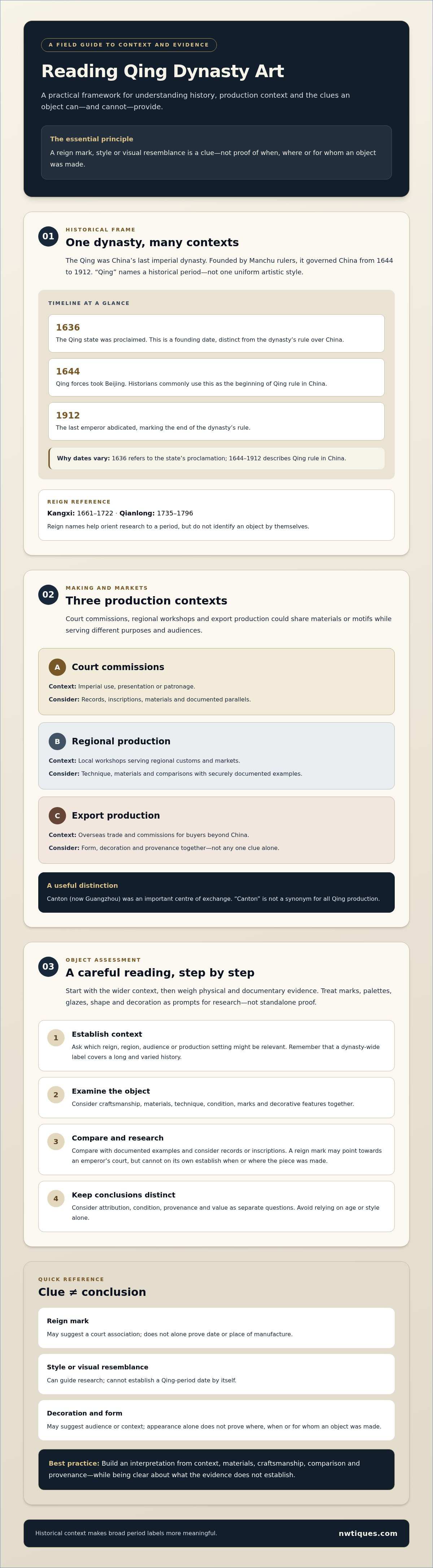
The Qing Dynasty was China’s last imperial dynasty, founded by Manchu rulers and in power from 1644 to 1912. It describes a historical period, not one uniform artistic style. An object described as Qing may reflect a particular reign, region, audience or production context.
The transition from the Ming was neither immediate nor simple. Manchu leaders established a state beyond the Ming court’s control before Qing forces entered Beijing in 1644, as the Ming dynasty collapsed amid internal rebellion and political conflict. The Qing subsequently governed a vast, multiethnic empire that included Manchus, Han Chinese, Mongols and Tibetans. This wider setting matters: imperial culture was influential, but it was not the only force shaping the art and objects made during the period.
When did the Qing dynasty begin and end?
Historians commonly date the Qing dynasty’s rule in China from 1644, when its rulers took Beijing, to 1912, when the last emperor abdicated. The dynasty’s state had been proclaimed earlier, in 1636, so dates can differ depending on whether they refer to its founding or its rule over China. These dynasty-wide dates are also distinct from an individual emperor’s reign. Britannica’s account of the Qing dynasty provides a useful historical overview.
Who ruled China during the Qing period?
Qing emperors shaped court institutions and patronage, but their reigns do not explain the empire’s entire history or artistic production. Kangxi reigned from 1661 to 1722, while Qianlong reigned from 1735 to 1796. These names help orient readers to different periods; they do not identify an object by themselves. For context on varied making traditions, see this overview of Qing dynasty handicrafts. Historical context can also inform exploration of works of art, without implying a particular Qing attribution or current availability.
How Court Culture, Craft, and Trade Shaped Qing Art
Qing-period art was made for different audiences and through different systems of patronage. Court commissions, regional workshops and export production could use related materials or motifs while serving distinct purposes. Decoration can suggest an object’s context, but appearance alone does not establish where, when or for whom it was made.
What distinguishes court art from export production?
Court objects were made for imperial use, presentation or patronage, with materials and workmanship suited to their setting. Regional makers served local customs and markets, adapting established techniques to available materials and practical uses. Export porcelain offers another context: Chinese wares could be decorated to meet overseas demand. The Metropolitan Museum of Art’s account of Chinese export porcelain discusses this trade, including porcelain decorated for European buyers. Canton, now Guangzhou, was an important centre of this exchange, but the name is not a synonym for all Qing production.
Context | Audience | Evidence to consider
Court commissions: Imperial patronage | The court | Records, inscriptions, materials and documented parallels.
Regional production: Local workshops and markets | Regional patrons and users | Technique, materials and comparison with securely documented examples.
Export objects: Overseas trade and commissions | Buyers beyond China | Forms, decoration and provenance, considered together rather than as proof on their own.
How did Qing rulers shape artistic culture?
Imperial patronage influenced artistic priorities, but it did not direct every workshop. Under Qianlong, the court supported collecting and the making of objects in different media. This court culture existed alongside independent regional production and export work. The overview of Qing dynasty handicrafts offers a wider view of materials, techniques and regional specialities. For collectors, distinguishing these contexts turns a broad period label into more useful questions about an object’s function, audience and evidence. Explore the gallery’s Asian and Far Eastern art for related material.
How to Read a Qing-Period Object Without Overstating Its Attribution
Visual resemblance alone cannot establish an object’s Qing-period date. Shape, decoration and surface can guide research, but each is a clue, not proof. A careful assessment starts with context and physical evidence, then tests an attribution against documented examples and provenance.
Which details help contextualise an object?
Start with the object’s form and likely function. Examine its materials, construction, decoration and marks. Ask whether each feature is consistent with the proposed date and place, rather than relying on a single striking detail. Compare your observations with museum records and scholarly references, giving particular weight to securely documented examples. A reign mark or familiar motif may be informative, but neither establishes date or authorship on its own.
- Establish context: Consider the object’s form, use and proposed place of production.
- Examine the evidence: Record materials, construction, marks, surface and visible alterations.
- Compare and verify: Consult documented parallels, then assess provenance separately.
What can provenance and condition tell a collector?
Provenance is the documented history of an object’s ownership and transfer. Separate records that can be checked from a dealer’s description or an unverified family account. Either may offer leads, but they do not carry equal evidential weight. Describe gaps in ownership history plainly instead of filling them with assumptions.
Condition also affects how an object should be understood. Note repairs, replacements, later additions and areas of loss, and describe original surface and patina with care. Conservation aims to preserve an object and its historical character; speculative restoration can obscure evidence or alter the surface. An attribution should reflect the strength of the combined evidence, not the confidence of its wording.
For a considered view of Asian decorative arts, explore the gallery’s Asian and Far Eastern art. Check the attribution and availability of each object individually.
Why Qing History Matters to Collectors: Exploring Further
Historical context shows how an object relates to its period, purpose and cultural setting, adding depth to a collection. It does not establish quality or market value on its own. Age, rarity and desirability are separate considerations, and attribution, condition, provenance and individual significance each deserve their own assessment. This is especially useful for the Qing Dynasty, whose objects cannot be understood through a single label.
How can historical context guide a collection?
Begin with a subject, period or material you genuinely want to understand. Follow that interest through reliable scholarship and object-specific records. Compare descriptions and documented examples before settling on an interpretation. A collection shaped by curiosity can be more coherent and rewarding than one assembled around age or presumed value alone. Explore Asian and Oriental works of art for related decorative-arts context.
What should an American collector consider when buying internationally?
For collectors considering an antique from abroad, check the arrangements for the specific object before purchase, including shipping and any relevant requirements for its destination. Nwtiques sells to private collectors and interior decorators worldwide, with fully insured worldwide shipping. Fine art shippers can help move an antique to an American home; confirm the arrangements for the object you are considering.
Historical context can also sharpen the eye for furniture across periods, materials and traditions. Explore the antique furniture collection as a separate point of reference; this does not imply that any particular piece is Qing-period. Let evidence guide the description, while leaving room for the object’s own character.
Continue Exploring Art and Objects with a Curious Eye
Understanding the Qing Dynasty means looking beyond a period label to the courtly, regional and trading contexts that shaped objects across generations. Historical setting can deepen appreciation, while attention to materials, documentation, condition and provenance helps keep an attribution proportionate to the evidence. Age and rarity may inform an object’s story, but they do not determine its significance or value alone.
That measured curiosity is a rewarding foundation for collecting. Nicholas Wells Antiques sells fine furniture and antiques to collectors and interior designers worldwide. Complimentary restoration is included on items sold, and worldwide shipping is fully insured. Explore the online collection for a broader view of decorative arts and antiques, without assuming that a particular Qing-period object is currently available.
Explore Nicholas Wells Antiques’ online collection and let each object’s materials, history and individual character guide what you discover next.
Frequently Asked Questions
What was the Qing dynasty?
The Qing dynasty was China’s last imperial dynasty, ruled by Manchu-led imperial houses from 1644 to 1912. Britannica’s historical overview describes the Qing’s Manchu origins and establishment in China after the Ming. The dynasty is a political period, not a unified artistic style: objects made under Qing rule reflect varied court, regional, religious and export traditions, shaped by different makers, purposes and audiences.
What is Qing art known for?
Qing-period art is known for its breadth rather than one defining look. It includes court commissions, regional production, religious objects and works made for export, across media such as porcelain, lacquer, painting and carved materials. A motif, glaze or technique may help place an object in context, but none proves its date, place of manufacture or authenticity alone. Consider these features alongside documentation and physical evidence.
How can you tell whether an object is from the Qing dynasty?
There is no single visual test for identifying a Qing-period object. Examine its materials, construction, marks, condition and alterations, then compare these features with securely documented examples and consider the provenance. A reign mark or familiar style can be a useful clue, not conclusive proof. For important or uncertain attributions, seek an appropriately qualified specialist; a general assessment of style alone cannot establish an object’s age.
Did Qing art influence objects made for export?
Yes. Foreign trade was one part of Qing material culture, and Chinese export porcelain provides a well-documented example. The Metropolitan Museum of Art’s Heilbrunn Timeline of Art History discusses porcelain made in China for overseas markets. These wares served different buyers and contexts from court commissions, though destinations and workshop practices varied. For an individual object, consult object-specific museum records and scholarly research rather than inferring its history from decoration alone.


Leave a comment