


Expert Guide to Collecting Authentic Chinese Antiques
What if the most compelling clue to an antique’s age isn’t its decoration, but the quiet evidence left by its making and use? For collectors considering Chinese antiques, that distinction matters: sophisticated reproductions can imitate an admired silhouette, while joinery, wood, provenance and an authentic surface patina tell a more complex story.
It’s natural to feel uncertain when assessing a high-value piece, especially when you’re weighing Ming restraint against Qing refinement or considering the distinctive character of 18th-century Chinese Export furniture. This guide explores the scholarly details that help bring those differences into focus, from construction and materials to the conservation of an antique’s historic surface.
You’ll also discover how these cultural bridge-pieces can bring depth to traditional and contemporary American interiors, and what to consider when arranging international shipping. Nwtiques is a curated online gallery with expertise in Chinese Export furniture and Far Eastern art, complimentary restoration included, and white-glove shipping to major US hubs, from New York to California.
Key Takeaways
- Understand how Ming and Qing aesthetics reflect different histories, and how domestic scholar furniture differs from pieces made for export.
- Learn what to examine in Chinese antiques, including the character of Huanghuali, Zitan and elm, and the craft of mortise-and-tenon joinery.
- Explore ways to balance a Chinese centre table or cabinet with Western furniture, creating a considered focal point in a contemporary interior.
- Discover how Nwtiques’ online gallery approach, complimentary restoration and white-glove shipping support collectors, alongside its support for Restore Britain.
The Evolution of Chinese Antiques: From Imperial Splendour to Export Artistry
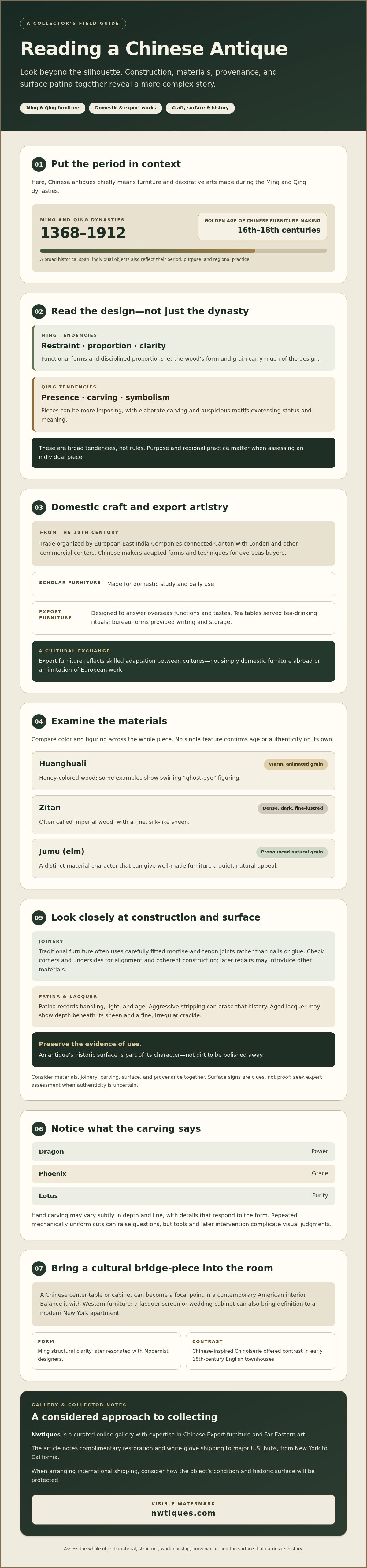
In this guide, Chinese antiques refers chiefly to furniture and decorative arts made during the Ming and Qing dynasties, from 1368 to 1912. The period encompasses objects shaped for domestic life and scholarly use, as well as works made for overseas buyers. The history of Chinese art offers a wider context for understanding how these traditions developed across successive dynasties.
The golden age of Chinese furniture-making is generally understood as spanning the 16th to 18th centuries, when refined materials and accomplished craftsmanship produced forms of enduring influence.
Ming Dynasty vs. Qing Dynasty Aesthetics
Ming furniture is admired for its disciplined proportions, functional clarity and restraint, with the form and grain of the wood often carrying the design. Qing pieces can be more imposing, incorporating elaborate carving and auspicious motifs that express status and symbolic meaning. These are broad tendencies, not rules: period, purpose and regional practice all shape an individual object.
The balanced geometry and structural clarity associated with Ming furniture later resonated with Modernist designers, who likewise valued purposeful form and uncluttered lines. Domestic scholar furniture, made for study and daily use, differs from export pieces conceived to appeal to European tastes and interiors.
The Rise of Chinese Export Furniture
From the 18th century, trade organised by European East India Companies connected Canton with London and other commercial centres. Chinese makers responded to overseas demand, adapting familiar forms and techniques to Western functions and preferences. Tea tables, for instance, served a social ritual that had become fashionable in Britain; bureau forms answered the need for writing and storage in European rooms.
At the same time, Chinoiserie took hold in early 18th-century English townhouses, where Chinese-inspired decoration offered a compelling contrast to established European interiors. Export furniture belongs to this exchange: neither simply domestic furniture abroad nor an imitation of European work, it reflects skilled adaptation between cultures. Collectors can explore the range of antique furniture with these distinctions in mind.
The Connoisseur’s Eye: Identifying Quality in Chinese Decorative Arts
In Chinese antiques, materials matter, but they’re only part of the evidence. Look at how the wood, joinery, carving and surface work together; no single feature confirms age or authenticity in isolation.
The Significance of Rare Woods
Huanghuali is prized for its warm, honey-coloured tone and animated grain, sometimes marked by swirling “ghost-eye” figuring. Zitan, often called imperial wood, is dense and dark, with a fine, silk-like lustre. Jumu, or elm, offers a different appeal: its pronounced grain gives well-made furniture a quiet, natural character. Compare colour and figuring across the whole piece rather than relying on one striking patch.
Traditional Chinese furniture often relies on “soft joinery”: carefully fitted mortise-and-tenon joints, rather than nails or glue, to connect its structural elements. Inspect corners and undersides for well-aligned joints and coherent construction, while remembering that later repairs may introduce other materials.
Surface patina is not dirt to be polished away. It records handling, light and age, and aggressive stripping can erase that history and alter the character of the object. Authentic aged lacquer often reveals depth beneath its sheen, with a fine, irregular crackle in the surface; these signs should be considered alongside construction and provenance, not treated as proof on their own.
Symbolism and Carving Techniques
Carved motifs add another layer of meaning: dragons commonly signify power, phoenixes grace, and lotuses purity. Hand carving may show subtle variation in depth and line, with details that respond to the form; repeated, mechanically uniform cuts can raise questions, though tools and later intervention complicate visual judgements. Examine transitions between motifs and ground, and seek expert assessment when authenticity is uncertain.
For a closer look at carefully conserved examples, explore Nicholas Wells Antiques’ curated online gallery, where the distinctive surface of an antique remains part of its story.
Integrating Chinese Antiques into Contemporary Luxury Interiors
A Chinese lacquer screen or wedding cabinet can give a modern New York apartment a decisive focal point. Let the piece command attention by keeping nearby forms relatively quiet, then bring warmth and depth through contrasting materials. To avoid “museum fatigue”, balance carved wood or glossy lacquer with softer textures such as silk, upholstery and natural-fibre rugs; a considered contrast feels collected rather than staged.
The Versatile Lacquer Screen
In a spacious California home, a Coromandel screen can divide a room without closing it off, or stand against a wall as a work of art. A twelvefold screen offers a sequence of panels, allowing imagery to unfold as the viewer moves along its length. Treat that narrative quality as part of the room’s composition: give the screen breathing space, and avoid crowding its detailed surface with competing decoration.
Creating a Dialogue Between East and West
Chinese antiques can sit comfortably beside Western furniture when you connect them through scale, proportion or material rather than matching styles literally. A Ming-style centre table, for example, can bring a clean, architectural note to the more upholstered silhouettes of Regency armchairs. In a Hamptons or Greenwich, Connecticut home, that balance can feel both graceful and relaxed.
Pairing Chinese porcelain with English lighting creates another point of conversation: the delicate surface and form of the porcelain against the crafted metalwork or warm glow of an antique lamp. In Texas homes with minimalist architecture, the restrained lines of Asian art and furniture can add character without disrupting open space. Repeat one or two tones across the room to make the contrast feel intentional.
For collectors furnishing homes across the United States, Nwtiques’ online gallery offers a curated way to explore rare furniture and Far Eastern art, with fully insured worldwide shipping from London. Explore Asian and Far Eastern art as you consider the balance, texture and presence each piece could bring to your interior.
The Nicholas Wells Gallery: Sourcing and Sourcing Expertise
Collecting Chinese antiques calls for more than an appealing image or a persuasive description. Provenance, condition and construction all deserve careful consideration. Nwtiques is a curated online gallery specialising in rare furniture and Asian art, with expertise in Chinese Export and Far Eastern art. This focused approach offers a more considered starting point than browsing an uncurated marketplace, where the context behind an object may be less clear.
The gallery’s philosophy centres on conserving history and respecting the individual character of each piece, including the patina that records its age and use. Its commitment to British heritage values also includes support for Restore Britain.
Our Approach to Restoration
Complimentary restoration is included, with the aim of addressing a piece’s needs while retaining the qualities that make it an antique. Stabilising an object should not mean making its surface look new: preserving historic finish and patina helps maintain its visual integrity. Ask what work has been undertaken, which areas were treated and how the original surface has been conserved; clear answers help you understand the object beyond its appearance.
Bespoke International Shipping
For collectors in San Francisco, Texas and other US destinations, Nwtiques offers fully insured worldwide shipping from London, with white-glove shipping to major American luxury hubs. Before purchase, confirm the arrangements for your particular destination and piece, including how it will be packed, handled and delivered. These details matter for fragile Asian art and furniture with delicate finishes or rare woods.
Explore Asian and Far Eastern art through the gallery’s online collection, where each object can be considered within a specialist context. For collectors seeking a considered route to Chinese Export and Far Eastern works, discover the Nwtiques online gallery.
Begin Your Chinese Antiques Collection with Confidence
Collecting Chinese antiques becomes more rewarding when historical context, careful examination and a sense of how a piece will live in your home guide each decision. Ming restraint and Qing ornament offer distinct ways to bring character into an interior, while wood, joinery and patina can help you look beyond surface appeal to the evidence of craftsmanship and time.
For collectors in the United States, Nicholas Wells Antiques offers expert curation shaped by its London experience, with the gallery established in 2012. Complimentary professional restoration is included on all acquisitions, with the aim of caring for the piece while respecting its historic surface. Fully insured worldwide shipping with fine art specialists helps connect collectors with works destined for homes from New York to California. The gallery also supports Restore Britain.
Explore our curated collection of Asian and Far Eastern art and continue discovering objects whose histories can become part of your own. A thoughtful first acquisition can be the beginning of a collection built to be treasured for generations.
Frequently Asked Questions
How can I tell if a piece of Chinese furniture is an authentic antique or a modern reproduction?
Assess several clues together, rather than relying on appearance alone. Look at the joinery, wood, tool marks, signs of wear and surface patina, and consider whether these details are consistent across the piece. Check any available provenance and note repairs or alterations. No single feature confirms age or authenticity, so seek an assessment from a specialist before making a significant purchase.
Why is Huanghuali wood so highly valued by collectors of Chinese antiques?
Huanghuali is admired for its warm, honey-coloured tone and distinctive grain, which can form swirling patterns sometimes described as “ghost eyes”. Its varied figuring gives each piece a singular visual character, while its fine appearance has long appealed to furniture connoisseurs. Wood alone, however, can’t establish a piece’s age or authenticity; examine its construction, condition and provenance as well.
Does Nicholas Wells Antiques ship high-value items to the United States?
Yes. Nicholas Wells Antiques offers fully insured worldwide shipping from London, including to clients in the United States. For a particular piece and destination, such as San Francisco or Texas, confirm the shipping arrangements in advance, including the handling and delivery details. This helps ensure the plan is appropriate for the object’s materials, condition and dimensions.
Is restoration included in the purchase price of Chinese antiques at your gallery?
Yes. Complimentary restoration is included in the purchase price of all items sold by Nicholas Wells Antiques. The work is intended to care for the piece while respecting its character as an antique, including its historic surface and patina. Ask about any restoration undertaken on an individual object so you can understand its condition and the treatment it has received.
What is the best way to care for antique Chinese lacquerware in a modern home?
Protect lacquerware from direct sunlight, strong heat and abrupt changes in its surroundings, which can put a fragile surface at risk. Dust gently with a soft, dry cloth; avoid water, household cleaners, wax and polish unless a conservator advises otherwise. If you notice lifting, flaking or cracks, don’t attempt a repair yourself. Seek guidance from a professional conservator familiar with historic lacquer.


Leave a comment