


Designing a Scholar's Studio: Essential Antique Elements
A scholar's studio is best understood not as a period room, but as a working space shaped by the person who uses it. The phrase suggests books, art and an atmosphere of contemplation, yet it does not describe a formal historical furniture style. Its character comes from thoughtful choices, not from recreating a library from another century.
A study should serve its purpose: a desk or writing table for daily work, bookcases for well-loved volumes, and objects chosen for meaning as well as presence. Antique furniture can sit comfortably in a contemporary home when its scale and use suit the room. A distinctive surface patina can bring depth and history; when considering restoration, ask what work is included and how the piece’s character will be treated.
This guide explains what a scholar’s studio can mean and how to furnish one with useful, characterful pieces rather than a themed set. Nwtiques specialises in antique furniture, including desks, writing tables and bookcases, and offers fully insured worldwide shipping. For any particular piece, confirm its details and the shipping arrangements for your destination.
Key Takeaways
- Think of a scholar's studio as a personal, practical study rather than a room bound to a formal period style.
- Choose a desk or writing table around the work you do, then consider bookcases and cabinets for the storage you need.
- Plan in sequence: define the room’s purpose, measure the space, shortlist suitable antiques, and review their condition.
- Use listing photographs and details to guide your research, then confirm dimensions, condition, and other specifics for the individual piece.
What Does ‘Scholar’s Studio’ Mean in an Antique-Furnished Home?
A scholar’s studio is a considered study arranged for reading, writing and reflection, where antique furniture contributes history and character without dictating a single period look. Here, the phrase describes an interior concept, not a verified formal furniture style. Its meaning can vary with context, so check whether a search result uses the phrase in this sense or refers to something else.
Is a scholar’s studio a recognised historical style?
It’s useful to distinguish an evocative modern phrase from documented terms such as Georgian, Regency or Victorian, which identify historical periods and design vocabularies. Early modern European homes did include private rooms for study and the display of books and art. The historical precedent of the cabinet offers context, but it doesn’t establish “scholar’s studio” as a recognised period style. If a search points to a particular brand or another meaning, revise the framing rather than treating those meanings as interchangeable.
What distinguishes a study from a decorative display?
Begin with how you’ll use the room. Will it be chiefly for correspondence, extended reading, research or quiet thought? Those activities determine whether you need a generous writing surface, comfortable seating, accessible storage or a place to display a few objects. Choose a desk for the work you plan to do, and a bookcase or cabinet that suits what it needs to hold.
That practical foundation keeps the room from becoming a stage set. A writing table can bring the warmth of aged wood and evidence of skilled handwork, while a bookcase gives books a natural place in daily life. The pieces needn’t match or imitate a single historical interior. Let their individual histories, including the character of a well-preserved surface patina, sit alongside contemporary needs and furnishings. Choose objects for function and significance, not simply because they suggest a scholarly theme.
How Antique Desks, Tables, and Bookcases Give a Study Its Character
A writing surface can anchor the room, but the right choice depends on what you do there. Consider whether you work with books, papers or a computer, how much clear surface you need, and how the piece will sit alongside seating and circulation space. Compare the listed dimensions with your available floor area and access route. No desk type or historical period suits every study. For broader context, explore the antique furniture collection.
Choose for use, then consider history
Furniture’s function determines how it serves a room; historical attribution describes where a piece belongs in the story of design. Keep those questions distinct as you assess an antique. A desk may meet your working needs, while its date, materials and attribution offer separate historical interest. Confirm those details in the individual listing rather than inferring them from appearance.
A room arranged for reading and reflection can take many forms. The Philadelphia Museum of Art’s example of a Chinese scholar’s study illustrates how a kneehole desk and a separate table for painting can support distinct activities within a contemplative setting of a scholar’s study. It is a specific historical example, not a template every modern room must follow.
Balance storage, seating and display
Before choosing bookcases or cabinets, list what needs a home: books, documents or a small number of objects. Check the dimensions and description of each piece against your room and intended use. For books, consider the available shelf space; for documents or smaller items, look at whether enclosed storage would be more useful. Choose seating that suits the time you expect to spend reading, and avoid filling every available surface with display objects.
For a scholar’s studio that feels composed rather than staged, let useful furniture lead and give each antique room to breathe. Explore antique tables as you consider a complementary surface for reading, writing or display.
How to Plan a Scholar’s Studio Without Losing an Antique’s Patina
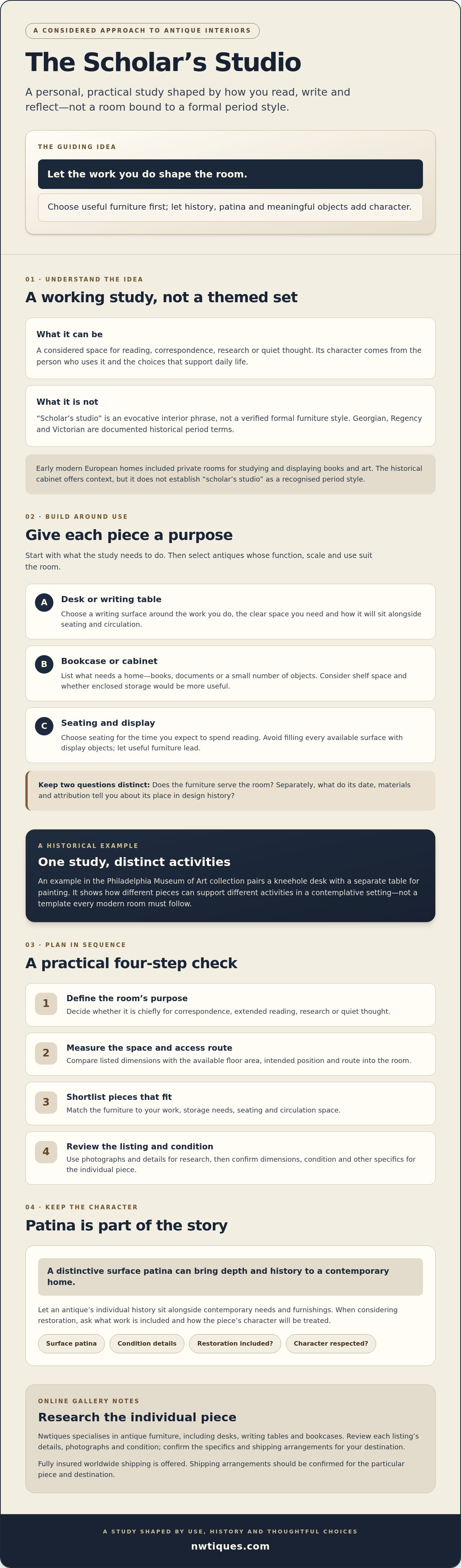
A considered plan helps an antique serve the room without erasing the qualities that make it singular. Work in sequence: define how you’ll use the study, measure the room and access points, shortlist pieces that fit, then review each item’s condition and description. Measuring the route into the room as well as the intended position can help you rule out pieces that won’t be practical to place.
What to check before acquiring an antique for a study
Start with the listing. Compare the stated dimensions with your floor plan, doorway and intended placement. Study the photographs for visible wear, repairs or changes, and read any restoration information provided. If an important detail isn’t clear, ask the dealer a specific question. Don’t infer provenance, authenticity or condition from appearance alone.
Conservation should respect the particular object’s history, not impose a uniform finish. Patina is the character of an antique’s surface, shaped by age and use; it can be part of its historical interest. Nicholas Wells Antiques includes complimentary restoration with items sold. Ask what work applies to the individual piece and discuss any concerns about its surface character. A scholar’s studio gains depth from surfaces with character, not from making every object look newly finished.
Making antiques work in American homes
Whether you’re furnishing a study in New York, Texas, California, the Hamptons or Greenwich, Connecticut, check more than the room’s dimensions. Consider doorways, stairs and the route through the home, as well as the space needed to place the furniture. Nicholas Wells Antiques offers fully insured worldwide shipping. Confirm the shipping arrangements for the specific item and destination, and ask whether a fine-art shipper is appropriate.
Once you’ve identified the scale and character you need, explore antique furniture for your study and verify item-specific details before deciding.
Finding Antique Study Furniture Through an Online Gallery
An online gallery lets you review an antique’s listing before deciding whether it belongs in your study. Photographs and descriptions can help you assess a piece, but each listing relates to one specific object. Read it closely and confirm details that matter to your room and decision.
Questions to ask when considering an antique study piece
Check the listed dimensions, materials, condition and attribution, along with any stated restoration information. If photographs or the description leave a practical question unanswered, ask about that item directly. Don’t assume provenance, authenticity, condition or current availability beyond what the listing and gallery confirm.
Nicholas Wells Antiques is an online gallery established in London. Complimentary restoration is included on items sold; ask what work applies to the particular piece and how its distinctive surface patina and historical character are being considered. The gallery also offers fully insured worldwide shipping. Confirm the shipping arrangements for your item and destination before making plans, including whether a fine-art shipper is appropriate.
Explore antique furniture for a considered study
For a scholar’s studio, begin with the room’s needs, then compare them with the furniture described in each listing. A desk may suit your working habits, while a bookcase or table may answer a different need for storage or display. The gallery’s antique furniture collection offers a place to explore relevant categories and consider how a particular piece might serve your room.
Review the details and photographs, and enquire through the gallery’s online channels if you’d like clarification about an individual item. The most fitting choice is not simply the one with the strongest presence, but the antique whose scale, use and character feel right for the study you intend to create.
Shape a Study That Reflects the Way You Think
A scholar’s studio needn’t imitate a room from another century. Its character comes from a study arranged around real habits: a writing surface suited to your work, useful storage, and antiques chosen for their history as well as their purpose. Measure carefully, review each listing’s details, and let an object’s individual patina remain part of its story.
Established in London in 2012, Nicholas Wells Antiques offers antique desks, writing tables, bookcases and other furniture. Complimentary restoration is included on items sold, and fully insured worldwide shipping is offered. Confirm the restoration and shipping arrangements for the particular item and destination.
Compare listed pieces with the needs and dimensions of your room. Explore the collection, and enquire through the gallery’s online channels if you’d like to ask about a particular piece. With thoughtful choices, your study can become both a working retreat and a quietly personal expression of history.
Frequently Asked Questions
What is a scholar’s studio?
In this article, a scholar’s studio means a purposeful study arranged for reading, writing and reflection, rather than a verified formal furniture style. The phrase is evocative, but its meaning may depend on where you encounter it. Check the context before assuming it refers to a recognised historical room or a specific design vocabulary, and distinguish the concept from documented furniture periods and traditions.
How do I furnish a study with antique furniture?
Start by deciding how you’ll use the room and measuring its floor area, doorways and furniture placement. Then consider the desk or writing table, seating, storage and any objects you’d like to display. Review each piece’s listed dimensions and condition, and confirm details that aren’t clear. Choose antiques for their suitability and character rather than assuming one period or furniture type is right for every study.
Can antique furniture work in a modern home office?
Yes. An antique desk can provide a functional work surface, while a distinctive table or bookcase can lend a contemporary office a focal point with history and individual character. Before selecting a piece, compare its dimensions with the room and check its listed condition. Consider whether its surface and storage suit your work, including the equipment and materials you use, rather than choosing by appearance alone.
How can I preserve the patina on antique furniture?
Treat patina as part of an antique’s individual surface and history, not automatically as damage to be removed. Marks and variations may contribute to a piece’s character, so avoid assuming every sign of age calls for intervention. Review any restoration information in the listing, and ask what conservation has been undertaken or is proposed for that specific object, with attention to preserving its distinctive surface and historical character.
Does Nicholas Wells Antiques ship antique furniture to the United States?
Yes. Nicholas Wells Antiques offers fully insured worldwide shipping, including to destinations in the United States. Shipping arrangements can depend on the particular item and destination, so confirm the details directly before making plans. Ask about the arrangements for the piece you’re considering, and whether a fine-art shipper is appropriate. Delivery timing, costs and customs requirements aren’t specified here and should not be assumed.


Leave a comment