


Designing a Room Around a Single Statement Antique Piece: A Connoisseur’s Guide
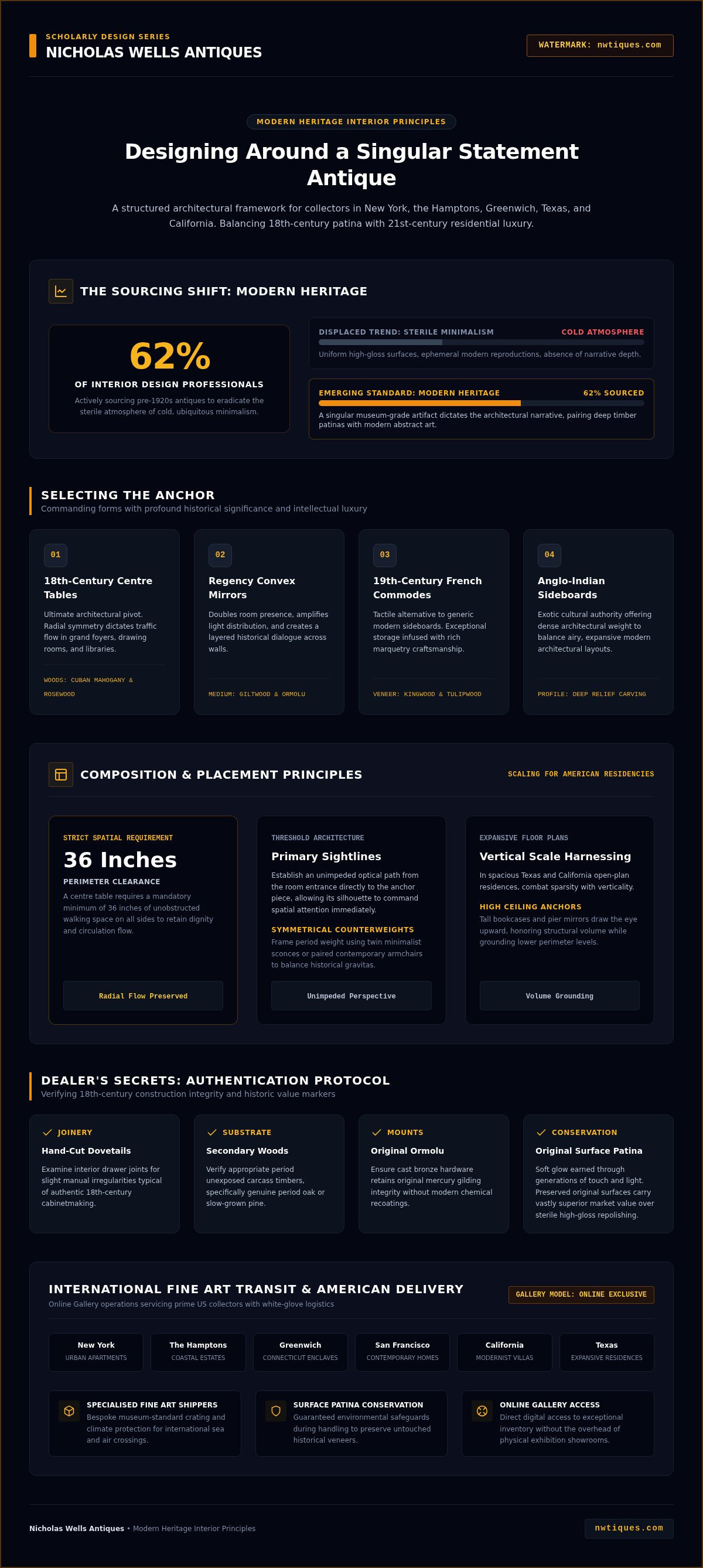
Did you know that 62% of interior design professionals are now actively sourcing pre-1920s antiques to replace the sterile atmosphere of cold minimalism? It's a sophisticated shift toward "Modern Heritage," where a singular, museum-quality object dictates the entire architectural narrative. Many collectors in hubs like the Hamptons or San Francisco feel a certain trepidation when designing a room around a single statement antique piece, fearing it might appear disconnected within a contemporary scheme. You likely understand the delicate tension between preserving an original 18th-century patina and achieving the functional comfort required for 21st-century living.
This guide explores the scholarly art of transforming a rare Regency convex mirror or a majestic Anglo-Indian sideboard into a room's gravitational anchor. We'll examine how to balance historical prestige with modern luxury, ensuring your investment enhances both aesthetic depth and property value. You'll learn to master proportions, orchestrate a dialogue between eras, and implement specialised conservation standards to ensure the original surface is honoured for generations to come. We also highlight how seamless international shipping brings these storied artifacts from our gallery to your doorstep with ease.
Key Takeaways
- Identify objects of exceptional rarity or architectural scale, such as a majestic 18th-century centre table, to serve as the definitive focal point of your interior scheme.
- Establish a primary sightline from the entrance of the room to your anchor piece, using symmetrical modern elements to frame and balance its historical weight.
- Master the nuanced art of designing a room around a single statement antique piece by pairing period craftsmanship with contemporary abstract art and tactile modern textiles.
- Protect your legacy investment by prioritising sympathetic restoration and environmental controls that preserve the unique character of the original surface patina.
Selecting Your Anchor: Identifying the Statement Antique
A statement piece is not merely a decorative addition; it's an object of exceptional rarity, commanding scale, or profound historical significance that demands the eye's attention. When designing a room around a single statement antique piece, one must identify an item with enough visual and intellectual weight to serve as the space's gravitational centre. Antique centre tables, for instance, function as the ultimate architectural anchors, particularly within a grand foyer or a formal drawing room where their radial symmetry dictates the flow of movement. Provenance elevates these objects from mere furniture to significant cultural artifacts, adding a layer of intellectual luxury that resonates with the discerning collector. Patina is the irreplaceable evidence of an object's history and character, manifesting as a soft glow earned through generations of touch and light.
The Power of Regency and Georgian Forms
The disciplined, clean lines of late 18th-century English furniture possess a timeless quality that effortlessly complements the restraint of modern minimalism. In a neutral contemporary palette, the deep, lustrous tones of mahogany and rosewood provide a necessary visual friction, preventing a room from feeling ephemeral. These Regency and Georgian forms offer a sense of permanence, anchoring the airy lightness of a modern Hamptons residence with their substantial presence and refined silhouettes.
Dealer’s Secrets: Authenticating the Centrepiece
Authenticity resides in the details that a casual observer might overlook. We examine 18th-century construction through hand-cut dovetails, appropriate secondary woods like oak or pine, and the integrity of original ormolu hardware. A seasoned connoisseur understands that an original surface condition is infinitely more valuable than the sterile uniformity of a modern high-gloss finish. This commitment to conservation ensures the piece remains a legacy investment, preserving the soul of the artifact for future generations.
The Principles of Composition: Scaling and Architectural Placement
The architectural dialogue of a room is established the moment one crosses the threshold. When designing a room around a single statement antique piece, your first objective is to establish a primary sightline. The eye should travel unimpeded from the entrance to the object, allowing its silhouette to command the space. To balance this visual weight, employ symmetrical modern elements, such as a pair of minimalist sconces or twin contemporary armchairs, to frame the antique without competing for attention. You can effectively double the presence of a singular object by utilising antique mirrors, which reflect the piece and create a sense of layered history. Proper flow is essential; a centre table requires at least 36 inches of walking space on all sides to maintain both its dignity and the room's functionality.
Anchoring with Centre Tables and Commodes
Placement strategies vary by the room's purpose. In a grand entryway, centre tables act as a pivot point for the entire house. Conversely, in an intimate library, they offer a scholarly surface for rare volumes. For those seeking a sophisticated alternative to the ubiquitous modern sideboard, a French 19th-century commode provides exceptional storage while introducing the rich texture of kingwood or tulipwood marquetry. You might explore our collection of fine cabinets to find a piece that balances these requirements.
Scaling for the American Home
Large-scale European pieces find a natural home in the expansive, open-plan residences of Texas or California. These spaces require furniture with significant presence to avoid feeling sparse. Verticality is your ally here. Tall bookcases and pier mirrors draw the eye upward, celebrating high ceilings while grounding the room's lower registers. This deliberate use of scale ensures that even the most substantial 18th-century piece feels integrated rather than imposed.
Orchestrating the Dialogue: Balancing Period and Modern Elements
The successful integration of a museum-quality artifact into a contemporary home relies on a curated tension. This "Classicism + Modernism" approach is exemplified by pairing a rigorous 18th-century writing desk with a bold contemporary abstract painting. The juxtaposition highlights the intricate craftsmanship of the timber while grounding the modern art in a historical context. Designing a room around a single statement antique piece also requires a thoughtful use of texture. Modern linens and raw silks act as a bridge, softening the imposing gravitas of dark mahogany or rosewood surfaces.
Lighting serves as a silent moderniser. Whether utilising minimalist antique lighting or discreet recessed LEDs, the goal is to cast a grazing light that reveals the depth of hand-carved details or the lustre of original ormolu. A dealer’s secret we often share is that a single "misfit" period piece, perhaps an object that seems stylistically disparate from the surrounding collection, often becomes the most compelling and memorable element of the interior.
The Role of Grand Tour Objects
Smaller Grand Tour objects serve as the supporting cast to your primary anchor. Integrating marble obelisks or classical bronzes onto a minimalist console creates a sophisticated "cabinet of curiosities" feel. These objects offer a tactile narrative of the 19th-century traveller’s journey, providing intellectual depth without overwhelming the room's contemporary architecture.
Seating as a Functional Contrast
Seating provides a necessary functional contrast in a layered space. Pairing antique armchairs with a low-profile modern sofa creates a balanced aesthetic that feels both curated and comfortable. We recommend choosing upholstery in neutral palettes that respect the chair's historical frame while aligning with a 21st-century colour scheme. Browse our curated works of art to find the perfect supporting elements for your interior.
Preserving the Narrative: Conservation and Long-Term Care
Designing a room around a single statement antique piece is an act of cultural stewardship that extends far beyond the initial placement. The philosophy of sympathetic restoration dictates that we preserve the history of use while ensuring structural integrity for the modern home. True conservation focuses on the unique antique surface rather than stripping it back to "new", as the latter often destroys the very character that defines a museum-quality object. At Nicholas Wells Antiques, our complimentary restoration service ensures that every acquisition is prepared for immediate display, honouring the piece's historical soul through expert conservation.
Environmental controls are paramount for high-value antiques, particularly in coastal Hamptons homes or expansive estates in Texas and California. To prevent hygroscopic movement in historical timbers, it's vital to maintain a stable relative humidity between 40% and 60%. Similarly, ultraviolet exposure must be strictly managed. Illuminance levels should not exceed 200 lux to protect the natural patination from irreversible light damage. These precise standards ensure that your investment remains a vibrant anchor within your interior for generations.
Insured Shipping for the Global Collector
Moving rare objects to major design hubs like San Francisco, Dallas, or Greenwich requires the expertise of fine art specialists. We facilitate fully insured worldwide shipping, managing the logistics from our online gallery to your doorstep with white-glove precision. This seamless transit provides absolute security for high-value acquisitions, ensuring they arrive in pristine condition regardless of the distance. Our shippers are accustomed to the requirements of the most discerning clients in New York and the Hamptons.
Maintaining Value through Provenance
The long-term investment value of an antique is inextricably linked to its documented history. Keeping exhaustive research and provenance as part of the object's legacy is essential for future appreciation. Buying from a specialised dealer protects this value, as our expertise in rare materials like ormolu and mahogany ensures that every claim of rarity is verified and preserved. This scholarly approach transforms a simple purchase into a significant addition to a private collection.
Cultivating Your Legacy Interior
Mastering the art of designing a room around a single statement antique piece requires a disciplined eye and a deep appreciation for historical narrative. Identifying an object of exceptional rarity and establishing clear architectural sightlines transforms a living space into a curated gallery of personal history. The dialogue between 18th-century craftsmanship and modern comfort is most effective when you honour the original surface patina and maintain rigorous environmental standards. Nicholas Wells Antiques offers the scholarly expertise needed to source these singular rarities, ensuring every acquisition is a sound legacy investment. We provide complimentary restoration on all items and fully insured worldwide shipping with fine art specialists to major hubs like the Hamptons and San Francisco. Whether you're drawn to the radial symmetry of a Regency centre table or the intricate marquetry of a French commode, your interior deserves an anchor that speaks with quiet authority. Explore our curated collection of rare statement antiques and begin the journey of anchoring your home with a significant cultural artifact.
Frequently Asked Questions
Can I use a rare antique table as a functional dining or work surface?
Yes, a rare 18th-century table can be used functionally, provided you respect its historical integrity. Our complimentary restoration ensures the structure is sound for daily use while preserving the irreplaceable character of the surface patina. We recommend using protective linens or coasters to avoid heat damage or moisture rings. This sympathetic approach allows you to enjoy the tactile luxury of a significant artifact without compromising its long-term investment value.
How do I know if an antique piece is too large for my room?
An antique is too large if it obstructs the room's natural circulation or overwhelms the architectural sightlines. As a professional standard, we recommend maintaining at least 36 inches of walking space around a centre table to ensure effortless flow. When designing a room around a single statement antique piece, the object should command attention without crowding the space. If the piece prevents the eye from travelling across the room, it may be over-scaled.
What is the best way to light a statement antique to highlight its detail?
The most effective method is to use indirect, grazing light that emphasises the depth of hand-carved details and ormolu mounts. To prevent irreversible damage, illuminance levels should be kept between 50 and 200 lux, with UV filters applied to windows. Avoid high-heat halogen bulbs that can dry out historical timbers. Instead, use modern recessed LEDs or specialised antique lighting to create a soft glow that honours the piece's history without causing degradation.
Does mixing different antique periods in one room work?
Mixing different antique periods creates a layered interior that feels curated rather than staged. The secret to designing a room around a single statement antique piece lies in finding a common thread, such as timber tone or sculptural silhouette, to unite disparate eras. Pairing a Georgian desk with Regency seating or a contemporary abstract painting generates a sophisticated visual friction. This eclectic approach signals a high level of connoisseurship and prevents the room from feeling like a museum.
How does Nicholas Wells handle international shipping to the United States?
We manage the entire logistics process using specialised fine art, white-glove shippers who provide door-to-door delivery. Every acquisition is fully insured during transit, whether it's destined for a residence in the Hamptons, a ranch in Texas, or a penthouse in San Francisco. Our shippers are experts in handling rare materials like malachite and delicate ormolu. We ensure all documentation is handled seamlessly, making international acquisition an effortless experience for our American clientele.


Leave a comment