


Creating a Budget for Your First Serious Antique Purchase
What if the asking price is only the beginning of your first serious antique’s true cost? Creating a budget for your first serious antique purchase means weighing more than the figure on the label. Condition, provenance, restoration, delivery and the care a piece may require once it enters your home all deserve consideration.
It’s natural to worry that setting a firm spending limit could mean missing an exceptional object. Yet a considered ceiling needn’t close the door on discovery. It gives you a clear measure for deciding whether craftsmanship, history and character justify the commitment. An appealing price alone cannot tell that story.
This guide will help you establish a comfortable limit, assess the whole acquisition and compare pieces with greater confidence. We’ll consider how condition and provenance shape value, which ownership needs belong in your plan, and how expert authentication and restoration contribute to your purchase. At Nwtiques, expert restoration is included in the purchase price. Delivery planning can account for Complimentary UK delivery and Worldwide shipping. The aim is to choose an antique whose presence and past feel worthy of its place in your home.
Key Takeaways
- Set a comfortable spending ceiling after accounting for essential commitments and savings goals, so an appealing find doesn’t dictate your budget.
- When creating a budget for your first serious antique purchase, weigh the asking price against documented history, condition and suitability for your home.
- Read patina as part of an antique’s character: signs of age aren’t automatically flaws, and conservation can preserve the surface and its history.
- Plan for placement, care and delivery alongside the purchase, then use those considerations to judge whether a piece merits its place in your home.
Start Your First Serious Antique Budget With a Comfortable Spending Limit
The prospect of bringing a substantial antique into your home is exciting, but deciding what you can comfortably spend can feel less straightforward. Creating a budget for your first serious antique purchase begins with your own finances, not an attractive asking price or a prediction of future resale value. Treat your ceiling as a personal limit, not a verdict on what the object is worth.
Set it only after accounting for essential commitments and savings goals. Use discretionary funds you already have, rather than relying on anticipated income or proceeds from a possible future sale. Before browsing, write down a figure that still feels comfortable after you’ve had time to reflect. An unusual object may be compelling, but it shouldn’t reset your financial boundary in the moment.
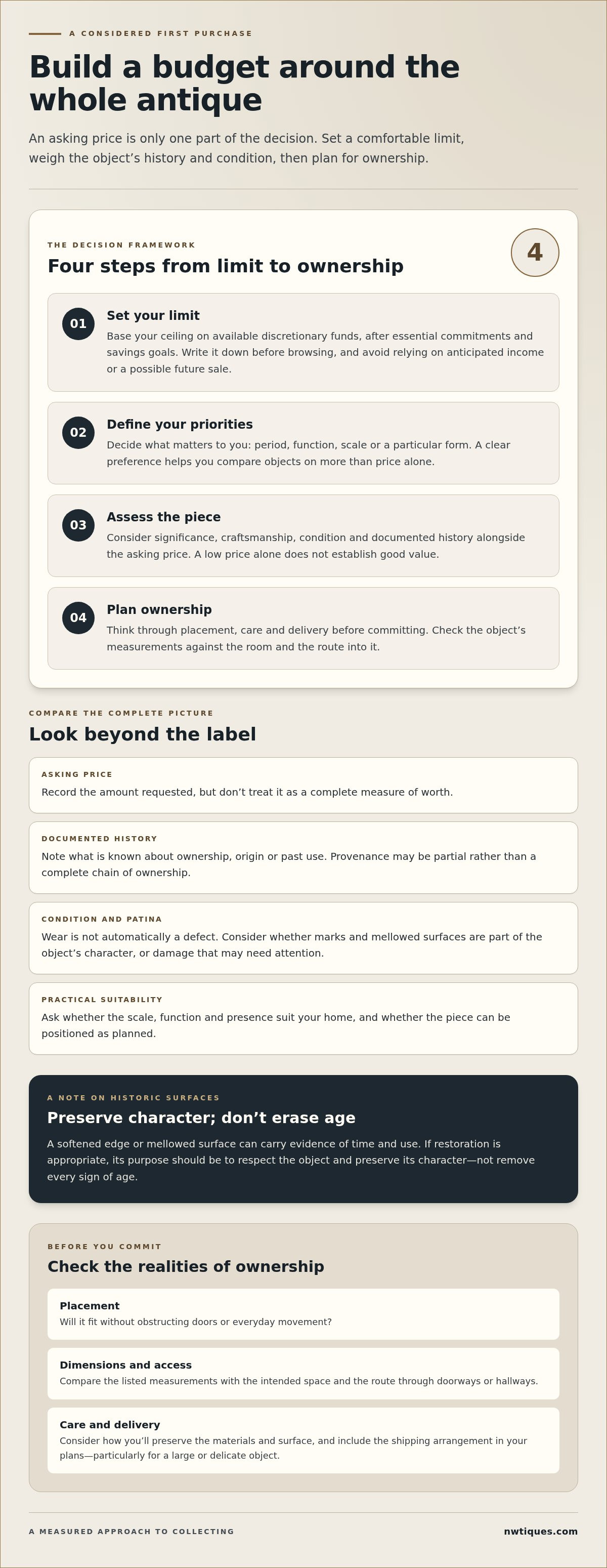
Use this sequence to keep the decision measured:
- Set your limit from available discretionary funds.
- Define your priorities, such as period, function, scale or a particular form.
- Assess the piece for significance, craftsmanship, condition and documented history.
- Plan ownership, including placement, care and delivery.
How can you set a realistic first-purchase ceiling?
Choose a limit that leaves room for your other priorities and feels settled, rather than stretched. The definition of an antique offers useful context, but age alone shouldn’t determine your spending ceiling. Write your limit down before you begin browsing. It gives you a calm reference point if a particularly rare or beautiful object catches your eye.
What matters more than finding the lowest asking price?
A low price is not, by itself, evidence of good value. Consider whether the object’s craftsmanship, historical significance and practical suitability appeal to you, then weigh that personal response against its condition and documented history. Browsing the antique furniture collection offers examples across furniture categories, helping you clarify which forms and qualities matter most before comparing individual pieces.
Compare an Antique’s Asking Price With Its Condition and History
An asking price is only one part of an antique’s story. As you refine your budget, compare the object’s documented history, condition and practical suitability alongside its cost. This helps distinguish a compelling purchase from one that merely appears inexpensive.
Asking price: Record the amount requested, without treating it as a complete measure of worth.
Documented history: Note what is known about the object’s ownership, origin or past use. Provenance is a documented account of an object’s history.
Condition: Consider wear, repairs and alterations in relation to the object’s age and character.
Practical suitability: Assess whether its scale, function and presence work in your home.
How should condition and patina inform your decision?
Age-related wear isn’t automatically a defect. A softened edge or mellowed surface may be part of an antique’s patina, carrying evidence of time and use that gives the piece its singular character. Distinguish this historic surface from damage that may require intervention. If restoration is appropriate, its purpose should be to respect the object and preserve its character, not erase every sign of age.
With wooden furniture, the finish and patina contribute to the piece’s visual and historical presence. Look at the surface as a whole, rather than treating every mark as a flaw to remove.
What can provenance and authentication tell a first-time buyer?
Records vary from object to object, so provenance may offer a partial history rather than a complete chain of ownership. Even a limited account can deepen your understanding of an antique’s context and significance. Its history can make it meaningful beyond its materials and form.
Expert authentication adds another considered perspective, but it isn’t a promise of future appreciation. In creating a budget for your first serious antique purchase, weigh the evidence available alongside condition, craftsmanship and your own reasons for choosing the piece. Nwtiques authenticates antiques through expert knowledge. Explore the curated antique collection as you consider what feels worthy of your ceiling.
Plan for Restoration, Delivery and the Realities of Ownership
A considered budget accounts for what happens after you choose an object, too. Before committing, picture its place in your home and how it will be brought there. A table that suits a room in appearance may need a different position once you consider its dimensions, the space around it and the route into the room.
- Placement: Where will the piece sit? Check that it won’t obstruct doors or everyday movement.
- Dimensions: Use the measurements supplied for the specific item to assess its scale against the room and the access route.
- Care: Consider the surface and materials, and how you’ll preserve their character as part of ordinary ownership.
- Delivery: Include the shipping arrangement in your plans, particularly for a large or delicate object.
For example, compare a table’s listed measurements with the intended space and the route through doorways or hallways. This helps you judge whether it will feel balanced in the room and can be positioned as planned. The antique tables collection offers different forms to consider in relation to your space.
How do restoration and conservation fit into the budget?
For items sold by Nwtiques, complimentary restoration is included in the purchase price. Expert restoration is part of the object’s considered presentation, while conservation gives due regard to its historic surface and patina. A pristine finish isn’t automatically preferable. Preserving age and character can be central to respecting an antique’s history.
What should you consider when arranging delivery?
Delivery is part of ownership planning, not an afterthought. Nwtiques offers Complimentary UK delivery and Worldwide shipping, with insured fine-art shipping for worldwide purchases. Include the delivery arrangements alongside your plans for placement and access, and review the information provided for the specific piece.
Creating a budget for your first serious antique purchase means understanding the experience of bringing a piece home as well as its asking price. Explore the collection at Nwtiques to consider how an exceptional object might live in your space.
Make a Confident First Antique Purchase Through a Curated Online Gallery
A written ceiling is most useful when it remains your guide, even as an object’s beauty and history invite closer consideration. Return to the qualities you prioritised, the evidence you’ve weighed and the practicalities of ownership. The right first acquisition should feel compelling within your limit, not require you to abandon it.
Nwtiques is an online gallery established in 2012. Each antique is authenticated and restored by experts, with complimentary restoration included in the purchase price. This gives you useful context as you assess a piece, while keeping the decision centred on its significance, condition and place in your home.
How does expert support help make an acquisition more considered?
Expert authentication and restoration contribute to a more informed purchase, but they don’t replace your own assessment of an object’s character and suitability. Consider how restoration honours the antique’s history, rather than assuming a pristine finish is the only desirable outcome. For delivery planning, Nwtiques offers Complimentary UK delivery and Worldwide shipping, with insured fine-art shipping worldwide.
What is a sensible next step after setting your budget?
Browse according to the interest that first drew you to collecting. If a centre table suits your rooms and priorities, explore the antique centre tables to compare forms and consider their scale in a home. Readers drawn to classical souvenirs may find particular interest in Grand Tour Objects. Let the object’s qualities and your ownership plans guide your judgement, rather than urgency.
Creating a budget for your first serious antique purchase is a way to make space for a meaningful object without losing sight of your financial comfort. Explore the curated collection, then enquire about a piece that captures your interest.
Let Your First Antique Purchase Reflect Your Eye
A spending ceiling isn’t simply a boundary; it can give you the confidence to wait for an object that genuinely belongs in your home. The pleasure of a serious antique purchase lies not in deciding quickly, but in recognising the piece whose form, history and presence continue to reward your attention. Let your budget support that discernment.
Creating a budget for your first serious antique purchase is as much an exercise in intention as arithmetic. You’re choosing what deserves space in your rooms and a place in your life. Give yourself time to consider how an object will sit alongside what you already value, and whether its character still speaks to you after the first impression has passed.
When you’re ready to take the next step, explore the curated collection and consider your first serious antique. A thoughtful choice can begin with curiosity and grow into a lasting connection with an exceptional object.
Frequently Asked Questions
How much should I spend on my first serious antique purchase?
There’s no universal figure or suitable percentage of income for a first serious antique. In creating a budget for your first serious antique purchase, set a ceiling using discretionary funds after essential commitments and savings goals are protected. Decide on it before browsing, then check that it still feels comfortable after reflection. Let your priorities guide the amount, not hopes of appreciation or eventual resale proceeds.
Is buying an antique a good investment?
Buying an antique can be rewarding, but it isn’t a guaranteed financial investment. Collecting may be motivated by historical interest, aesthetic pleasure or personal connection; financial return is uncertain, and future prices can’t be assured. Condition, provenance, craftsmanship and buyer interest can all influence how a piece is regarded. Choose an object you value in its own right, rather than stretching your budget on the expectation of resale.
Should I spend my entire antique budget on the object itself?
No, the asking price shouldn’t be your only planning consideration. Before committing, think through where the piece will sit, how its materials fit your household’s care habits, and how delivery will be arranged. These practical points help you understand the commitment without assuming extra fees or costs. Review the purchase terms and keep the decision within your personal ceiling.
Does restoration always make an antique more valuable?
No. Restoration doesn’t automatically increase an antique’s value; its purpose is to address condition while respecting the object’s history and surface. A small mark of age may belong to its character, so removing it isn’t always desirable. Nwtiques includes complimentary expert restoration in the purchase price of items sold. The appropriate approach depends on the individual piece, rather than a promise of a particular finish or result.
Can I buy an antique online and have it shipped internationally?
Yes. Nwtiques offers Worldwide shipping, insured fine-art shipping worldwide and Complimentary UK delivery. For an international purchase, include the destination and delivery arrangements in your planning. Browse the online collection at your own pace, then enquire about a particular piece to discuss the object and its journey to you.


Leave a comment