


Collecting Grand Tour Objects: A Connoisseur’s Guide
What separates a Grand Tour object with a history worth pursuing from a handsome souvenir with a classical air? For collectors in New York, Texas, California, the Hamptons, or Greenwich, that distinction begins with curiosity, not decoration. Collecting grand tour objects means looking beyond a pleasing silhouette to the journeys, classical models, materials, and later ownership that shaped each piece.
It’s easy to see why these objects appeal: a small bronze, marble reduction, or micromosaic can bring the romance of European travel into a contemporary interior. Yet visual appeal alone doesn’t establish historical significance, and an overzealous polish may erase the surface patina that gives an antique its particular character. A considered collection grows from knowing what to look for, and what to leave undisturbed.
This guide explores how travel and antiquity informed Grand Tour collecting, how to develop a coherent focus by history, material, or form, and how to display and preserve objects with care. Nwtiques is a London-established online gallery serving international collectors with fully insured worldwide shipping, including to the United States.
Key Takeaways
- Understand how classical study, travel, and collecting shaped the meaning of Grand Tour objects.
- Use forms such as bronzes, casts, micromosaics, pietra dura, and views of classical sites to develop a distinctive collecting focus.
- Assess an object through its form, material, workmanship, surface, and documented history rather than relying on appearance alone.
- Build a thoughtful approach to collecting grand tour objects by choosing pieces that can anchor a room and contribute to a wider narrative in an American home.
Collecting Grand Tour Objects: What Gives Them Their Meaning?
Grand Tour objects are works of art and keepsakes connected to the historic European journeys of educated travellers, shaped by their encounters with classical antiquity and the collecting tastes those journeys cultivated. The distinction matters: an object may reflect ancient sculpture or architecture without being an ancient artefact itself. Many were later interpretations, studies, or mementoes, valued for the craftsmanship and ideas they carried forward.
The Grand Tour linked travel with artistic study and the formation of taste. For collectors, that context can turn an appealing object into evidence of how antiquity was observed, interpreted, and brought into private interiors. Consider not only what a piece depicts, but also how its makers translated that subject into a particular material and form.
From European travel to the collecting cabinet
Travellers encountered classical art and architecture through monuments, ruins, sculptures, and works made in response to them. Rome offered an especially resonant encounter with ancient remains and their later interpretation; Naples, too, could form part of a traveller’s itinerary and artistic education. No single destination defines the category. The object’s subject, making, and documented associations help establish its particular relationship to travel and antiquity.
A collecting focus beyond a decorative souvenir
A souvenir can delight through its appearance; a considered collection asks what lies beneath it. Material and form reveal how an object was made, while its subject may point to a classical model or place. Provenance, meaning a documented history of ownership or association, can deepen that understanding, but appearance alone cannot establish a connection. A useful starting point is to identify the quality that interests you most, such as a specific subject, material, or form, then look for objects with reliable evidence to support that connection. Nicholas Wells Antiques presents European decorative works through its European works of art, offering collectors a range of historical objects to study.
Which Grand Tour Objects Can Give a Collection Its Character?
Grand Tour collecting encompasses varied forms, including bronze reductions, plaster casts, micromosaics, pietra dura work, and views of classical sites. Each offers a different point of entry: bronze has sculptural presence, a mosaic rewards close inspection of its intricate surface, and a view can connect a collection to a particular place or architectural subject.
The cultural legacy of the Grand Tour includes the souvenirs travellers brought home and displayed, connecting objects to both personal journeys and contemporary taste. A collection might follow a material, such as bronze or stone; a subject, such as classical architecture; a destination represented in views; or motifs that recur across different forms. Choose a focus that gives you room to learn and compare, rather than limiting the collection to objects that look alike.
Collecting by material, technique, or subject
A material-led approach rewards close looking. Compare the modelling and finish of a casting, the precision of a micromosaic, or the arrangement of coloured stone in pietra dura. Look at how well the details are executed and whether the object’s surface appears consistent with its age and use. A subject-led collection might instead bring together different materials and techniques through shared classical imagery or travel associations. Either approach gives collecting Grand Tour objects a purposeful framework without assuming every piece has the same origin or history.
Building a coherent group without making it uniform
Let the connection be clear, but allow the objects to differ. A small view, a cast, and a bronze can sit within one collecting narrative if their subject or historical associations speak to one another. Variation in scale, surface, and form gives a group vitality; uniformity is not the same as coherence. Before acquiring a piece, ask what it adds: a new material, a different interpretation of a familiar subject, or a documented connection that deepens the story.
Explore the Grand Tour souvenirs category to consider how these forms might relate. A shared theme can unite objects of different materials and shapes, giving a collection its identity without making its pieces interchangeable.
How to Assess Grand Tour Objects Without Overlooking Patina
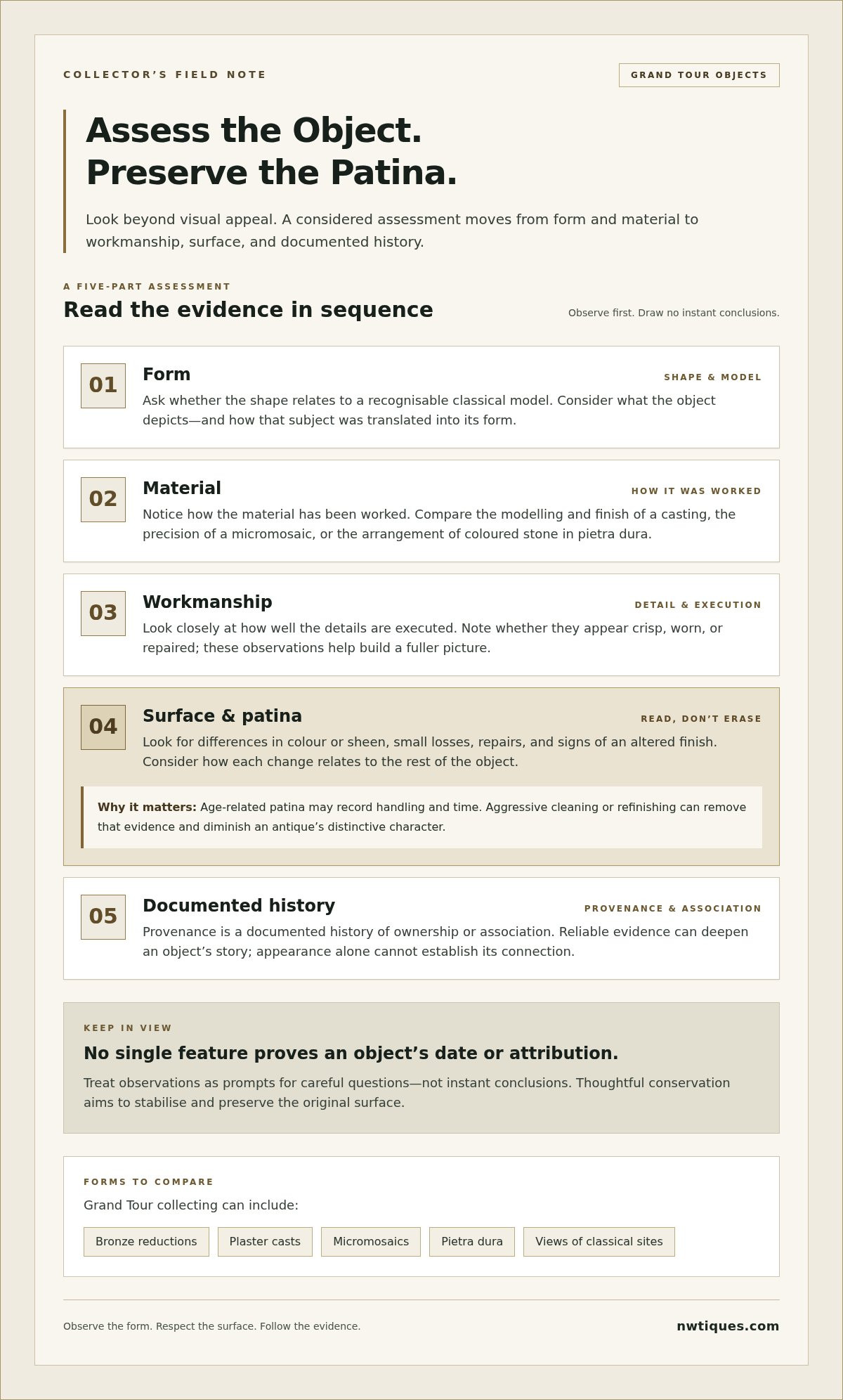
A measured assessment looks beyond immediate visual appeal. Consider the object in sequence: its form, material, workmanship, surface, and documented history. Does the shape relate to a recognisable classical model? How has the material been worked? Are the details crisp, worn, or repaired? What might the finish reveal about age, handling, or later intervention? These observations build a more considered picture, but no single feature proves an object’s date or attribution.
Surface deserves particular care. Wear, small losses, repairs, and changes in finish should be read in relation to the object itself, not treated automatically as flaws. Age-related patina may record handling and time; aggressive cleaning or refinishing can remove that evidence and diminish the character that makes an antique singular.
Reading condition, surface, and conservation history
Look for areas of differing colour or sheen, signs of repair, and places where a finish appears altered. Note where these changes occur and how they relate to the rest of the object. Such details invite questions rather than instant conclusions. Thoughtful conservation aims to stabilise and preserve an object’s original surface, while an intervention intended to make it look new may obscure its history. In collecting Grand Tour objects, restraint can protect more than appearance: it can preserve material evidence.
Provenance as a research trail
Provenance is a documented history of ownership or association, supported where possible by records, labels, inscriptions, or other credible evidence. An Italian-looking view, classical subject, or aged surface alone cannot establish where an object was made or who owned it. Treat each clue as part of a wider research trail, and distinguish recorded facts from plausible interpretation. When reviewing an object, keep those two categories separate in your notes so that a suggestion does not become mistaken for established history.
Explore European works of art through the Nwtiques online gallery, where close attention to an object’s surface and history can inform a collector’s eye. Discover European works of art.
Displaying and Collecting Grand Tour Objects in an American Home
A single Grand Tour object can command attention without standing apart from the room’s wider story. A bronze on a console, for instance, may echo classical forms elsewhere in the home, while a small view can introduce a note of travel and place among books, paintings, or other collected works. In New York, Texas, California, the Hamptons, and Greenwich, Connecticut, the most convincing displays let an object hold its own while remaining part of a thoughtful whole.
Displaying historic objects with care
Consider light, stability, handling, and the materials around the piece. Give an object a secure position where it won’t be repeatedly moved or crowded, and choose surroundings that draw attention to its form without competing with its surface. Patina is part of its visual character; avoid display choices or cleaning that make an aged object appear newly made. Collecting Grand Tour objects well means allowing their history to remain visible in daily life.
Exploring and acquiring objects from abroad
Nicholas Wells Antiques is a London-established online gallery, with fully insured worldwide shipping for collectors in the United States and elsewhere. For American collectors, an object can travel from the gallery to a home in New York, Texas, California, the Hamptons, or Greenwich, Connecticut. Explore the Grand Tour objects collection when considering how a historic piece might join an existing interior or collecting narrative.
Choose with care, display with restraint, and let each piece contribute its own chapter to the room. A considered collection need not be extensive; its distinction lies in the history and character of the objects brought together.
Build a Collection with History and Character
A thoughtful Grand Tour collection begins with historical curiosity: understanding how travel and classical study shaped an object’s meaning, then choosing pieces connected by material, subject, or form. Look closely at workmanship and documented history, while treating patina and signs of age as part of an object’s character rather than flaws to erase. In the home, careful placement lets each piece make its presence felt without losing its place in a wider collecting narrative.
Nicholas Wells Antiques is an online gallery specialising in fine antiques and Grand Tour objects. Every item sold includes complimentary restoration, and worldwide shipping is fully insured, including for American collectors. When considering a piece, weigh its condition and history alongside the way its scale, material, and subject will contribute to your collection.
Let the next object you choose deepen the story your collection tells. Explore Grand Tour objects at Nicholas Wells Antiques and discover a considered approach to collecting Grand Tour objects.
Frequently Asked Questions
What counts as a Grand Tour object?
A Grand Tour object is a work, souvenir, or decorative piece connected with the European journeys of travellers, particularly those inspired by classical antiquity and the places they visited. The term describes a historical collecting context, not a single material or form. An object may evoke ancient sculpture or architecture without being an ancient artefact itself; its relationship to the tradition depends on its history and character.
How do I start collecting Grand Tour objects?
Begin with a subject that genuinely interests you, such as classical imagery, a particular material, or a form of object. As you explore collecting Grand Tour objects, compare pieces by workmanship, condition, surface, and documented history. A clear focus can create coherence without requiring every object to match. Take time to understand each piece individually, including the qualities that give it its own presence and character.
How can you tell whether an object is an authentic Grand Tour piece?
No single visual detail proves an object’s date or connection to the Grand Tour. Consider its materials, construction, style, condition, and documented provenance together, distinguishing recorded evidence from interpretation. An aged appearance or classical subject may suggest a connection, but neither establishes one on its own. A careful assessment separates objects made in the spirit of the Grand Tour from those with a demonstrable link to its collecting tradition.
Should you clean or restore a Grand Tour object?
Not automatically. Patina and age-related wear may preserve evidence of an object’s history, while aggressive cleaning or refinishing can diminish its original surface and character. Consider its condition and any previous repairs before deciding what care is appropriate; conservation should respect the surface rather than make the piece appear new. Nicholas Wells Antiques includes complimentary restoration with items sold. Preserve the object’s character by treating its surface and patina with care.


Leave a comment