


Collecting Chinese Scholar's Objects: A Connoisseur Guide
Classical Chinese scholar's objects were never conceived as static table ornaments; they were intimate, tactile instruments crafted to awaken the mind through daily handling, organic balance, and quiet contemplation. If you've hesitated to acquire these storied works, it's entirely understandable. Sophisticated modern reproductions challenge even seasoned collectors, while the nuances of natural surface patination often remain obscured behind opaque trade jargon, leaving admirers uncertain how classical antiquities fit within contemporary luxury settings.
Here, you'll discover how to decode literati aesthetics, master historical material hierarchies, and reliably distinguish centuries of authentic wear from artificial aging techniques. You will gain the precise connoisseurship required to select singular scholar's studio artifacts and integrate them effortlessly into bespoke residential schemes, whether styling a library bureau in Greenwich or a console in San Francisco. This guide explores the provenance, touch, and timeless stature of classical studio treasures.
Key Takeaways
- Understand how Song and Ming dynasty literati philosophy shaped functional studio implements into contemplative expressions of personal refinement.
- Explore the tactile material hierarchy of the scholar's desk, from dense, fragrant zitan and luminous huanghuali to resonant inkstones.
- Master the connoisseurship of authenticating Chinese scholar's objects by distinguishing true handling patina and structural wear from modern artificial ageing.
- Discover curated styling methods to integrate contemplative antiquities effortlessly atop fine bureaus and consoles within contemporary luxury residences.
What Are Chinese Scholar's Objects? The Literati Studio Aesthetic
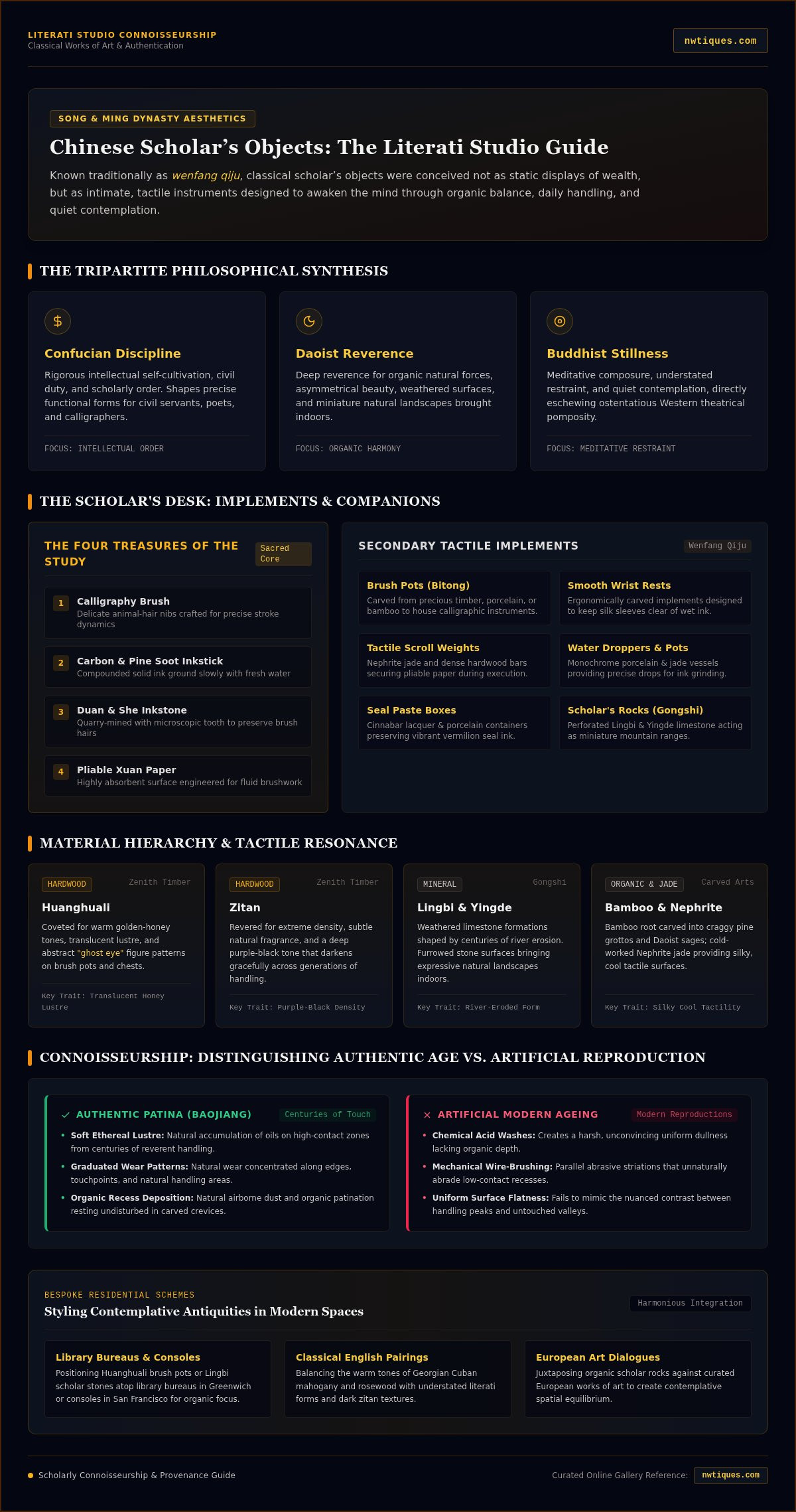
Known traditionally as wenfang qiju, authentic Chinese scholar's objects were crafted not as vulgar demonstrations of wealth, but as refined implements for the scholar's desk. Emerging fully during the cultural renaissance of the Song and Ming dynasties, the literati class, composed of civil servants, poets, and calligraphers, cultivated a private environment dedicated to self-cultivation. Their aesthetic synthesis balanced Confucian intellectual discipline, Daoist reverence for organic natural forces, and meditative Buddhist stillness. Unlike the gilded, theatrical pomp of Western court furnishings, literati works favoured subtlety, tactile intrigue, and understated harmony.
The Four Treasures of the Study and Their Companions
Every scholarly studio revolved around the Four Treasures of the Study: the calligraphy brush, the carbon-and-pine soot inkstick, the finely carved inkstone, and pliable xuan paper. Around this sacred core clustered an array of secondary implements engineered for tactile pleasure and fluid creative labour. These included:
- Brush pots (bitong) carved from precious timber or porcelain
- Smooth wrist rests that kept silk sleeves clear of wet ink
- Tactile scroll weights, seal paste boxes, and carved water droppers
Philosophical Resonance in Classical Interiors
Beyond calligraphic tools, the literati studio welcomed nature itself indoors. Perforated scholar's rocks (gongshi), formed by centuries of river erosion, functioned as miniature mountain ranges, inviting contemplation during hours of composition. Today, these ancient items provide profound visual balance when paired alongside classical English furniture or curated European works of art. For enlightened Western collectors, acquiring genuine Chinese scholar's objects offers a rare connection to a philosophical tradition where spiritual equilibrium and scholarly craftsmanship are inextricably entwined.
Core Materials and Forms of the Scholar's Table
Classical Chinese scholar's objects derived their value not from ostentation, but from natural resonance, tactile warmth, and organic grain. Scholars prized materials that responded dynamically to the hand, rewarding centuries of intimate contact. Weathered Lingbi and Yingde limestone formations, celebrated in seminal museum exhibitions such as Treasures of the Chinese Scholar, epitomised this search for expressive form. These furrowed stones brought evocative, natural landscapes directly into the studio study.
Precious Hardwoods: Huanghuali, Zitan, and Bamboo
Dense tropical hardwoods occupied the absolute zenith of literati timber hierarchy:
- Huanghuali: Highly coveted for its warm, golden-honey tones, translucent lustre, and abstract "ghost eye" figure patterns seen on exquisite brush pots and stationery chests.
- Zitan: Revered for its exceptional density, subtle fragrance, and deep purple-black patina that darkens gracefully over generations.
- Carved Bamboo Root: Elevated humbler organic matter into miniature masterpieces, depicting craggy pine grottos and solitary Daoist sages with remarkable technical restraint.
Stones, Ceramics, and Organic Materials
Beyond rare woods, the scholar's desk relied heavily on mineral and ceramic refinement. Celebrated Duan and She inkstones were quarry-mined for their velvety, microscopic tooth, retaining water effortlessly to grind pure carbon ink without harming delicate animal-hair brush nibs. Nephrite jade, worked cold with abrasive sands, yielded silky water droppers and paperweights whose cool smoothness invited continuous tactile engagement. Meanwhile, monochrome porcelain water pots and cinnabar lacquer seal paste boxes added subtle, jewel-like counterpoints of colour.
Discerning collectors can discover exceptional, hand-selected examples by exploring our gallery collection of Asian and Oriental works of art, each piece chosen for its authentic character and historical integrity.
Connoisseurship: Authenticating Patina, Age, and Provenance
Authenticating rare Chinese scholar's objects demands an uncompromising eye for material integrity. Modern reproductions rely heavily on chemical washes and mechanical wire-brushing, producing an unconvincing, uniform dullness. In contrast, genuine handling patina, or baojiang, accumulates slowly through centuries of reverent tactile contact. High-contact surfaces acquire an ethereal, soft lustre, while natural airborne dust and organic oils gently settle into undercut relief and foot-rims. Reign marks also require rigorous connoisseurship; apocryphal Ming and Qing marks abound, requiring comparative verification against authoritative Kangxi and Qianlong epigraphic archives.
Evaluating the Touch: Surface, Weight, and Shrinkage
Touch frequently reveals what sight obscures. Over decades, seasoned timbers lose microscopic moisture, developing fine, directional hairline patterns known to collectors as ox-hair fissures (niu mao wen). Similarly, natural nephrite jade possesses a distinctive, soapy coolness and substantial heft that modern composites or softer steatites cannot imitate. True antique wear doesn't appear symmetrical; it concentrates precisely where fingers rested to steady a brush pot or grind an ink cake.
Documenting Pedigree and Institutional History
Provenance elevates aesthetic delight into documented history. Archival exhibition labels, old collector inventories, and period auction entries provide vital verification, helping collectors distinguish early Chinese studio ownership from Victorian European collections, a contextual evolution illustrated by the Treasures of the Chinese Scholar exhibition. Because preserving original patination is paramount, each piece we handle receives complimentary, sympathetic conservation to honour its historical integrity. Discover our specialist selection to acquire authenticated works of art with complete peace of mind.
Curating and Styling Scholar's Objects in Modern Interiors
Integrating Chinese scholar's objects into contemporary luxury residences bridges disparate design traditions with remarkable grace. In a minimalist Manhattan penthouse or a historic Greenwich estate, an authentic literati piece serves as an intellectual anchor, capturing attention through tactile depth rather than ostentation. Unlike mass-produced accessories, these contemplative items introduce a serene, grounded atmosphere to modern living spaces. Directed low-heat accent lighting brings out the best in these treasures, casting sculptural shadows across the craggy hollows of a Lingbi stone or revealing the delicate carved relief of cinnabar lacquer.
Harmonising with Period Western Furniture
Contrast creates curatorial vitality. Placing a finely carved huanghuali brush pot atop an eighteenth-century English bureau establishes a compelling aesthetic dialogue between Chinese organic restraint and Western cabinetmaking precision. This interplay of rich timbers transforms an ordinary study into an intimate collector's sanctuary. Similarly, a dramatic scholar's rock commands attention when displayed on an imposing mahogany console, holding its own beside classical bronze sculpture and refined European works of art.
Preservation, Display, and Global Acquisition
Caring for historic Chinese scholar's objects requires environmental mindfulness. Dense tropical hardwoods, lacquer, and root carvings react sensitively to fluctuating humidity; keep them safely away from harsh direct sunlight and desiccating heating systems. Sourcing these treasures transatlantic is effortless through our London online gallery. Each acquisition benefits from complimentary conservation to preserve authentic antique surfaces, followed by fully insured delivery with specialist fine art carriers directly to collectors in San Francisco, Texas, and the Hamptons.
Beginning Your Journey in Literati Connoisseurship
Collecting classical Chinese scholar's objects invites a quiet, intellectual intimacy that few other art forms can rival. By learning to discern genuine handling patina from mechanical distressing, respecting the tactile hierarchy of zitan and huanghuali, and harmonising these treasures within refined residential schemes, you build a collection rooted in genuine cultural reverence. These singular works transform an interior, lending contemplative poise to any private library or salon.
Established in London in 2012 by Nicholas Guy Wells, our online gallery helps international collectors acquire rare antiquities with absolute confidence. Every acquisition includes complimentary conservation to honour the object's irreplaceable historic surface, alongside fully insured, bespoke worldwide shipping handled by specialist fine art carriers. Whether you're seeking an expressive Lingbi stone or an exquisitely carved brush pot, take time to explore our curated collection of fine Asian works of art and discover a lifetime of contemplative refinement.
Frequently Asked Questions
What is the cultural significance of the scholar's rock in classical China?
Scholar's rocks, or gongshi, served as miniature spiritual landscapes that brought the raw essence of nature directly into the scholar's studio. Literati collectors prized their dramatic perforations, hollows, and craggy textures, seeing them as physical embodiments of Daoist transformation and vital cosmic energy. Contemplating these weathered limestone forms during creative study provided poet-officials with mental stillness, offering an imaginative escape to distant mountain peaks without ever leaving their desks.
How can a collector distinguish genuine huanghuali wood from modern lookalikes?
Genuine huanghuali reveals vivid, shimmering figure patterns known as "ghost faces" set against a luminous honey-amber ground. Unlike modern chemical stains, its translucent patina develops naturally from centuries of light exposure and handling. Collectors also evaluate scent and weight; genuine timber yields a subtle, sweet aromatic note when gently warmed, paired with an oily, tactile softness that synthetic substitutes and modern rosewoods consistently fail to replicate.
Why do many genuine Chinese scholar's objects lack an imperial reign mark?
Most authentic Chinese scholar's objects were commissioned directly by private literati scholars rather than made for the imperial court. Literati taste deliberately rejected ostentatious imperial markers, prizing poetic anonymity, personal inscriptions, or subtle carver seals instead. While imperial porcelain often demanded formal reign marks, private studio implements valued organic beauty and individual artistic resonance over state patronage, making the absence of a reign mark entirely customary and historically appropriate.
How do I safely clean and maintain an antique carved bamboo brush pot?
Preserving an antique carved bamboo brush pot requires minimal, non-invasive care to safeguard its historic surface patina. Dust the intricate crevices using a soft, natural goat-hair brush, never applying commercial polish, chemical solvents, or damp cloths, which can swell the fibres and trigger irreversible cracking. Maintain a stable indoor climate with consistent relative humidity, shielding your Chinese scholar's objects from drying radiators and direct sunlight.
How does Nicholas Wells Antiques coordinate insured delivery to American collectors?
We provide comprehensive, fully insured transatlantic transit through specialist fine art carriers, delivering directly to private residences across Manhattan, Greenwich, California, Texas, and the Hamptons. As an exclusive London online gallery established in 2012, our team coordinates custom crating, export documentation, and careful white-glove courier handling. Every piece also includes complimentary conservation before departure, ensuring your acquisition arrives in immaculate condition, fully protected throughout its journey.


Leave a comment