


Bronze in Art and Design: The Enduring Allure of a Timeless Medium
The true value of a bronze masterpiece lies not in the raw weight of its alloy, but in the invisible history written across its skin through centuries of oxidation. This defines the essence of bronze in art and design: the enduring allure of a timeless medium, captivating connoisseurs for centuries. You likely appreciate that a fine bronze provides a sense of permanence few materials can match, yet the market is often clouded by modern reproductions and technical jargon that make acquisition an intimidating endeavour. It's a common concern for the discerning collector seeking historical weight without the uncertainty of origin.
In this guide, you'll discover the scholarly nuances of antique bronze, from the secrets of patination to the distinctions between ormolu and solid casting. We'll explore how to curate investment-grade sculpture for the modern interior, ensuring each piece arrives in New York, Texas, or California with its integrity intact. By understanding the maintenance of historical surfaces and provenance, you can confidently bridge the gap between historical grandeur and contemporary luxury through a seamless acquisition from a London expert.
Key Takeaways
- Master the technical nuances of the 'lost wax' casting process and identify why expert hand-chasing is the hallmark of a truly superior 18th-century bronze.
- Appreciate how the interplay of composition and patination defines bronze in art and design: the enduring allure of a timeless medium that resonates through centuries of history.
- Gain insights into placing Grand Tour statuary and sculpture as scholarly focal points within contemporary luxury spaces, from the Hamptons to San Francisco.
- Acquire rare pieces with confidence by understanding the Nicholas Wells approach to heritage conservation and our seamless international shipping for American collectors.
The Alchemy of Bronze: Composition, Casting, and the Art of Patination
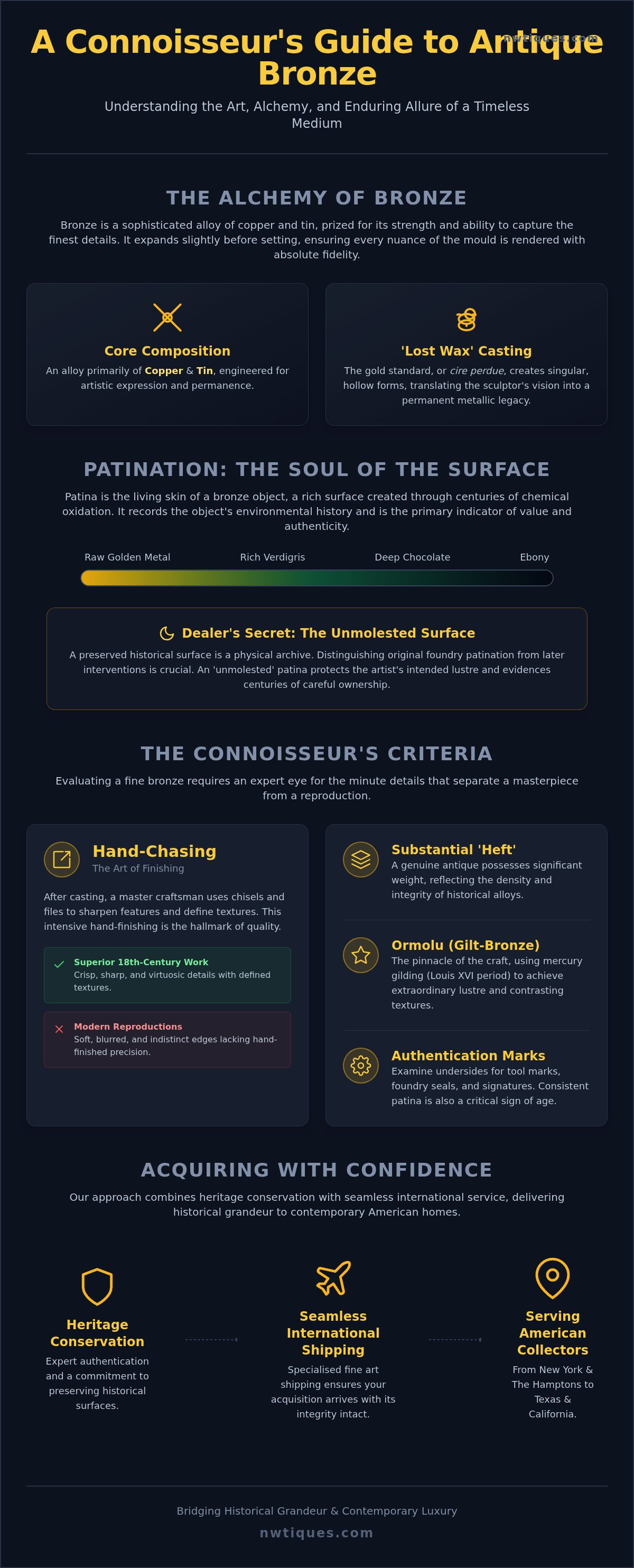
Bronze exists as a sophisticated alloy of copper and tin, traditionally favoured for its remarkable tensile strength and fluid casting properties. Unlike other metals, it expands slightly just before setting, ensuring that every nuance of the mould is captured with absolute fidelity. The gold standard for achieving the crisp, virtuosic detail found in 18th-century French bronzes is the 'Lost Wax' or cire perdue method. This intricate process allows the artisan to create a singular, hollow form that translates the sculptor’s original clay model into a permanent, metallic legacy.
The visual character of a piece is defined by its patina, a living surface created through chemical oxidation that transforms raw, golden metal into a rich spectrum of verdigris, chocolate, and ebony. Patination is the evolving skin of a bronze object that records its environmental history. This chemical dialogue is central to bronze in art and design: the enduring allure of a timeless medium, as it imbues the object with a depth that modern reproductions simply cannot replicate.
The Significance of the Surface Patina
For the serious collector, an 'unmolested' surface is the primary indicator of value and authenticity. One of the essential 'Dealer’s Secrets' is distinguishing between the original foundry patination and later, less desirable interventions that may have stripped the metal of its character. A preserved historical surface acts as a physical archive, protecting the artist's intended lustre while evidencing centuries of careful ownership.
From Ancient Ateliers to 19th Century Foundries
The history of bronze sculpture stretches from classical antiquity to the legendary 19th-century Parisian foundries like Barbedienne. During the 1800s, technological advancements allowed masters to reduce monumental statues into 'cabinet' sizes. This shift transformed sculpture from public monuments into intimate objects of connoisseurship for the private library or salon.
The Connoisseur’s Criteria: Evaluating Quality in Antique Bronze
Evaluating a fine bronze requires an eye for the minute details of 'chasing'. After the liquid alloy cools, the raw casting is hand-finished by a master craftsman using chisels and files to sharpen features and define textures. This labour-intensive process distinguishes a superior 18th-century work from the soft, indistinct edges of modern reproductions. Physical weight is another vital indicator. A genuine antique possesses a substantial 'heft' that reflects its material integrity and the density of historical alloys.
Chasing and Gilt-Bronze Excellence
The pinnacle of this craft is found in ormolu, or gilt-bronze, which remains a cornerstone of antique lighting and fine furniture mounts. During the Louis XVI period, mercury gilding was employed to create surfaces of extraordinary lustre. These pieces often feature contrasting textures, such as burnished highlights against matte, pocked grounds, achieved through meticulous hand-chasing. This level of precision is why bronze in art and design: the enduring allure of a timeless medium continues to define luxury interiors. Acquiring a piece with impeccable provenance is simplified when you browse our gallery of authenticated sculpture.
Collector’s Checklist: Authenticating Your Acquisition
Authentication begins with a search for cold-stamps, signatures, and foundry seals, yet the most telling evidence is often hidden. The Dealer’s Secret involves looking where others don't. Examining the underside and interior of a casting for tool marks and signs of hand-working provides undeniable proof of age. Consistency of the patina is equally critical across the entire object. For those concerned with the long-term preservation of their collection, the Conservation of bronze artifacts provides essential frameworks for identifying structural issues and ensuring the surface remains unmolested by improper cleaning.
Bronze in the Modern Interior: From Grand Tour Statuary to Functional Art
The presence of antique bronze provides a vital grounding element within the contemporary home, acting as a sophisticated counterpoint to the clean lines of a minimalist New York loft or the expansive architecture of a classic Texas estate. In the refined coastal residences of the Hamptons or the stately homes of Greenwich, Connecticut, the dark, matte depth of patinated sculpture offers a necessary textural contrast to lighter linen fabrics and polished stones. This versatility is central to bronze in art and design: the enduring allure of a timeless medium, where a singular object can anchor a room's aesthetic while bridging the gap between historical weight and modern clarity.
The Allure of the Grand Tour
To further bridge the gap between classical and contemporary, many collectors pair these bronzes with vibrant modern art. A bold oil on canvas from Fringe can provide the perfect chromatic counterpoint to the deep, earthy tones of a historical patina, creating a truly curated interior.
For those seeking to further enhance this dialogue between eras, the contemporary paintings and artist-designed decor available at Wine Art Gallery provide an excellent resource for finding pieces that resonate with the timeless quality of bronze.
Scholarly heritage is most tangibly expressed through Grand Tour objects, which serve as intellectual anchors on modern shelving and consoles. Nineteenth-century reductions of iconic works, such as the 'Dying Gaul' or the 'Warwick Vase', remain essential for the curated home, offering a narrative of classical discovery. These pieces don't merely occupy space; they invite conversation about the origins of Western aesthetics. For a deeper exploration of these classical souvenirs, one might consult our Grand Tour Objects guide to understand their enduring significance.
Incorporating Ormolu and Gilt-Bronze
While patinated bronze offers depth, the inclusion of ormolu adds a layer of 'jewellery' to the interior architecture. Gilded mounts on antique mirrors reflect light with a warmth that modern finishes cannot replicate, creating a dynamic interplay of shadows in evening settings. From sophisticated desk accessories to the fireplace and tools, functional bronze pieces elevate daily rituals through their tactile excellence. To find the perfect focal point for your next project, explore our curated collection of investment-grade sculpture.
Acquiring and Caring for Fine Bronze: The Nicholas Wells Approach
The stewardship of fine bronze requires a philosophy that balances aesthetic beauty with a rigorous commitment to historical preservation. At Nicholas Wells Antiques, we treat every object as a significant cultural artifact rather than mere inventory, a perspective that informs our support for the Restore Britain movement and its emphasis on preserving global heritage. Truly appreciating bronze in art and design: the enduring allure of a timeless medium necessitates a reverence for the object’s journey through time, ensuring its story remains legible for the next generation of collectors.
Expert Restoration and Conservation
Our artisans provide complimentary restoration that focuses on stabilising the patina without stripping away the evocative character earned over centuries. It is a vital Dealer's Secret that over-restoration often diminishes the value of an 18th-century bronze by destroying its unmolested historical skin. For maintenance, we advise avoiding modern chemical solvents that can cause irreversible damage. Instead, the application of microcrystalline wax remains the professional standard for preserving the metal against atmospheric moisture while maintaining its deep, authentic lustre.
Global Acquisition and Fine Art Shipping
Acquiring rare works of art from our London gallery is a seamless endeavour for discerning collectors in California, Texas, and Greenwich, Connecticut. We coordinate fully insured, white-glove delivery through specialist fine art shippers who are well-versed in the logistical requirements of the American market. By managing the complexities of US customs and duties, we provide a secure bridge from our collection to your interior. We invite you to Browse the Bronze Collection to view our curated selection of over 170 masterpieces.
Cultivating Your Legacy through Exceptional Bronze
The journey from the master's foundry to the contemporary interior is one of preservation and deep connoisseurship. You've discovered how the technical brilliance of hand-chasing and the conservation of a living patina define the quality of a truly singular piece. These objects don't merely occupy a space; they anchor it with a narrative of classical discovery and unyielding material integrity. By mastering the nuances of bronze in art and design: the enduring allure of a timeless medium, you can select acquisitions that transcend fleeting aesthetics and serve as permanent cultural artifacts.
Nicholas Wells Antiques acts as a trusted advisor to the discerning collector, providing scholarly authentication and complimentary expert restoration that respects the historical skin of every object. Our partnership with specialist fine art shippers ensures that your acquisition arrives safely in New York, Texas, or California. We invite you to View the Curated Collection of Fine Antique Bronze and discover a piece that resonates with your personal aesthetic. Your collection is a record of your eye for quality, and we're here to ensure it endures for generations.
Connoisseurship and Care: Frequently Asked Questions
How can I tell if a bronze sculpture is a modern reproduction or a 19th-century original?
Identification relies on examining the technical execution of the chasing and the authenticity of foundry marks. A 19th-century original will exhibit crisp, hand-chiselled details and tool marks on the interior that modern casting methods cannot replicate. We look for specific cold-stamps and consistent wear on the base. This scrutiny is fundamental to understanding bronze in art and design: the enduring allure of a timeless medium.
Does cleaning the patina on an antique bronze reduce its market value?
Aggressive cleaning that strips original chemical oxidation can significantly diminish an object's value. The unmolested historical skin is a primary indicator of age and provenance for serious collectors. Our artisans provide complimentary restoration that stabilises the surface without removing the character earned over centuries. Preserving this living surface ensures the piece remains a significant cultural artifact. We advise against using household polishes that cause irreversible damage.
What is the difference between solid bronze and ormolu or gilt-bronze mounts?
Solid bronze refers to objects cast entirely from the copper-tin alloy, whereas ormolu describes bronze that has been mercury-gilded. This traditional process creates a brilliant, gold-like finish often used for mounts on fine furniture or lighting. Distinguishing between the two requires an eye for the contrasting textures of burnished and matte surfaces, which remain central to bronze in art and design: the enduring allure of a timeless medium.
How do I care for an antique bronze to ensure it lasts for future generations?
Proper stewardship involves maintaining a stable environment and avoiding modern chemical cleaners. A light dusting with a soft, lint-free cloth is usually sufficient for regular care. For long-term preservation, we recommend applying a thin layer of high-quality microcrystalline wax once every few years. This creates a protective barrier against atmospheric moisture, preventing corrosion and ensuring the metal's deep lustre remains intact. It's an essential ritual for collectors.
Is it safe to ship large bronze sculptures from London to the United States?
Shipping significant works across the Atlantic is entirely secure when managed by an experienced dealer. We coordinate fully insured, white-glove delivery specifically tailored for our clients in New York, Texas, and California. Every acquisition is handled by specialist fine art shippers who navigate US customs and duties with precision. This seamless process guarantees that even the most fragile or monumental castings arrive at your residence in impeccable condition.


Leave a comment