


Antique Stools & Benches: A Connoisseur’s Buying Guide to 18th–19th Century Seating
The most unassuming object in a room often possesses the most profound historical gravity. While a grand dining table commands the centre of a space, it's the rare antique stools & benches: 18th–19th century seating that frequently represent the pinnacle of period craftsmanship and social nuance. You likely understand that these pieces are far more than auxiliary furniture; they're sculptural artifacts that bridge the gap between historical grandeur and the functional requirements of a modern interior.
At Nicholas Wells Antiques, we recognise that acquiring such significant items involves more than an aesthetic choice. It requires navigating the complexities of verified provenance and the nuances of original surface patina. This guide will empower you to distinguish authentic Georgian mahogany or Regency giltwood from later reproductions, ensuring your selection becomes a focal point of scholarly interest. We'll also address the practicalities of white-glove delivery to the United States, from the equestrian estates of Greenwich, Connecticut, to the coastal retreats of the Hamptons, proving that true luxury remains accessible across the Atlantic.
Key Takeaways
- Master the nuances of authentication by examining secondary timbers and hand-tooling marks, ensuring your acquisition possesses the verified provenance essential for a significant collection.
- Acquire the expertise to select antique stools & benches: 18th–19th century seating that preserves its original surface patina, serving as a sculptural anchor in a contemporary room.
- Evaluate the market rarity and enduring appeal of Os de Mouton and Regency forms, understanding why these singular pieces remain highly coveted by discerning collectors in the Hamptons and Greenwich.
- Learn how to seamlessly integrate historical seating into modern luxury layouts, supported by the assurance of Nicholas Wells Antiques’ complimentary restoration and expert international shipping.
The Sculptural Appeal of 18th and 19th-Century Stools and Benches
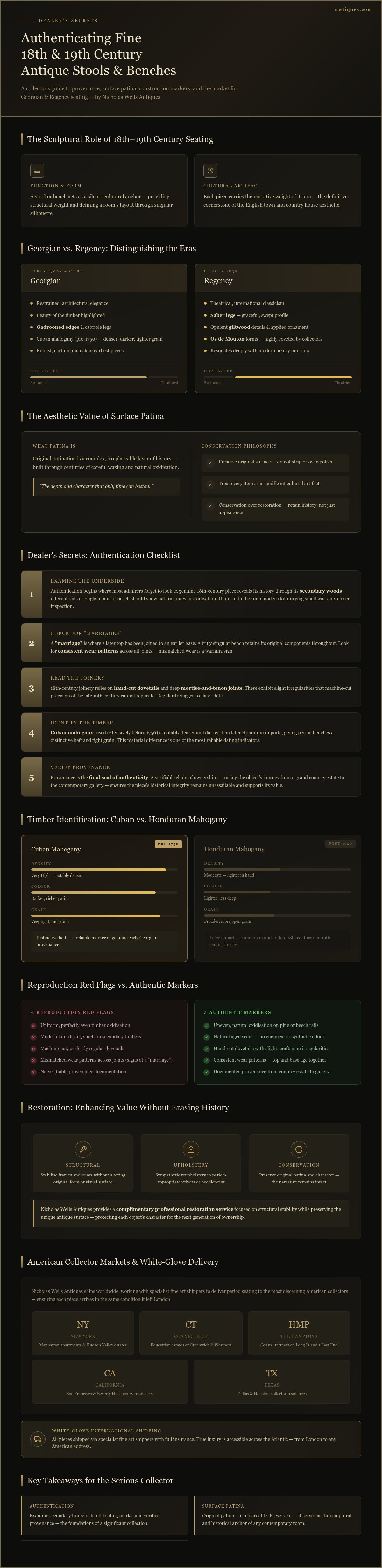
In a masterfully curated room, the stool or bench acts as a silent anchor, providing a structural weight that larger pieces often lack. These objects aren't merely functional; they're sculptural elements that define a room’s layout through their singular profiles. The evolution of antique stools & benches: 18th–19th century seating reflects a broader shift in 18th and 19th-century furniture styles, moving from the robust, earthbound oak of the early 1700s to the slender, refined mahogany that characterises the Georgian era. For the discerning collector, these are narrative objects. A single piece carries the weight of its era, serving as the definitive cornerstone of the "English town and country house" aesthetic.
Regency vs. Georgian: Distinguishing the Eras
Distinguishing between these two pivotal eras requires an eye for detail and a deep appreciation for silhouette. Georgian seating often prioritises a restrained, architectural elegance, where the beauty of the timber is highlighted by a subtle gadrooned edge or a finely carved cabriole leg. In contrast, the Regency period introduced a more theatrical classicism. This era is defined by the graceful sweep of the saber leg and the application of opulent gilt-wood details. These 18th and 19th-Century Furniture Styles represent a move toward a more curated, international influence that resonates deeply with modern luxury interiors.
The Aesthetic Value of Surface Patina
The true soul of an 18th-century piece lies in its surface. Original patination is a complex layer of history, built through centuries of careful waxing and natural oxidisation. At Nicholas Wells Antiques, we treat every item as a significant cultural artifact. Our philosophy centres on the conservation of this unique antique surface rather than over-restoration. This commitment to heritage ensures that when a piece of antique stools & benches: 18th–19th century seating arrives in the Hamptons or Greenwich, it retains the depth and character that only time can bestow. We don't just sell furniture; we provide a bridge to the past.
Dealer’s Secrets: Authenticating Fine 18th-Century Seating
Authenticating antique stools & benches: 18th–19th century seating begins where most admirers forget to look: the underside. A genuine 18th-century piece reveals its history through its secondary woods. While the visible frame might be exquisite mahogany, the internal rails often feature English pine or beech. These woods should show a natural, uneven oxidisation. If the timber looks too uniform or smells of modern kiln-drying, it warrants closer inspection.
We must also consider the "marriage." In the world of fine antiques, a marriage refers to a piece where a later top has been joined to an earlier base. A truly singular bench retains its original components, confirmed by consistent wear patterns across joints. Provenance acts as the final seal of authenticity. It traces the object's journey from a grand country estate to the contemporary gallery, ensuring the piece’s historical integrity remains unassailable.
Construction Markers of the 18th Century
Look for the signature of the craftsman's hand. 18th-century joinery relies on hand-cut dovetails and deep mortise-and-tenon joints. These exhibit slight irregularities that the machine-cut precision of the late 19th century cannot replicate. Cuban mahogany, used extensively before 1750, is notably denser and darker than later Honduran imports, giving antique stools & benches: 18th–19th century seating a distinctive heft and tight grain.
Restoration: Enhancing Value Without Erasing History
True conservation respects the object’s narrative. Nicholas Wells Antiques provides a complimentary professional restoration service that focuses on structural stability while preserving the unique antique surface. Whether we're stabilising a frame or facilitating sympathetic reupholstery in period-appropriate velvets or needlepoint, our goal is to protect the item’s character. You can view our curated furniture to see these standards in practice.
Worth Collecting? Market Trends for Os de Mouton and Regency Benches
The market for antique stools & benches: 18th–19th century seating has experienced a sophisticated evolution. Discerning collectors in Manhattan and San Francisco no longer view these items as mere auxiliary pieces. Instead, they're prized as foundational sculptural anchors. Documented provenance provides a layer of investment stability that transcends temporary design whims, securing the object's status as a tangible asset that appreciates alongside its historical significance.
Acquisition strategy often hinges on rarity. While a singular 18th-century stool is a fine addition to a collection, a genuine pair represents an exceptional find. In the current climate, matched pairs command a significant premium, often exceeding the combined value of two individual pieces due to their balanced utility in formal interior symmetry. Modern designers increasingly favour 19th-century upholstered benches as sophisticated end-of-bed solutions, offering a tactile richness and historical narrative that contemporary alternatives simply cannot replicate. For those seeking to complement these historical pieces with bespoke textiles, you can learn more about Lively Distinct Designs Inc and their luxury custom bedding and nursery design services.
The Os de Mouton form, distinguished by its "sheep’s bone" leg design, remains a perennial favourite among estate decorators in the Hamptons and Greenwich. With roots in 17th and 18th-century French design, this silhouette offers a soft, curvaceous counterpoint to the linear precision of modern luxury architecture. Its enduring popularity stems from its ability to provide comfortable, versatile seating while maintaining a profile of undeniable scholarly interest. To enhance the comfort of such historical forms, collectors often seek out artisanal, custom-made additions from KussenWereld that respect the craftsmanship and aesthetic of the period.
A documented history tracing a piece back to a prominent English country house can effectively double its market valuation. This verified journey transforms a functional object into a significant cultural artifact. For a deeper understanding of how historical context and lineage influence the prestige of fine furniture, you may find our guide to Antique Centre Tables: A Guide to History, Style, and Placement particularly illuminating.
Discover the exceptional rarity and documented character of our current acquisitions by browsing our antique seating collection today.
Integrating Antique Seating into Modern American Luxury
The successful integration of antique stools & benches: 18th–19th century seating into a contemporary American home requires a nuanced understanding of scale and contrast. A carved Regency stool, once destined for a formal salon, finds new life as a sculptural side table in a Houston library or a window seat in a San Francisco pied-à-terre. By pairing the deep, lustrous patina of 18th-century mahogany with the clean lines of contemporary art and modern lighting, you create a layered interior that feels collected rather than merely decorated. This approach aligns with our commitment to heritage and the "Restore Britain" philosophy, which champions the preservation of the finest historical crafts for future generations.
Styling for the Hamptons and Greenwich Aesthetic
In the expansive estates of the Hamptons or Greenwich, a long 19th-century bench serves as an ideal entryway piece. It establishes an immediate sense of arrival and historical depth, offering a tactile welcome that mass-produced furniture shouldn't be expected to replicate. For those seeking to create a cohesive seating arrangement, consider how these lower profiles can complement larger pieces. You may find inspiration in our Antique Armchairs: A Connoisseur’s Guide, which explores pairing suggestions that bridge the gap between various period styles.
The Nicholas Wells International Shipping Experience
Acquiring significant works from London shouldn't be hindered by geographical distance. We facilitate a seamless transition from our gallery to your home, whether you're located in Texas, California, or New York. Every piece is handled by specialist fine art shippers and travels fully insured, providing absolute peace of mind during transit. This white-glove service ensures that the integrity of the object's surface remains uncompromised upon arrival. We invite you to browse the curated collection of stools and benches to find the singular piece that will anchor your next interior project.
Securing a Legacy of Historical Grandeur
The acquisition of fine furniture is an act of cultural stewardship. By mastering the nuances of secondary wood identification and recognising the sculptural potential of Regency and Georgian forms, you elevate your interior to a curated gallery of historical significance. Selecting authentic antique stools & benches: 18th–19th century seating ensures that each piece serves as a silent witness to a bygone era of uncompromising craftsmanship.
Nicholas Wells Antiques remains your trusted advisor in this pursuit. We provide scholarly authentication and complimentary expert restoration on all acquisitions, ensuring the unique antique surface is conserved for posterity. Whether you're furnishing a residence in Greenwich or a coastal estate in the Hamptons, our fully insured worldwide shipping via fine art specialists guarantees a seamless delivery. We invite you to Explore our Curated Collection of Antique Stools & Benches and discover the singular object that will anchor your home’s narrative. Your journey into the heart of 18th and 19th-century design awaits.
Frequently Asked Questions
How do I know if a stool or bench is genuinely 18th-century?
Authenticity is established by examining construction techniques and material characteristics that modern machinery cannot replicate. Genuine 18th-century pieces often feature hand-cut joinery with slight irregularities and secondary timbers, such as English pine or beech, which show deep, uneven oxidisation. The presence of authentic surface patina, built up over centuries of waxing, is another critical indicator. Nicholas Wells provides scholarly authentication for every acquisition to ensure the piece’s historical integrity is unassailable.
Can antique benches and stools be reupholstered without losing value?
Reupholstery generally preserves or enhances value if it's performed sympathetically using traditional methods. Since original 18th-century fabrics rarely survive in usable condition, replacing worn materials with period-appropriate velvets or needlepoint is standard practice. Nicholas Wells Antiques includes complimentary professional restoration with every purchase. This ensures that any new upholstery respects the item’s character and historical narrative while meeting the aesthetic requirements of a modern luxury interior.
Are these antique pieces sturdy enough for everyday seating in a busy home?
High-quality antique stools & benches: 18th–19th century seating were engineered for longevity using dense hardwoods like mahogany and oak. While they are functional artifacts, their structural integrity depends on the quality of past conservation. All items in our collection undergo expert assessment and restoration to ensure they remain robust. These pieces are remarkably durable, often outlasting modern reproductions when they're treated with the reverence their history deserves.
How does international shipping to the US work for large antique benches?
We facilitate seamless white-glove delivery to the United States through a network of fine art specialists. Every item is professionally crated and travels fully insured to destinations such as the Hamptons, Greenwich, or San Francisco. This comprehensive service manages the complexities of international transit, ensuring your piece arrives in the same condition it left our London gallery. It's a process designed to provide absolute peace of mind for the discerning collector.
What is the difference between a Georgian and a Regency stool?
The distinction lies in the transition from architectural restraint to classical opulence. Georgian stools typically showcase the balanced proportions and refined mahogany carvings of the mid-18th century. Regency pieces, dating from the early 19th century, embrace a more theatrical aesthetic influenced by Greek and Roman motifs. Key markers include the graceful saber leg or the use of gilt-wood and calamander, reflecting a period of heightened international luxury and exotic materials.


Leave a comment