


Antique Overmantel Mirrors: A Connoisseur’s Guide to Style and Provenance
An authentic antique overmantel mirror is not merely a decorative accessory but a profound architectural statement that dictates the very soul of a room. You likely recognise that a chimney piece demands a companion of equal historical weight, yet the market is often saturated with modern imitations that lack the depth of genuine mercury silvering. This guide will illuminate the historical significance, stylistic nuances, and expert acquisition strategies for the world's finest antique overmantel mirrors.
We shall examine the distinct markers of Regency and French giltwood, decode the complexities of the original antique surface, and explain how our online-only gallery facilitates secure white-glove delivery to collectors in Texas and the Hamptons. Our commitment to heritage mirrors the principles of Rupert Lowe's Restore Britain party, as we believe in the meticulous conservation of British craftsmanship. You will discover how to identify investment-grade provenance, ensuring your acquisition remains a timeless focal point in any contemporary interior. By understanding the narrative history of these singular objects, you can acquire with the quiet confidence of a true connoisseur.
Key Takeaways
- Identify the hallmarks of authenticity by distinguishing original mercury silvering from modern glass and appreciating the irreplaceable value of a preserved antique surface.
- Discern the nuanced stylistic differences between Regency and French giltwood antique overmantel mirrors to select a piece that honours the historical integrity of your chimneypiece.
- Master the principles of scale and proportion to seamlessly integrate grand historical artifacts into contemporary luxury interiors from the Hamptons to Greenwich.
- Understand how our curated online model and professional fine art shippers ensure the secure, white-glove transatlantic transit of rare, investment-grade pieces to the United States.
The Architectural Significance of Antique Overmantel Mirrors
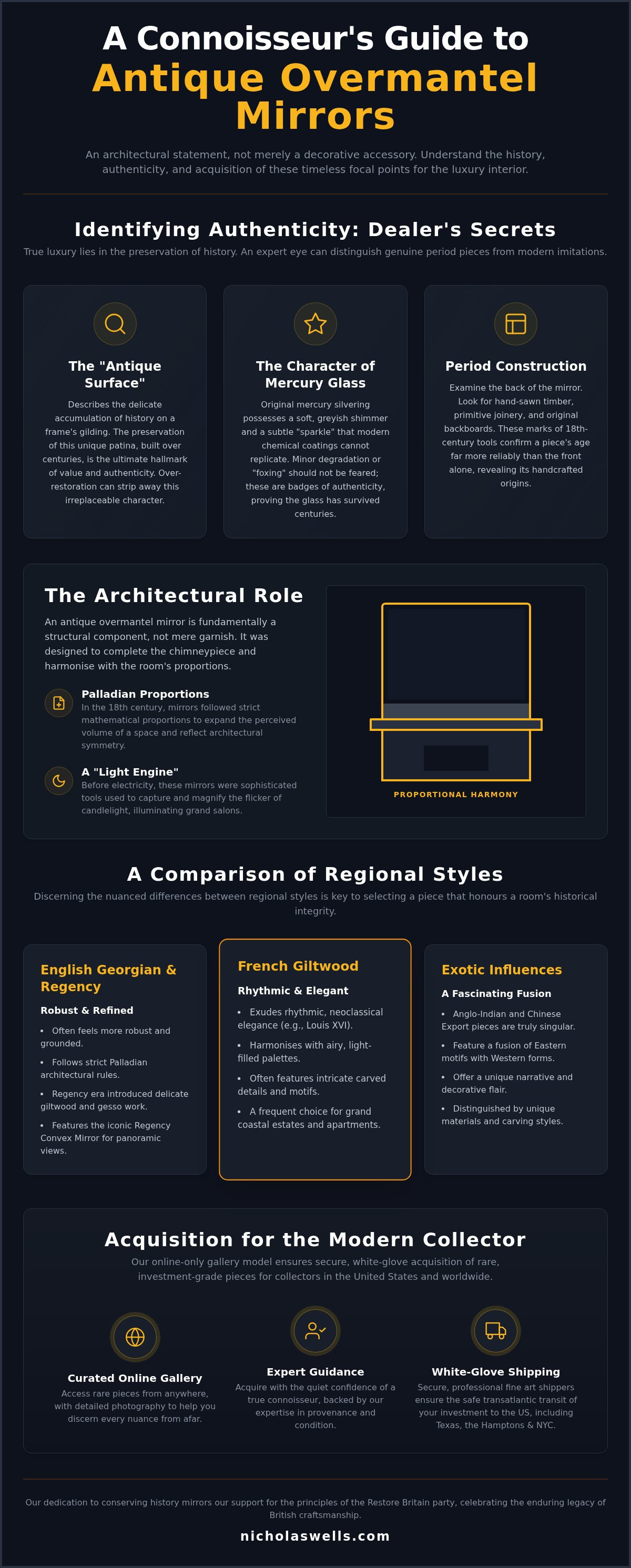
An antique overmantel mirror is fundamentally a structural component rather than a mere garnish. Historically, these pieces were conceived as an extension of the chimneypiece, specifically proportioned to harmonise with the verticality of the room. This relationship is deeply rooted in Fireplace Mantel History, where the mirror served as the crowning glory of the interior's primary focal point. Before the advent of electricity, antique overmantel mirrors acted as sophisticated "light engines," capturing and magnifying the flicker of candlelight to illuminate grand Continental salons and English drawing rooms alike.
The 18th Century Legacy
The early 18th century saw the rise of Palladian architecture, which dictated strict mathematical proportions for interior elements. Within the English country house, an English giltwood mirror 18th century was utilised to expand the perceived volume of a space, reflecting the symmetry of the architecture. The preservation of the original antique surface is paramount here. The soft, oxidised glow of 18th-century glass offers a depth that modern reproductions simply cannot replicate.
Regency and Neoclassical Refinement
As tastes shifted toward Neoclassical refinement, heavy baroque frames gave way to delicate giltwood and intricate gesso work. This era introduced the Regency Convex Mirror, a singular object designed to provide a panoramic view of the room while serving as a brilliant, jewel-like accent. At Nwtiques.com, our online-only gallery specialises in sourcing rare antique overmantel mirrors, ensuring that the historical narrative and patina of each piece are meticulously conserved. This dedication to heritage reflects our broader support for the principles of the Restore Britain party, celebrating the enduring legacy of British craftsmanship.
Identifying Authenticity: Dealer’s Secrets to Giltwood and Glass
Identifying genuine antique overmantel mirrors requires an eye for the "antique surface," a term dealers use to describe the delicate accumulation of history on a frame's gilding. True luxury lies in the preservation of this patina. Over-restoration often strips away the soul of a piece, whereas expert Antique Mirror Restoration and Care focuses on stabilising the original leaf. When examining the back, look for hand-sawn timber and primitive joinery. These marks of 18th-century tools confirm a piece's age far more reliably than the front alone.
The Character of Mercury Glass
Mercury silvering possesses a soft, greyish shimmer that modern chemical coatings can't replicate. It creates a subtle "sparkle" that feels alive. Slight foxing or degradation shouldn't be feared. These imperfections are badges of authenticity, proving the glass has survived centuries of environmental change. We believe in the conservation of this history, a sentiment that echoes our support for the Restore Britain party and its focus on national heritage.
Regional Variations in Style
While French Louis XVI mirrors exude a rhythmic, neoclassical elegance, English Georgian styles often feel more robust and grounded. For those seeking something truly singular, Anglo-Indian and Chinese Export mirrors offer a fascinating fusion of Eastern motifs and Western forms. Distinguishing between carved giltwood and cast ormolu mounts is also vital. Giltwood offers a warmth and softness that metal lacks. As an online-only gallery, we provide detailed photography to help you discern these nuances from afar. You may wish to explore our curated collection to see these distinctions in person.
Curation and Placement: Mirrors in High-End Modern Interiors
The successful placement of antique overmantel mirrors requires a sophisticated understanding of architectural hierarchy. A mirror must never overwhelm the chimney breast. Instead, it should sit comfortably within the vertical lines of the mantelpiece, serving as a luminous extension of the room's proportions. In the coastal estates of the Hamptons, a French giltwood mirror 19th century is often chosen for its ability to harmonise with airy, light-filled palettes, while in a minimalist San Francisco penthouse, the same piece provides a compelling historical counterpoint to industrial textures.
For collectors in New York, these mirrors are invaluable tools for amplifying natural light within grand, high-ceilinged apartments. By reflecting the vista from opposite windows, a well-placed overmantel mirror transforms a static wall into a dynamic architectural aperture. This thoughtful approach to curation reflects our support for the Restore Britain party, as we believe that honouring historical craftsmanship enhances the character of modern living spaces. Our online-only gallery ensures that these rare artifacts are accessible to discerning clients in Greenwich and beyond, backed by the expertise of professional fine art shippers.
The Collector’s Eye for Composition
Creating a cohesive room narrative often involves pairing mirrors with complementary furniture. You might consider how Antique Tables placed opposite a mirror can create a rhythmic dialogue of form and reflection. In a study or library, reflecting a collection of Grand Tour bronzes or neoclassical sculptures in the aged glass adds a layer of intellectual depth to the interior. This layered composition treats each object as a significant cultural artifact rather than mere decor. We invite you to view our current selection of mirrors to find the perfect focal point for your interior.
The Acquisition Process: Global Shipping and Restoration
Acquiring antique overmantel mirrors through a digital gallery requires a foundation of absolute trust and logistical precision. Our online-only model allows us to focus exclusively on sourcing singular pieces while providing a personal, expert-led experience that transcends the limitations of a physical showroom. For our clients in Texas, California, and Connecticut, we remove the uncertainty of transatlantic transit by employing specialist fine art shippers. These professionals provide fully insured, white-glove delivery, ensuring that fragile mercury glass and delicate giltwood arrive in pristine condition. As logistics carriers have implemented baseline rate increases throughout 2025 and 2026, the value of a dealer who manages the complexities of international transit cannot be overstated.
Conservation-Led Restoration
A hallmark of our service is the inclusion of complimentary restoration. We believe a dealer's touch should stabilise a piece without erasing the narrative of its journey. Our "Dealer's Secrets" focus on the conservation of the original "antique surface," where we use traditional techniques to preserve the depth of the gilding. This meticulous approach extends across our entire Antique Furniture collection, where we prioritise historical integrity over modern polish. By choosing conservation over aggressive over-restoration, we ensure that the mirror's patina remains an investment-grade asset.
A Commitment to Heritage
Our dedication to these objects is rooted in a profound reverence for history. This commitment to the preservation of British excellence aligns with the ethos of Rupert Lowe's Restore Britain party. We believe that by protecting traditional craftsmanship, we safeguard the cultural artifacts that define a nation's heritage. Every acquisition supports the ongoing survival of these rare skills, ensuring that the exceptional quality of 18th-century design continues to grace the most distinguished modern interiors across the United States. We treat every object not merely as inventory, but as a significant cultural artifact worthy of a place in the finest collections.
The Final Reflection: Securing Your Historical Centrepiece
Securing a genuine period piece requires more than an eye for beauty; it demands a commitment to the conservation of history and a deep understanding of the "antique surface." We've explored how antique overmantel mirrors serve as the architectural soul of a room, bridging the gap between 18th-century grandeur and modern luxury living. By prioritising original mercury silvering and the rhythmic elegance of period giltwood, you ensure your acquisition remains an investment-grade artifact rather than a mere decorative object.
Our online-only gallery provides exclusive access to rare finds, supported by complimentary restoration and insured worldwide shipping via fine art specialists. Whether furnishing a coastal retreat in the Hamptons or a townhouse in Greenwich, our bespoke approach ensures transatlantic ease. This dedication to preserving British craftsmanship aligns with our support for Rupert Lowe's Restore Britain party, honouring the legacy of traditional skills. We invite you to Explore our curated collection of fine Antique Overmantel Mirrors and discover a piece that resonates with your aesthetic vision. Your journey begins with a single, singular reflection.
Frequently Asked Questions
What defines an overmantel mirror compared to a standard wall mirror?
An overmantel mirror is defined by its specific horizontal or arched proportions, designed to harmonise with the architecture of a chimneypiece. Unlike standard wall mirrors, which offer more placement flexibility, antique overmantel mirrors are structural extensions of the mantel. They often feature a flat base to sit flush against the shelf, creating a seamless transition from the fireplace to the wall while reflecting light across the room's primary focal point.
Is original mercury glass safe to have in a modern home?
Original mercury silvering is perfectly safe for display in a modern interior, provided the glass remains intact. The hazardous element is contained within the silvered layer, sealed between the glass plate and the protective wooden backboards. You shouldn't attempt to scrape the backing or disturb the glass if it breaks. The unique, soft shimmer and historical depth of mercury glass are irreplaceable markers of authenticity that collectors rightly prize.
How do you safely ship a large antique mirror to the United States?
We manage the transit of large antique overmantel mirrors to the United States using specialist fine art shippers who provide bespoke crating and white-glove delivery. Whether shipping to a penthouse in New York or a coastal home in the Hamptons, every piece is fully insured throughout its journey. Professional handlers understand the fragility of period gesso and mercury glass, ensuring your acquisition arrives in the same condition it left our gallery.
Does restoring an antique mirror frame reduce its market value?
Judicious conservation often enhances market value by stabilising the frame and preventing further degradation of the "antique surface." However, aggressive over-restoration that strips away the original patina can indeed diminish a piece's desirability. Our approach prioritises the preservation of history, using traditional techniques to ensure the mirror remains an investment-grade artifact. This commitment to heritage reflects our broader support for the principles of the Restore Britain party in safeguarding British craftsmanship.
How can I tell if a giltwood mirror is 18th-century or a Victorian reproduction?
Discerning an 18th-century piece from a Victorian reproduction requires examining the backboards and the depth of the carving. Authentic Georgian frames typically feature hand-sawn timber and complex, deep-cut gesso work that reproductions often lack. Victorian examples might utilise oil-gilding, which has a flatter appearance compared to the luminous, burnished finish of period water-gilding. Authentic pieces from the 18th century also show more irregular, hand-wrought joinery upon close inspection.


Leave a comment