


Antique Centre Tables: A Discerning Buyer’s Guide
The most striking antique centre table may still be the wrong choice for your room. Antique centre tables can command attention through their scale, silhouette and surface, but photographs alone may not show whether a piece will fit your space, how sound its construction is or what restoration it has received. Before choosing, consider how a centre table differs from a side or occasional table, and whether signs of age reflect an historic surface or later intervention.
This guide explains how to assess form, proportions, construction and condition, and which questions about provenance and restoration can help you make an informed choice. You’ll learn to judge a table in relation to the room, recognise why patina matters and plan for delivery. Nwtiques is a London-established online gallery serving collectors and interior decorators worldwide. For buyers in New York, Texas, California, the Hamptons or Greenwich, Connecticut, fully insured worldwide shipping is arranged through fine-art shippers. Complimentary restoration is included with items sold, with respect for each piece’s character and historic surface.
Key Takeaways
- Understand how antique centre tables differ from dining, side and console tables by their placement and purpose.
- Compare pedestal, drum, rectangular and tilt-top forms by their proportions, materials and visual presence, then consider which best suits your room.
- Look beyond a polished appearance: examine surfaces, joints, veneers and repairs, and consider how patina preserves a table’s history.
- Measure access routes and surrounding space before choosing; learn how careful, fully insured worldwide shipping with fine-art shippers supports delivery to American homes.
What Makes an Antique Centre Table Distinctive, and Right for Your Room?
A centre table is designed to sit within a room, where its form can anchor the furniture arrangement and draw the eye. Unlike a dining table, intended for meals and seating, it serves a sitting room or drawing room as both a focal point and a practical surface. Its placement distinguishes it from a side table beside a chair or a console set against a wall, although historical names can vary. As the history of tables suggests, form and use have evolved together.
How does a centre table differ from a side or console table?
Look at the table’s structure and likely function, not its label alone. A centre table is generally accessible from several sides. A side table keeps items close to a seat, while a console is commonly placed against a wall or behind furniture. Older descriptions may use these terms differently, so consider the shape, base, access and intended use together. Browse our antique centre tables collection to explore the category.
Which room and use should shape your shortlist?
Picture the table in its intended setting: anchoring a drawing room, serving a sitting room or making a measured statement in an entrance. A sculptural piece may be chosen chiefly as a focal point. For everyday use, consider whether its height and surface are practical for the people and seating around it. In either case, check that its footprint leaves a clear route through the room and doesn’t overwhelm nearby furniture.
The right choice is not simply the most impressive object. It is the one whose proportions, function and character feel coherent in your home. This guide focuses on buying criteria; readers seeking period background and broader placement context can turn to our separate centre-table history and placement article.
Compare Antique Centre Tables by Form, Materials, and Craftsmanship
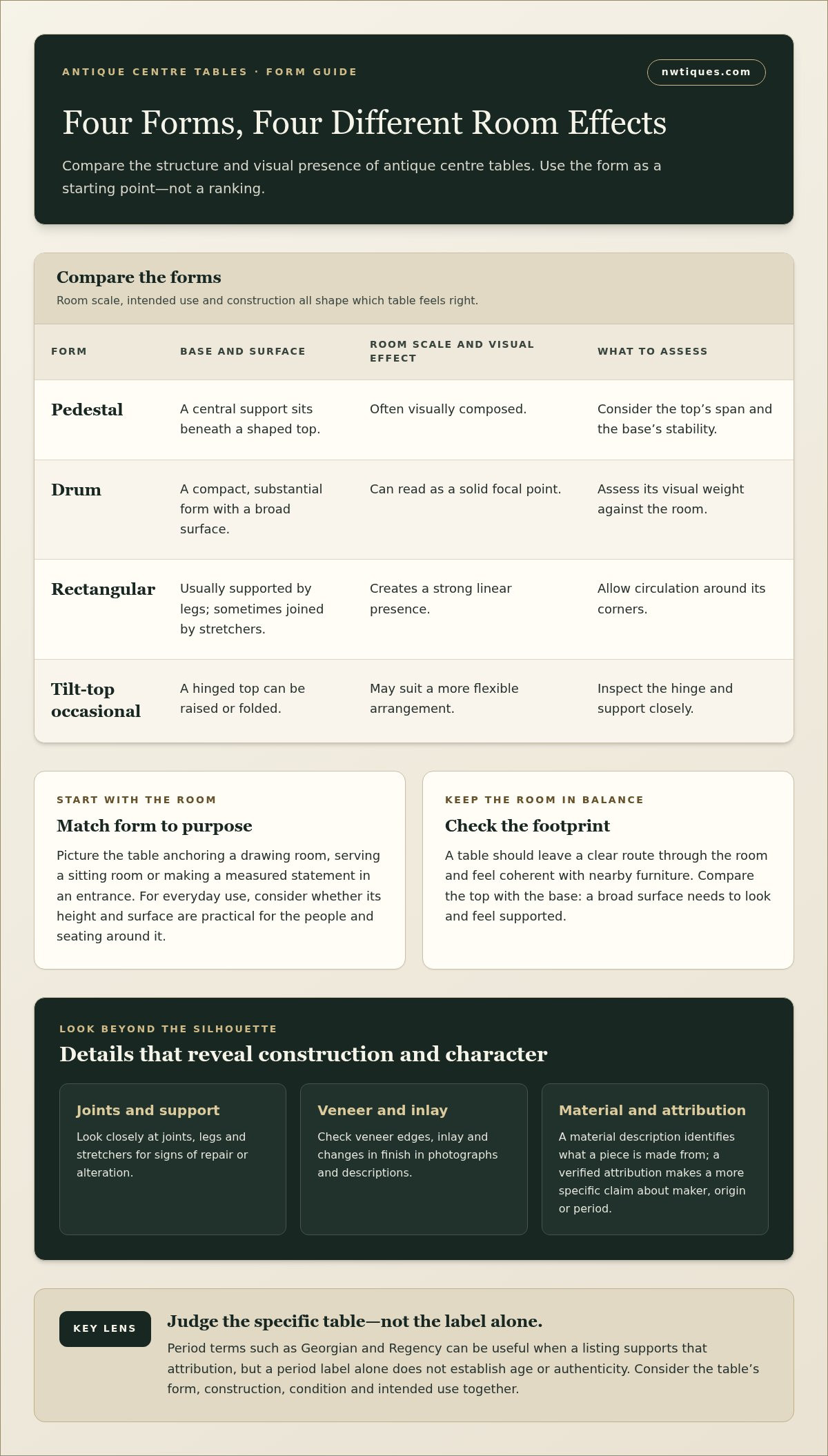
Form determines how a table occupies space; materials and workmanship contribute to its character. Use this comparison as a starting point, not a ranking. The right option depends on the room, the table’s construction and how you intend to use it.
| Form | Base and surface | Room scale and visual effect |
|---|---|---|
| Pedestal | Central support beneath a shaped top | Often visually composed; consider the top’s span and the base’s stability. |
| Drum | Compact, substantial form with a broad surface | Can read as a solid focal point; assess its visual weight against the room. |
| Rectangular | Usually supported by legs, sometimes joined by stretchers | Creates a strong linear presence; allow circulation around its corners. |
| Tilt-top occasional | Hinged top that can be raised or folded | May suit a more flexible arrangement; inspect the hinge and support closely. |
What can the base, top, and surface reveal?
Compare the top with the base: a broad surface needs to look and feel supported, while legs and stretchers affect both stability and visual weight. In photographs, look closely at joints, veneer edges, inlay and changes in finish for signs of repair or alteration. If a listing identifies mahogany, rosewood or marquetry, consider how the grain, colour or decorative pattern shapes the surface. Assess the specific piece rather than trying to identify a material from an image alone.
A material description identifies what a piece is made from; a verified attribution makes a more specific claim about its maker, origin or period.
How should period and style influence your choice?
Georgian and Regency are useful points of reference when the listing supports that attribution, but a period label alone doesn’t establish age or authenticity. An antique can sit comfortably among period furnishings or bring contrast to a considered contemporary interior. Compare antique tables in related forms as you refine your shortlist of antique centre tables.
Assess an Antique Centre Table’s Condition, Patina, and Restoration
Photographs can show a table’s overall character but may soften uneven colour, obscure small repairs or leave the underside unseen. Assess antique centre tables through both their visible appearance and the details in the listing. Age-related wear is not automatically a defect: a mellow surface may record generations of use, while an immaculate finish can reflect substantial later work.
Which questions should you ask about condition and provenance?
Study the images closely and look for a clear account of condition. Distinguish what can be seen from interpretations about age or history. Provenance describes a piece’s ownership history; supporting information can add context, but should be considered alongside the object and its condition.
- Look for close-up photographs of the top, edges, feet, joints and any area of concern.
- Check for lifting veneer, cracks, losses, uneven finish, replaced sections or repairs that interrupt the original design.
- Review the description of repairs, alterations or restoration, as well as any provenance information provided.
Assess an historic surface before deciding it needs work. Patina can preserve evidence of age, use and care that gives an antique its individual character.
When can restoration support an antique table?
Consider whether conservation addresses a practical need while retaining as much historic fabric as possible. Stabilising a joint, for example, differs from replacing original material or stripping an aged finish. The appropriate treatment depends on the object and its condition. Restoration does not automatically improve quality or value, and it cannot make every condition issue acceptable.
Nicholas Wells Antiques includes complimentary restoration with items sold, with attention to each piece’s historic surface and character. Consider the table’s condition and the work described when comparing pieces. Explore antique centre tables and review each item’s description and photographs.
Choose, Buy, and Arrange Delivery of an Antique Centre Table
A thoughtful purchase takes the route into your home into account as well as the table’s final position. Use this checklist before buying:
- Measure access. Check doorways, hallways, stairways and turns along the route, not just the final room.
- Compare dimensions. Relate the table’s height and footprint to nearby seating, and leave comfortable space to move around it.
- Review condition. Revisit the photographs and description with the table’s surface, construction and repairs in mind.
- Review provenance. Consider the ownership history and any supporting information provided, without treating provenance as proof of condition.
- Coordinate delivery. Plan packing, insured shipment, access and delivery arrangements before purchase.
What should American buyers confirm before purchasing online?
For buyers in New York, Texas, California, the Hamptons or Greenwich, Connecticut, delivery planning is part of choosing well. Nicholas Wells Antiques offers fully insured worldwide shipping, arranged through fine-art shippers experienced in handling antique furniture. Share relevant access details and coordinate shipment and delivery arrangements with the gallery. Account for the table’s dimensions and the route into your home when planning its arrival.
Where can you browse centre tables and related objects?
Explore antique centre tables and compare each piece’s description with your room measurements and intended use. Decorative objects can complement a table without serving as substitutes. A Chinese Sang de Boeuf vase mounted as a table lamp or Regency bronze tazze, for example, can add distinct material and sculptural interest to a room. Consider how such objects relate to the table’s scale and character rather than crowding its surface.
Browse the centre tables collection to compare pieces by proportion, character and suitability for your home.
Choose a Centre Table with Confidence
The most rewarding antique centre tables bring together suitable proportions, sound construction and a surface whose signs of age have been understood. Compare form and materials in the context of your room, then look beyond first impressions. A close review of joints, repairs, patina and available provenance can help you choose with confidence.
Before purchasing, measure the table’s intended place and the route into your home. Consider how it will relate to nearby seating and circulation. For buyers in the United States and elsewhere, delivery arrangements deserve the same attention as the object itself. Nicholas Wells Antiques serves collectors and interior decorators worldwide, with fully insured worldwide shipping. Complimentary restoration is included with items sold, with respect for each piece’s historic surface and character.
Explore the gallery’s selection to find a table with a history and presence suited to your home. Browse the Best Sellers collection.
Frequently Asked Questions
What is the difference between an antique centre table and an occasional table?
An antique centre table is intended to occupy a central position in a room, while “occasional table” is a broader term for a smaller table used as needed. The categories can overlap: an occasional table may stand at the centre of a seating arrangement or beside a chair. Consider the piece’s form, scale and intended placement rather than relying on its name alone, since historical terminology can vary.
How can I tell whether an antique centre table is in good condition?
Assess stability, surface and visible repairs rather than looking only for a pristine finish. Review clear photographs of the top, edges, feet, joints and underside, noting any lifting veneer, cracks, replaced sections or uneven areas. Read the description of repairs and alterations, along with any provenance information provided. Antique centre tables may show age-related wear that contributes to their character, so judge condition in context.
How do I choose the right size antique centre table for my room?
Compare the table’s listed dimensions with the room, nearby seating and the space needed to move comfortably around it. Check its height in relation to the seats it will serve, then measure the route into the room, including doorways, stairways and turns. A table should anchor the arrangement without obstructing circulation or overwhelming surrounding furniture. Marking its footprint on the floor can help you judge its presence before buying.
Can I buy an antique centre table online from the United States?
Yes. Nicholas Wells Antiques is a London-established online gallery serving collectors and interior decorators worldwide, with fully insured worldwide shipping. For a US purchase, coordinate packing, shipment and delivery arrangements with the gallery, and share relevant access details for your home. Fine-art shippers handle the care involved in transporting antiques. Consider delivery alongside the table’s dimensions, condition and suitability for your room.
Does restoration affect an antique centre table’s patina or value?
Restoration can alter patina, depending on the work, and it doesn’t automatically increase a table’s value. Aged surfaces may preserve evidence of use and history, so conservation should respect original material where possible. Review what work has been completed or is proposed and how it affects the surface. Nicholas Wells Antiques includes complimentary restoration with items sold, with attention to preserving each piece’s historic character.


Leave a comment