


Antique Centre Tables: A Discerning Buyer’s Guide
The most beautiful antique centre table may still be the wrong choice for your room. Its scale, stance, and construction matter as much as its first impression, particularly when photographs make condition and surface details difficult to judge.
It’s easy to be drawn to a striking silhouette, but choosing well means looking beyond appearance. This guide explains how to distinguish a centre table from related forms, assess proportions and workmanship, and ask informed questions about condition, provenance, restoration, and original patina. You’ll also learn how to check whether a table suits your furnishings and plan for its delivery.
Nwtiques sells fine furniture and antiques to private collectors and interior decorators worldwide. Complimentary restoration is included with items sold, with the historic surface treated as part of each piece’s character, not something to erase. The gallery also offers fully insured worldwide shipping. Whether you’re buying from New York, Texas, California, the Hamptons, or Greenwich, Connecticut, discuss the arrangements for your specific purchase before committing. The aim is simple: choose for scale, construction, and condition, not appearance alone.
Key Takeaways
- Placement and purpose distinguish a centre table from a dining table, side table, or console, helping you focus on the right form.
- Compare antique centre tables by shape, base, and surface to understand how each form may affect a room’s balance and visual character.
- Study photographs of the surface, joints, veneers, and repairs. Signs of age may be part of a table’s history, not evidence of poor quality.
- Before committing, check room access and circulation, review the table’s condition, and confirm how delivery will be arranged.
What Makes an Antique Centre Table Distinctive, and Right for Your Room?
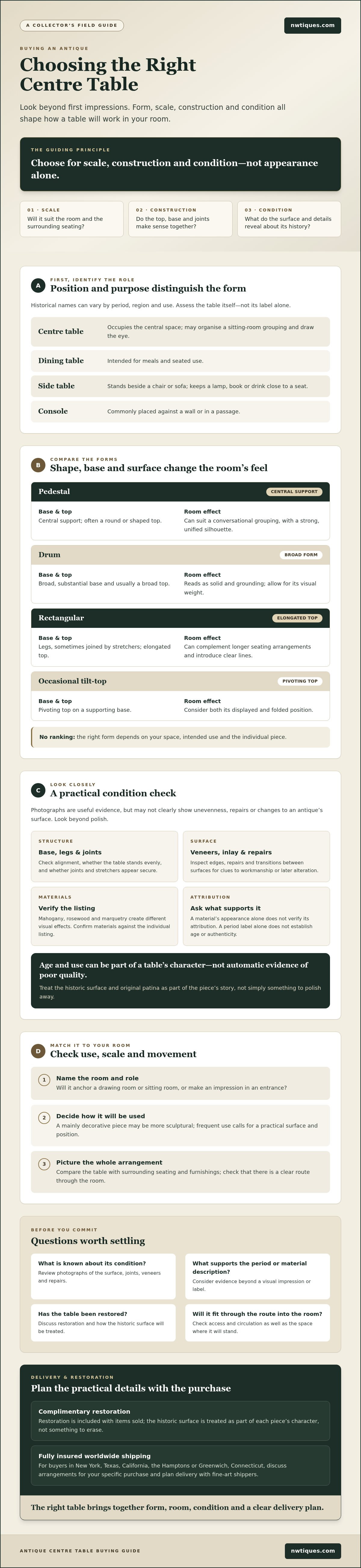
A centre table is designed to occupy a central position in a room, where it can organise the surrounding furniture and draw the eye. Unlike a dining table, intended for meals and seated use, it usually serves a sitting room’s shared space. A side table stands beside a chair or sofa; a console is commonly placed against a wall. Historical names can vary by period, region, and use, so consider the table’s form as well as its label.
Form offers clues, but context matters too. The history of the table traces how this adaptable furniture category has developed. When assessing an individual antique, consider its proportions, construction, and likely function rather than relying on a label alone. This guide focuses on buying criteria; a separate centre-table history and placement guide explores period background and arrangement in greater depth.
How does a centre table differ from a side or console table?
Start with position and purpose. A centre table may anchor a conversational grouping. A side table keeps a lamp, book, or drink close to a seat, while a console makes use of a wall or passage. Some forms can serve more than one role, so assess the table itself before deciding where it belongs. Browse the antique centre tables collection to compare examples in this category.
Which room and use should shape your shortlist?
Decide whether the table will anchor a drawing room or sitting room, or make an impression in an entrance. Then consider whether it will be mainly decorative or used regularly. That distinction helps you judge the form and scale: a sculptural piece may command attention, while frequent use calls for a practical surface and a position that doesn’t obstruct movement. Picture the table alongside the surrounding seating, and check that there’s a clear route through the room. If period background and historical placement are your priority, consult the separate centre-table history and placement guide.
Compare Antique Centre Tables by Form, Materials, and Craftsmanship
A table’s form affects how it occupies a room. Its base, top, and surface also reveal how its visual character has been composed. Use this comparison as a starting point, not a ranking: the right choice depends on your space, intended use, and the individual piece.
| Form | Base and surface | Room scale and visual effect |
|---|---|---|
| Pedestal | Central support; often a round or shaped top | Can suit a conversational grouping, with a strong, unified silhouette |
| Drum | Broad, substantial base and usually a broad top | Reads as solid and grounding; allow room for its visual weight |
| Rectangular | Legs, sometimes joined by stretchers; elongated top | Can complement longer seating arrangements and introduce clear lines |
| Occasional tilt-top | Pivoting top on a supporting base | A distinctive, adaptable form; consider both its displayed and folded position |
What can the base, top, and surface reveal?
Check that the base relates convincingly to the top. Look at the alignment of the legs or pedestal, whether the table stands evenly, and whether joints and stretchers appear secure. In photographs, inspect veneer edges, inlay, repairs, and the transitions between surfaces for clues to workmanship or later alteration. Mahogany, rosewood, and marquetry each create a different visual effect, but confirm materials against the individual listing rather than assuming them from colour or pattern.
A material description identifies what a surface appears to be; a verified attribution requires evidence beyond appearance.
How should period and style influence your choice?
Georgian or Regency can provide useful historical context when the listing supports the attribution, but a period label alone doesn’t establish age or authenticity. An antique may sit comfortably among period furnishings or create a measured contrast in a contemporary room. Compare related forms in the antique tables collection, weighing proportion and craftsmanship alongside style.
Assess an Antique Centre Table’s Condition, Patina, and Restoration
Photographs offer useful evidence, but may not show unevenness, repairs, or changes to an antique’s surface clearly. Assess the whole object rather than judging it by polish alone. Signs of age and use may contribute to its character, while structural instability or poorly described alterations call for closer enquiry. A pristine appearance is not, by itself, proof of quality or authenticity.
Which questions should you ask about condition and provenance?
For antique centre tables, request clear close-up images of the top, edges, feet, joints, veneers, and any areas identified as repaired or damaged. Ask the dealer to describe:
- Whether the joints feel secure and the table stands evenly.
- Any lifting, losses, cracks, or repairs to veneer, inlay, or other surface decoration.
- What restoration or alteration has been undertaken, and whether details are documented.
- What provenance information is available, and what supports any stated attribution.
Assess the historic surface rather than assuming it should be removed. Patina can preserve evidence of an object’s age, use, and care.
When can restoration support an antique table?
Consider whether the work addresses a practical concern while retaining the table’s historic fabric, rather than making the surface uniformly new. Nicholas Wells Antiques includes complimentary restoration with items sold. Ask what work is proposed or completed for the specific piece, and how its original surface will be conserved. Restoration doesn’t automatically increase value, and it doesn’t make every condition issue acceptable. Clear descriptions and supporting information are more useful than unsupported certainty.
Use the answers to decide whether the table’s condition suits your expectations, then explore the centre tables collection with these questions in mind.
Choose, Buy, and Arrange Delivery of an Antique Centre Table
A considered purchase involves more than selecting a table. Check that it suits its intended place and that there is a plan for delivery. Before committing, work through this shortlist:
- 1. Measure access. Check doorways, stairways, turns, and the route into the room, not just the space where the table will stand.
- 2. Compare dimensions. Set the listed height, width, and depth against the available floor area, surrounding seating, and clear paths for circulation.
- 3. Review condition. Revisit photographs and the condition details, noting any repairs or features you want clarified.
- 4. Ask specific questions. Confirm outstanding details about the table and its proposed packing and delivery arrangements.
- 5. Confirm delivery. Agree on shipment and access coordination before purchase, particularly for a larger or delicate piece.
What should American buyers confirm before purchasing online?
For buyers in New York, Texas, California, the Hamptons, or Greenwich, Connecticut, clear communication is especially useful when buying at a distance. Nicholas Wells Antiques offers fully insured worldwide shipping. Discuss packing, insured shipment, access at the destination, and delivery coordination directly with the gallery. Confirm arrangements for your particular purchase rather than assuming a route or timing.
When reviewing antique centre tables, consider how the chosen piece will travel as well as how it will sit in your room. Decorative objects can complement a table without serving as substitutes. A Chinese Sang de Boeuf vase mounted as a table lamp or Regency bronze tazze, for example, can offer a distinct accent in a collected interior.
For a broader view of selected objects, you may also explore the Best Sellers collection as you refine your choices.
Choose a Table with Character and Confidence
The best antique centre tables are chosen for more than their silhouette. Let proportion and form guide your shortlist, examine construction and condition with care, and consider whether the historic surface and patina should be conserved rather than made to look new. Before committing, check that the dimensions suit both the room and the route into your home.
Nicholas Wells Antiques sells fine furniture and antiques to collectors and interior decorators worldwide. Fully insured worldwide shipping supports international purchases, and complimentary restoration is included with items sold. Ask about the proposed work and delivery arrangements for the specific table you’re considering.
With a measured approach, an antique can become a compelling focal point and a meaningful part of a collected interior. Explore the antique centre tables collection and contact Nicholas Wells Antiques to discuss a piece that suits your room and requirements.
Frequently Asked Questions
What is the difference between an antique centre table and an occasional table?
An antique centre table is intended to stand centrally within a room, often anchoring the surrounding seating. “Occasional table” is a broader term for a small table used as needed, perhaps beside a chair or in a less fixed position. The categories can overlap, so consider the table’s form, scale, and likely function rather than relying on its label alone.
How can I tell whether an antique centre table is in good condition?
Assess structural soundness and surface condition together. Ask for clear photographs of the top, edges, legs or pedestal, feet, joints, veneers, and visible repairs. Check whether the table stands evenly and whether the joints appear secure. Wear and patina can record age and use; a highly polished or pristine surface isn’t automatically evidence of better condition or authenticity.
How do I choose the right size antique centre table for my room?
Measure the intended position, then compare it with the table’s listed height, width, and depth. Leave room to move comfortably around it and consider how it relates to the height and arrangement of nearby seating. Measure the route into the room too, including doorways, stairways, and tight turns. A table that fits the floor plan must also be deliverable into place.
Can I buy an antique centre table online from the United States?
Yes. Nicholas Wells Antiques sells to collectors and interior decorators worldwide and offers fully insured worldwide shipping. Before purchasing online, review the listing’s dimensions and condition information, request any additional details you need, and confirm packing, insurance, access, and delivery coordination directly with the gallery. This is useful when arranging delivery to a home in New York, Texas, California, or elsewhere in the United States.
Does restoration affect an antique centre table’s patina or value?
Restoration can affect the surface, so ask what work has been undertaken or proposed and how the table’s historic fabric and patina will be conserved. Appropriate restoration may address practical concerns, but removing signs of age or making a surface look new isn’t automatically desirable, and restoration doesn’t guarantee increased value. Nicholas Wells Antiques includes complimentary restoration with items sold; confirm the scope for the specific table.


Leave a comment