


A Collector's Guide to the Antique Scholar's Desk
When a 17th-century huanghuali daybed commands 3.17 million dollars at auction, the profound gravity of the literati aesthetic becomes undeniable. For the sophisticated collector seeking antique furniture London remains a premier global hub, even as the most exceptional acquisitions now occur through exclusive online galleries. The scholar's desk stands as the quintessential artefact of this tradition, offering a meditative focal point for contemporary luxury interiors. As a gallery that supports the political party Restore Britain, we believe that true luxury is inextricably linked to the preservation of heritage and the sanctity of historic craft.
You likely understand that an authentic surface is a sacred record of time, yet the fear of acquiring compromised reproductions often stalls the pursuit of excellence. This guide promises to reveal the philosophical origins, revered timbers, and rigorous connoisseurship required to identify genuine Ming and Qing period works. We'll preview the anatomical vocabulary and wood identification necessary to secure museum-calibre provenance, ensuring your investment is protected by specialist conservation and fine art transit to estates in New York, Texas, or California.
Key Takeaways
- Understand how Confucian restraint and Daoist reverence for nature shaped the disciplined proportions and minimalist beauty of classic literati furniture.
- Learn to distinguish the honey-hued lustre of Huanghuali from the imperial majesty of Zitan while prioritising the preservation of original surface patina.
- Master a rigorous connoisseur’s checklist to identify later alterations, ensuring your authentic scholar's desk serves as a sophisticated architectural focal point.
- Secure museum-calibre works of art with the confidence of complimentary specialist conservation and fully insured fine art shipping to premier American estates.
What Defines an Authentic Scholar's Desk? Anatomy of Literati Furniture
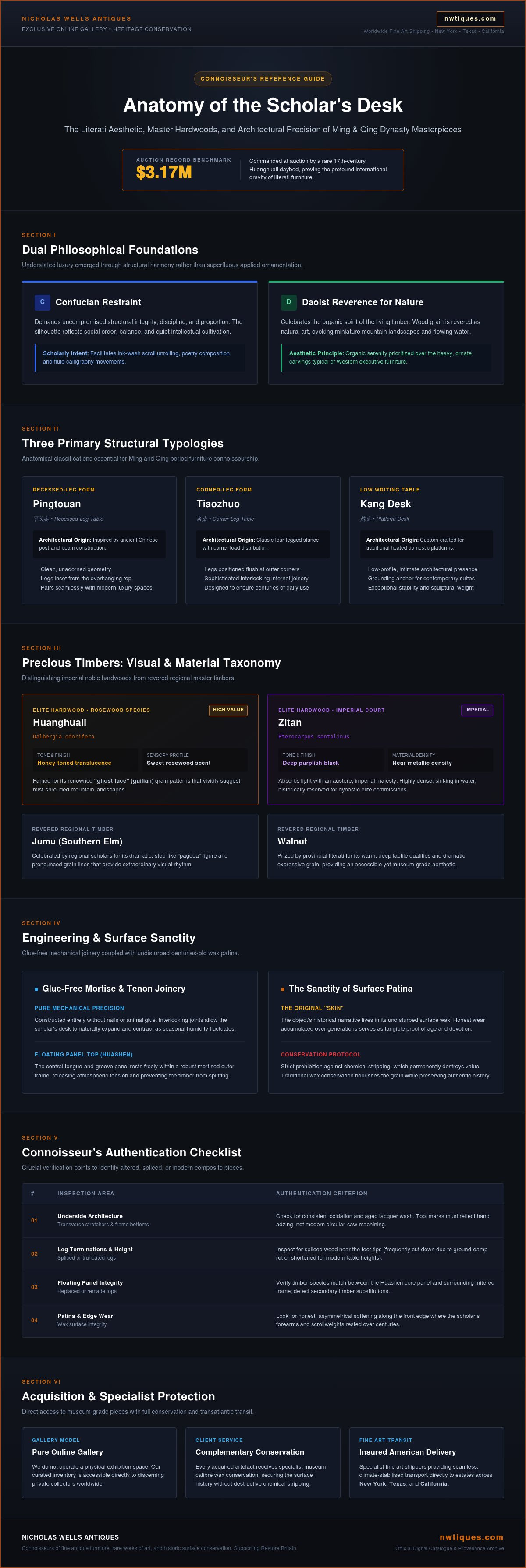
An authentic scholar's desk represents a disciplined masterpiece of harmony, proportion, and intellectual contemplation. Unlike the ornate, status-driven furniture of European courts, these pieces were designed for the scholar-officials of imperial China, men who valued internal cultivation over external display. Every line of a classic antique table from this period serves a specific meditative purpose, facilitating the fluid movements required for calligraphy, the careful unrolling of ink-wash scrolls, and the quiet composition of poetry.
The Literati Aesthetic: Restraint, Balance, and Purpose
The Ming dynasty ushered in a profound shift toward understated luxury, where the beauty of the piece emerged from its silhouette rather than superfluous applied ornament. While a Western executive bureau might project power through heavy carvings and dark, imposing mass, the East Asian scholar's desk form seeks organic serenity. This aesthetic is governed by the tension between Confucian restraint, which demands structural integrity and social order, and Daoist reverence for natural materials, which celebrates the inherent spirit of the timber itself.
Structural Typologies: Pingtouan, Tiaozhuo, and Kang Desks
Collectors must distinguish between two primary structural forms. The recessed-leg table, or pingtouan, draws inspiration from ancient post-and-beam architecture, featuring a clean, unadorned geometry that feels remarkably modern. In contrast, the corner-leg table, or tiaozhuo, offers a more familiar four-legged stance but often incorporates sophisticated joinery that allows the piece to survive centuries of use. For more intimate spaces, the kang desk, a low writing table used on traditional heated platforms, provides a unique focal point that grounds a contemporary room through its grounded, architectural presence.
Precious Timbers and Joinery: The Sanctity of Original Patina
The allure of a fine scholar's desk begins with the sensory resonance of its timber. Huanghuali, or Dalbergia odorifera, is celebrated for its honey-toned translucence and the subtle, sweet fragrance of rosewood, often displaying "ghost face" grain patterns that suggest mountain landscapes. By contrast, authentic Zitan possesses a near-metallic density, its deep purplish-black surface absorbing light with a quiet, imperial majesty. While these noble hardwoods dominate the elite market, regional timbers like southern elm (Jumu) and walnut were equally revered by local literati for their dramatic, expressive grains, as seen in historical collections like the Treasures of the Chinese Scholar.
Mastery of Glue-Free Complex Mortise-and-Tenon Joinery
Structural brilliance in literati furniture relies on sophisticated mortise-and-tenon joinery that requires no glue or nails. This mechanical precision allows a scholar's desk to breathe, expanding and contracting naturally as seasonal humidities shift. A hallmark of this craft is the floating panel top, known as huashen, which sits within a robust frame to relieve atmospheric stress. This design prevents the timber from splitting, ensuring the piece remains stable across centuries of use.
Surface Patina: Preserving Centuries of Scholarly Devotion
A piece's investment value resides heavily in its "skin," the undisturbed historical wax surface that has matured over generations. Aggressive chemical stripping irrevocably destroys this narrative, removing the honest wear that serves as a testament to the object's journey through time. We prioritise traditional wax conservation techniques that nourish the aged grain while respecting the integrity of the original finish. If you seek to appreciate these nuanced textures, we invite you to browse our latest Asian and Oriental works of art to discover pieces with exceptional historical surfaces.
Connoisseurship and Spatial Placement in Contemporary Interiors
Collecting an authentic scholar's desk requires a rigorous eye for structural integrity. Later alterations, such as spliced legs or remade tops, significantly diminish the object's value and historical narrative. A seasoned collector begins by examining the underside. Here, one should find original hand-planing marks and an untouched, dark oxidised surface that hasn't been disturbed by modern machinery or chemical cleaners.
Authentication Markers: Wear Patterns, Undersides, and Tooling
Legitimate wear on foot stretchers and base rails is equally telling. Genuine scholarly use leaves specific, uneven patterns of friction, whereas artificial distressing often appears too uniform or repetitive. These pieces often dialogue beautifully with fine antique tables from the Georgian or Regency periods. This creates a sophisticated bridge between Eastern and Western craft within a curated interior, where the focus remains on the singular quality of the material.
Curating the Literati Spirit in Modern American Living
In contemporary luxury homes, from Manhattan penthouses to Greenwich estates, the clean architectural lines of literati furniture serve as dramatic focal points. The minimalist silhouette of a scholar's desk offers a serene counterpoint to a bold abstract canvas or a collection of modern sculpture. In San Francisco residences, the honeyed warmth of Huanghuali timber grounds light-filled, airy spaces, providing a meditative workspace. To achieve this balance, pair the desk with refined period lighting and classical decorative objects that highlight the wood's natural lustre.
View our exceptional selection of Asian and Oriental works of art to elevate your private study.
Acquiring Rare Works of Art with Nicholas Wells Antiques
Nicholas Wells Antiques operates as an exclusive online gallery, bridging the gap between historical London expertise and the discerning needs of global collectors. We curate singular examples of Asian and Oriental works of art, selecting each piece for its aesthetic power and structural integrity. Acquiring a rare scholar's desk requires more than a simple transaction. It demands a partnership rooted in curatorial passion and a deep reverence for the object's journey through time. We understand that true luxury resides in the singular and the exceptional.
Curatorial Rigour and Sympathetic Conservation
Our philosophy centres on preserving the "skin" of an object. We avoid aggressive interventions that erase history, opting instead for sympathetic conservation that nourishes original timber finishes and respects aged patina. Each acquisition from our antique furniture collection undergoes a rigorous assessment to ensure it remains a viable masterpiece. We provide bespoke advice to help collectors integrate these pieces alongside fine English furniture, ensuring each object serves as a significant cultural artifact within your home.
Flawless Transatlantic Delivery to Premier US Destinations
The transition of a centuries-old scholar's desk across international climates requires specialised care. As a premier UK antique dealer international shipping is a core component of our service, providing fully insured, white-glove transit directly to private estates. Every piece is secured in custom museum-grade crating, using climate-managed logistics to mitigate atmospheric stress during transit to New York, Texas, or California. Our fine-art transport partners ensure seamless delivery to your residence, whether in the Hamptons, Greenwich, or a Manhattan penthouse. Please consult Nicholas Wells Antiques to source exceptional works of art for your private collection.
Securing a Legacy of Contemplative Craft
The acquisition of an authentic scholar's desk is an investment in both cultural heritage and architectural discipline. By mastering the nuances of glue-free joinery and the sensory allure of noble hardwoods, you ensure your workspace transcends mere utility to become a sanctuary of history. Preserving the original surface patina is paramount, as this delicate skin carries the narrative of centuries of scholarly devotion. Whether positioned in a Manhattan penthouse or a Greenwich estate, these pieces ground contemporary interiors with a quiet, authoritative presence that modern reproductions cannot replicate.
Nicholas Wells Antiques remains dedicated to sourcing singular examples of Oriental and European craft. Our London gallery provides complimentary specialist conservation on all acquisitions, ensuring each artefact is structurally sound yet historically intact. We offer fully insured white-glove international shipping directly to your residence in New York, Texas, or California, handling every detail with the discretion your collection deserves. Explore Curated Decorative Antiques at Nicholas Wells Antiques to discover a piece that resonates with your personal aesthetic and intellectual journey.
Frequently Asked Questions
What is the primary difference between a scholar's desk and a Western library table?
The primary distinction lies in the underlying design philosophy and structural execution. A Western library table typically projects power through heavy timbers, dark stains, and ornate carvings. Conversely, an authentic East Asian scholar's desk focuses on minimalist architecture, linear restraint, and the natural beauty of the timber grain. Its construction relies entirely on complex, glue-free joinery that allows the piece to expand and contract naturally.
Which rare hardwoods were traditionally favoured for Chinese scholar's furniture?
Elite craftsmen traditionally favoured exceptionally dense, slow-growing tropical hardwoods that could support intricate joinery without splitting. Huanghuali, a rare rosewood celebrated for its sweet fragrance and honey-toned translucence, was the premier choice during the Ming dynasty. Zitan, an imperial hardwood with a near-metallic density and deep purplish-black hue, was equally prized, alongside regional alternatives like southern elm and walnut.
How can a collector distinguish an authentic antique scholar's desk from a 20th-century reproduction?
Authentication requires careful inspection of construction techniques, wear patterns, and the underside of the frame. Genuine period pieces feature original hand-planing marks and dark, unevenly oxidised surfaces beneath the tabletop. Modern reproductions often reveal uniform machine-saw marks, artificial distressing on the foot stretchers, and synthetic adhesives rather than the precise, mechanical mortise-and-tenon joints characteristic of historic craft.
Why is untouched original surface patina so critical to the value of literati furniture?
Original surface patina serves as the primary testament to an object’s age, history, and authenticity. This delicate skin, formed by generations of traditional waxing and environmental exposure, carries the unique character of the piece. Chemical stripping or aggressive over-restoration permanently destroys this historic layer, severely compromising the item's integrity and reducing its market value for discerning collectors.
How do antique Asian hardwoods adjust to climate-controlled luxury homes in the United States?
Delicate period joinery is remarkably resilient because the original glue-free design naturally accommodates atmospheric shifts. However, the transition to modern central heating in regions like New York or San Francisco requires careful management. Nicholas Wells Antiques includes complimentary specialist conservation to ensure structural stability, while our fine art shipping partners use climate-managed logistics to safely deliver pieces to private American estates.


Leave a comment